


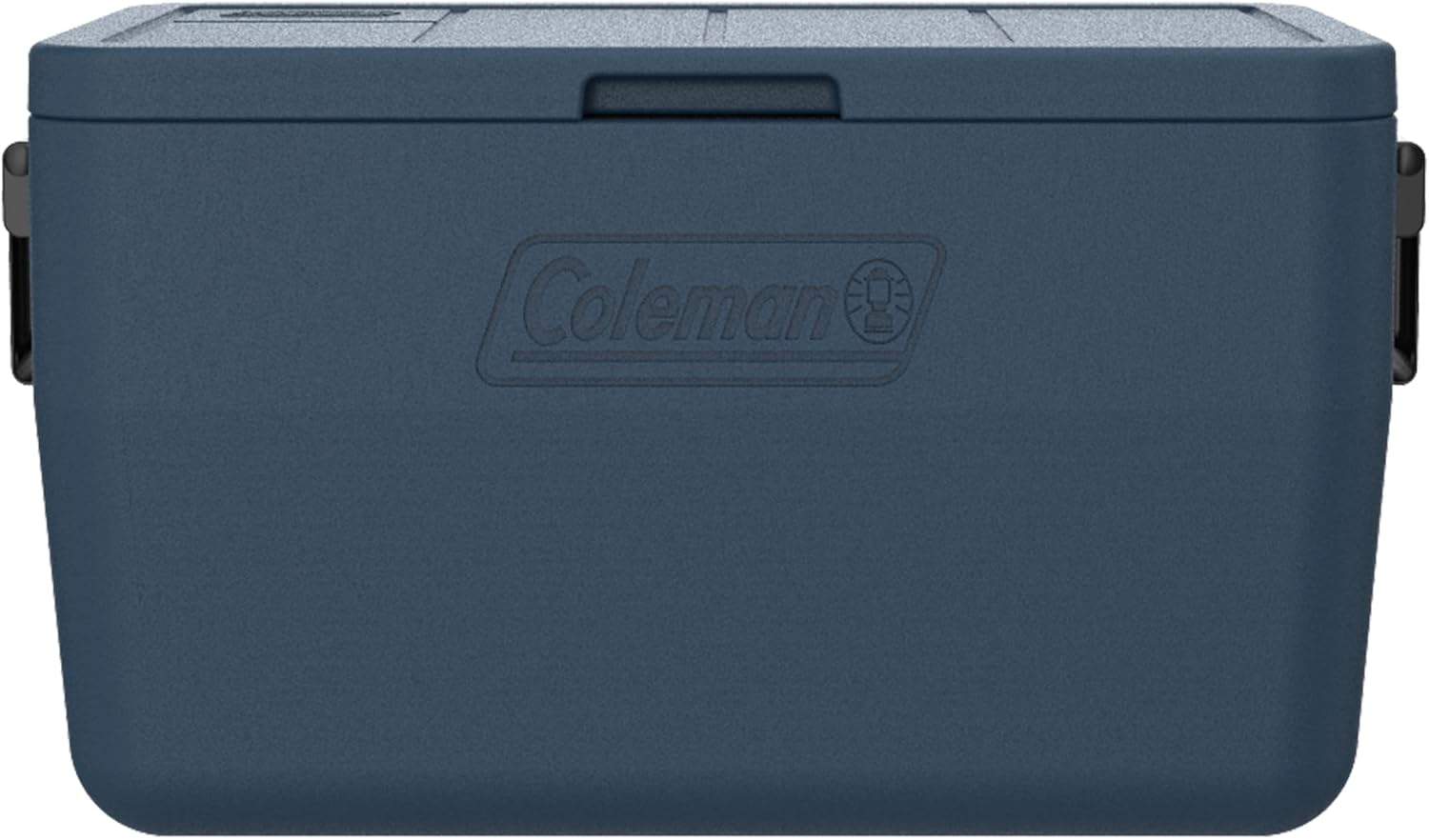
Coleman Marine 52Qt Wheeled Cooler
Wheeled cooler that handles weekend heat and minivan life without leaking, rated for five days of ice retention.
Why we love it
- Big wheels roll over gravel and sand easily
- Antimicrobial liner stays fresh between trips
- Lid holds 250 lbs, works as a seat or table
Pros
- Fully insulated lid and body
- Rust-resistant stainless steel hardware
- Leakproof channel drain plug
- Heavy-duty wheels and tow handles
- UV coating protects from sun damage
Cons
- Heavy when loaded with ice and food
- Wheels may struggle in deep sand

Igloo Maxcold Glide 110Qt Wheeled
Big wheeled cooler rated for five days of ice in heat. Built for families who need to haul gear across a hot campground without the cooler dying halfway through the weekend.
Why we love it
- Wheels handle gravel and dirt without tipping
- 110 quarts holds a full family weekend
- Stainless hinges and hybrid latch last years
Pros
- Oversized wheels for rough terrain
- Ultratherm insulation rated five days
- Stainless-steel hinges and latch hardware
- Threaded drain plug for easy cleaning
- Made in USA
Cons
- Heavy when full, tough to lift alone
- Large footprint in a packed minivan

Coleman Chiller 60Qt Wheeled Cooler
Wheeled cooler rated for 72 hours of ice retention, built tough enough for packed minivans and hot high-desert weekends with kids constantly opening the lid.
Why we love it
- Wheels handle gravel and sand, not just pavement
- Holds 47 cans with ice for a full weekend trip
- Reinforced lid doubles as a seat at camp
Pros
- Rated for 72 hours ice retention
- Oversized wheels roll over rough terrain
- Secure lid prevents spills during transport
- Doubles as extra seating when full
- Lightweight for a 60-quart capacity
Cons
- Heavy when fully loaded with ice
- Wheels may struggle in deep sand

Igloo Trailmate 52Qt Wheeled Cooler
Wheeled 52-quart hard cooler built to handle weekend heat and constant lid opens with thick insulation and soft-ride wheels that roll over gravel.
Why we love it
- Soft-ride wheels roll over campground gravel
- 1.5-inch foam walls rated for extended ice
- Telescoping handle pulls full weight easily
Pros
- Soft-ride 6.25-inch wheels
- 1.5-inch foam-insulated walls
- Locking lid with bottle opener
- Marine-grade telescoping handle
- Cool Riser Technology base
Cons
- 19.9 lbs adds weight when packed
- Wheels less stable in deep sand

Igloo Trailmate Journey 70Qt Wheeled
Wheeled 70-quart hard cooler built to handle hot high-desert weekends and campground loops without tipping or leaking.
Why we love it
- Ten-inch never-flat wheels roll over gravel
- Holds ice through a full weekend in heat
- Horizontal handle pulls 50% easier when full
Pros
- Never-flat ten-inch wheels
- Telescoping dual-trigger steel handle
- Holds 112 cans, seats two kids
- THERMECOOL foam insulation
- Made in USA
Cons
- Weighs 35.8 pounds empty
- Difficult to carry across rough terrain
Wheels That Actually Roll on Gravel
Best wheeled coolers separate the ones that move from the ones that sit. After 14 years of dragging coolers across campground loops, river access points, and high-desert sand, I know the gap between a smooth parking lot roll and what happens when you hit actual ground. Wheel size, handle height, and how the whole thing balances when loaded matter far more than any marketing claim about ice retention.
Most wheeled boxes fail because they either tip over when you tow them or the wheels collapse under a real load. You need to know what “wheeled” actually costs you in weight, where the weak points hide, and whether your vehicle can even fit the thing once it is packed.
Wheel Size and Terrain
A 6-inch wheel rolls fine on smooth concrete but bogs down in sand and gravel. The Igloo Trailmate Journey 70-Quart Wheeled Cooler runs 10-inch never-flat wheels that actually bite into uneven ground without deflating. That extra 4 inches changes everything when you are rolling across a gravel bar or a soft campground loop. Smaller wheels also require more force to push through debris, and they sink into sand. The trade-off is weight and cost. Larger wheels add a couple of pounds and come with a higher price tag, but if you are towing a loaded cooler more than 50 feet, you notice the difference immediately.
Handle Design and Stability
Telescoping handles need enough rigidity that they do not flex when you pull hard. A wobbly handle means the whole cooler tips side to side as you move it. The Igloo Trailmate 52-Quart Wheeled Cooler uses a marine-grade telescoping handle that locks in place, and the height sits right at mid-thigh so you are not stooping or reaching. A low handle forces you to bend, which destabilizes the load. A high handle means you pull at an angle that lifts the back wheels off the ground. Test handle height before buying by standing next to the cooler in the store and visualizing how you would actually tow it loaded.
Weight When Full
An empty 60-quart cooler weighs around 12 pounds. Once you add 30 pounds of ice and 40 pounds of food and drinks, you are pushing 80 pounds across uneven ground. If you are over 60 and not strong, or if you have kids who will be moving it, a wheeled cooler becomes a liability instead of a solution. The Coleman Chiller 60-Quart Cooler keeps weight down at 12.3 pounds empty, which means it stays manageable even with a full load. Lighter frames roll easier and handle rough ground better because there is less momentum fighting you on each correction.
Footprint and Vehicle Fit
A wheeled cooler with a big base takes up real floor space in a minivan or truck. Before you buy, measure your vehicle and the cooler you are considering. A 70-quart box sits around 32 inches long and 20 inches wide with wheels attached. In a minivan with kids and gear, that footprint competes with everything else. If you pack it upright behind the middle seat, it blocks your sight line when backing. If it tips during a hard stop, loose wheels can become projectiles. Measure twice and consider whether you actually need wheels or whether a hand-cart attachment for your existing cooler makes more sense for your vehicle setup.
A 10-inch wheel rolls over gravel without effort, but it adds weight and cost to every trip where you need it.
What Stays Cold and Why
Ice retention claims on wheeled coolers are tested with the lid sealed and unopened in a lab. A family trip looks nothing like that test. Kids open the lid every ten minutes. The cooler sits in direct sun while you are swimming. You load it in the car while it is warm, not pre-chilled. Real retention depends on lid gasket quality, wall thickness, and how much ice you actually pack inside, not on a five-day rating printed on the box.
Gasket and Latch Design
Rotomolded coolers hold a seal tighter than injection-molded boxes because the wall is uniform and the gasket sits flush. Check the gasket by closing the lid with your hand and feeling for air gaps. A good gasket should feel snug but not require you to yank the lid shut. Latches that split in the cold or wear out by the second season are a common failure point. The hinges matter too. Stainless-steel hinges resist rust and last through repeated opening cycles. Plastic hinges crack after one season of UV exposure in the high desert.
Wall Thickness and Insulation
Foam thickness ranges from 1.25 inches to 1.5 inches on most wheeled boxes in this range. The Coleman Marine Cooler and Igloo Trailmate both advertise 1.5-inch foam, which is the practical sweet spot for ice retention without adding excessive weight. Thicker is not always better because you lose usable capacity inside the box. A rotomolded build holds foam more uniformly than an injection-molded shell, so ice lasts slightly longer hour for hour, but both work fine for weekend trips. The real difference shows up after three or four days with the lid open repeatedly in heat above 85 degrees.
Ice-to-Contents Ratio
A cooler filled halfway with ice and half with food keeps things cold longer than one filled halfway with food and topped with a thin layer of ice. The mass of ice acts as a thermal battery. Most people underestimate how much ice they need. A 60-quart box needs 30 to 40 pounds of ice to hold cold for a full weekend with kids opening it every ten minutes. Plan for one pound of ice per 24-ounce container of food or drink, then add 50 percent more for safety. Pre-chilling the cooler the night before matters more than wall thickness because a cold interior starts already at the target temperature and uses less ice to stay there.
Pre-chill your box the night before, and ice lasts 30 percent longer than a box you load cold.
Drain Plugs and Long-Term Durability
The drain plug fails more often than any other part of a cooler. A leaking drain plug in a packed minivan turns into a wet carpet and a smell that lasts. The Coleman Marine Cooler uses a leakproof channel drain with a threaded plug that tightens securely. Test the drain by filling the cooler with water and opening the plug over a sink. It should stream, not dribble or leak around the seal. Some wheeled coolers use push-plug drains that work fine for a season, then swell or crack, and the seal fails. A threaded plug lasts longer and costs more upfront, but it is worth the investment if this is a cooler you plan to use for more than one season.
Hardware and Rust Resistance
Stainless-steel hinges, latches, and hardware resist rust better than zinc-plated steel, especially if you are storing the cooler wet or leaving it in a humid environment. After a season of exposure to sand, salt water, or even just chlorinated pool splashes, zinc hardware corrodes and becomes hard to operate. Stainless costs more upfront but saves you from replacing hinges or latches after the second year. The lid should close smoothly even if it sits for months between uses. If you hear grinding or feel resistance, grit or corrosion is building up inside the hinge.
Lid Seating and Reinforcement
A reinforced lid that supports 200 to 250 pounds of weight stays useful as extra seating at camp, but the real value is durability. A thin lid flex when you open it hard, and that repeated movement breaks the gasket seal faster. A reinforced lid with internal ribbing distributes pressure across a wider area and lasts through hundreds of open cycles without degrading. Feel the lid when you test-drive a cooler at a store. Does it bend when you press on it, or does it stay rigid? Rigidity correlates directly with longevity.
What Gets Cut at This Price
Entry-tier wheeled coolers under $100 use thinner foam, push-plug drains, and plastic or zinc-plated hardware. The wheels are usually 6 inches, the handle does not telescope, and the whole package weighs more than a mid-tier box because of cheaper materials. You get maybe 2 to 3 seasons out of one before something breaks. Mid-tier boxes around $150 have 1.5-inch foam, telescoping handles, 6 to 8-inch wheels, and stainless hardware that lasts. You can expect 4 to 5 seasons of regular use. High-end wheeled coolers over $250 add never-flat 10-inch wheels, advanced insulation, and marine-grade handles. They hold ice longer in extreme heat and survive repeated rough handling without degrading. The entry tier works fine for casual beach trips or a single camping season. The mid-tier is the practical sweet spot for families who use the cooler 15 to 20 times a year. The high end is for people who run multiple coolers or take week-long backcountry trips where the cooler is the workhorse.
Tips
- Pre-freeze your cooler the night before. A cold interior keeps ice 30 percent longer than loading it cold. Even 8 hours in a freezer or a cold garage makes a measurable difference on a hot weekend.
- Use block ice, not cubed. Block ice melts slower and takes up less space than cubed ice of the same weight. A 5-pound block lasts longer than 5 pounds of cubes.
- Leave meltwater in the cooler. Drain it only at the very end of your trip. The cold meltwater keeps everything at cooler temperatures longer than removing it continuously.
- Pack food items on top of ice, not beside it. Heat rises, so food packed directly on the ice layer or in a suspended basket stays cold longer than food packed against the sides of the walls.
- Clean the gasket and drain after every trip. Mildew builds in the gasket crevices and can create smells that persist for months. A quick rinse and air-dry prevents that.
- Crack the lid open slightly when storing between trips. Trapped air and moisture inside a sealed cooler create mold and odor. A tiny gap lets condensation evaporate.
FAQ
Do I really need wheels, or would a regular cooler and a hand-cart work better?
A. Wheels save time and effort if you are moving the cooler more than 100 feet or across rough ground regularly. A hand-cart is cheaper and lighter, and you can detach it from the cooler when you get to camp. If you have a truck with a bed, wheels add weight you do not need.
How long does a five-day rating actually hold with kids opening the lid every ten minutes?
A. Every time the lid opens, cold air escapes and warm air enters. With frequent opening and direct sun exposure, expect 3 to 4 days, not 5. The manufacturer’s test assumes a sealed cooler in shade at 70 degrees. Your reality is different.
Can I use a wheeled cooler with dry ice, or does it damage the plastic?
A. Dry ice can crack rotomolded plastic if it contacts the walls directly. Wrap dry ice in newspaper or cardboard before placing it inside, and never let it sit against the interior shell. Most cooler warranties exclude dry ice damage.
What should I do if the drain plug leaks during a trip?
A. Tighten it first by hand in case it just loosened from vibration. If tightening does not stop it, wrap plumber’s tape around the threads and reinstall it. Carry plumber’s tape in your gear kit as an emergency seal.
How do I get rid of smells that build up inside after a few seasons?
A. Rinse the interior with a 50/50 water and white vinegar solution, then leave the lid open for 24 hours in sunlight. Do this twice a year if you use the cooler frequently. Mildew is easier to prevent than remove.
Will my cooler work on rough terrain, or do I need special wheels?
A. Wheels 8 inches or larger roll over gravel and uneven ground without bogging down. Anything under 7 inches requires smooth pavement or well-maintained paths. Check the wheel size before buying if rough access is your normal scenario.


Write Your Review
No reviews yet. Be the first to share your experience!