

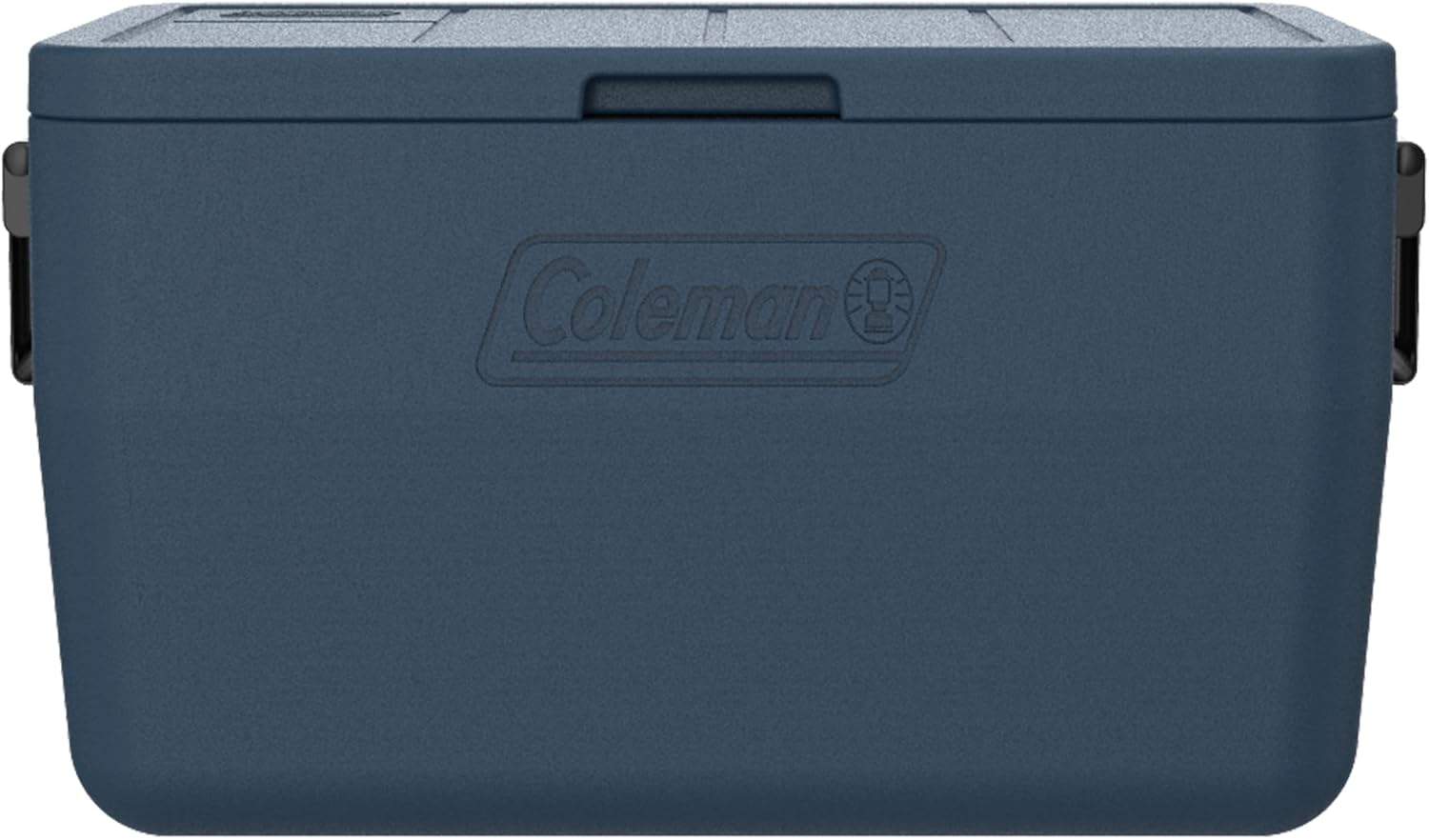
Coleman Chiller 48qt Cooler
Standard hard cooler rated for five days of ice retention, holds 31 cans with ice, and seats two adults on the reinforced lid.
Why we love it
- Ice rated to last 60 hours through hot weekend trips
- Lightweight at 7.6 lbs empty, easy to carry loaded
- Lid supports 200 lbs, doubles as extra seating
Pros
- TempLock foam insulation rated to 60 hours
- Fits 2-liter bottles standing upright inside
- Swing-up handles fold flat for vehicle storage
- Smooth surfaces wipe clean after use
- Made in USA with 1-year limited warranty
Cons
- Standard hard cooler, not rotomolded
- Lighter weight means thinner insulation walls
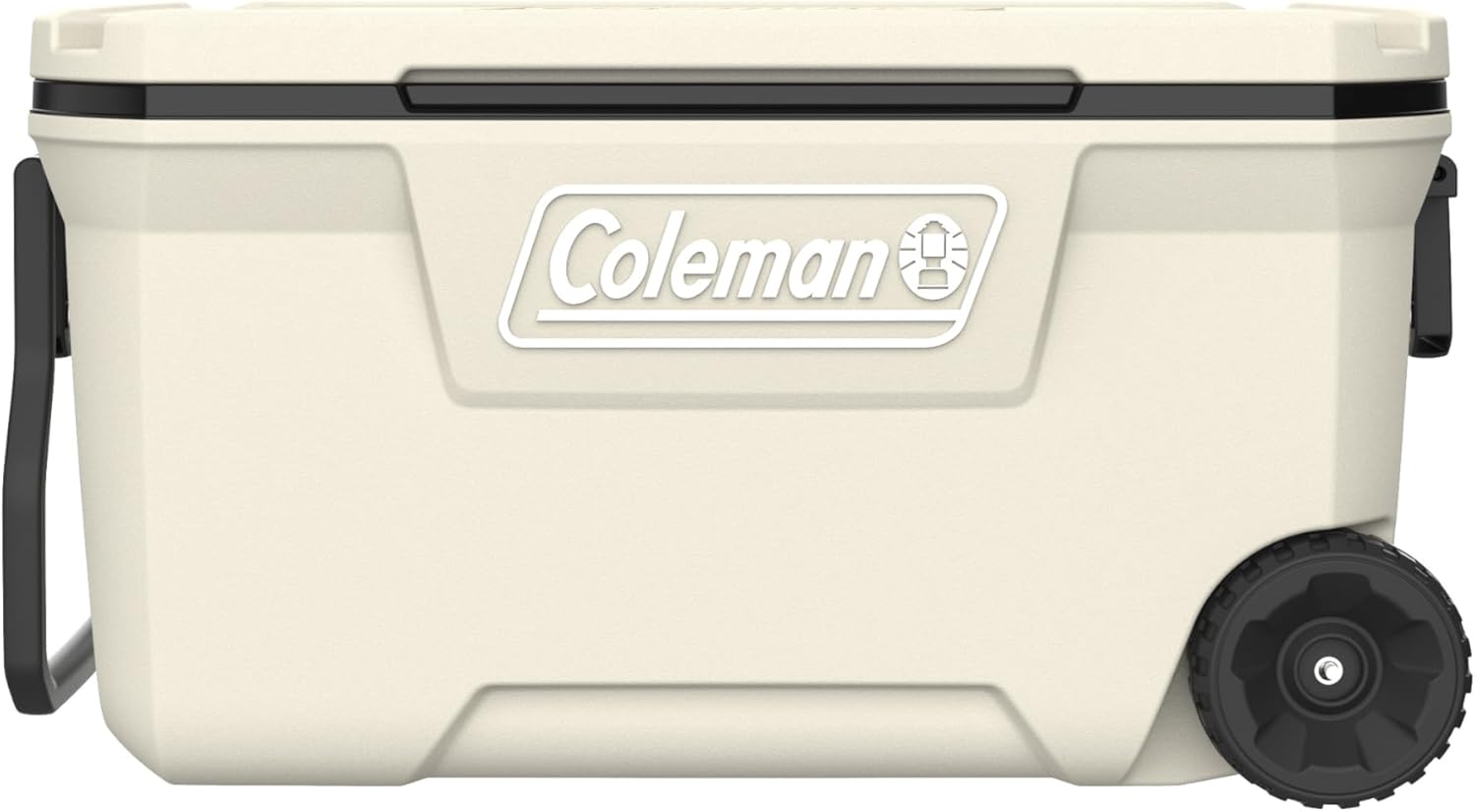
Coleman Classic Wheeled Cooler 80-Can
Wheeled hard cooler rated for five days of ice, built tough enough for family camping weekends with a lid that doubles as a seat.
Why we love it
- Six-inch wheels roll over gravel and grass
- Holds 80 cans with ice for a full weekend
- Lid seats 250 lbs, becomes extra camp seating
Pros
- All-terrain wheels for rough ground
- Tethered drain plug stays attached
- Molded cup holders keep drinks secure
- Hard shell lid rated for 250 lbs
- Dual tow and swing-up handles
Cons
- Heavy when loaded with ice
- Wheel performance varies in deep sand

Igloo Trailmate 52Qt Wheeled Cooler
Wheeled 52-quart hard cooler built to handle weekend heat and constant lid opens with thick insulation and soft-ride wheels that roll over gravel.
Why we love it
- Soft-ride wheels roll over campground gravel
- 1.5-inch foam walls rated for extended ice
- Telescoping handle pulls full weight easily
Pros
- Soft-ride 6.25-inch wheels
- 1.5-inch foam-insulated walls
- Locking lid with bottle opener
- Marine-grade telescoping handle
- Cool Riser Technology base
Cons
- 19.9 lbs adds weight when packed
- Wheels less stable in deep sand
Igloo Marine Ultra 90 Qt Cooler
A wheeled cooler built for hot weekends and constant lid-opening, rated for five days of ice retention with oversized wheels that actually roll through campground gravel.
Why we love it
- Oversized wheels roll through sand and gravel
- Hybrid latches hold tight against constant use
- Rated for five-day ice retention in heat
Pros
- Oversized wheels for all-terrain mobility
- Hybrid latches for secure lid closure
- Five-day ice retention rating
- Engineered hinges with stay-open detent
- Made in USA
Cons
- Heavy at 22.4 lbs empty, much more loaded
- Bulky for storing when not in use
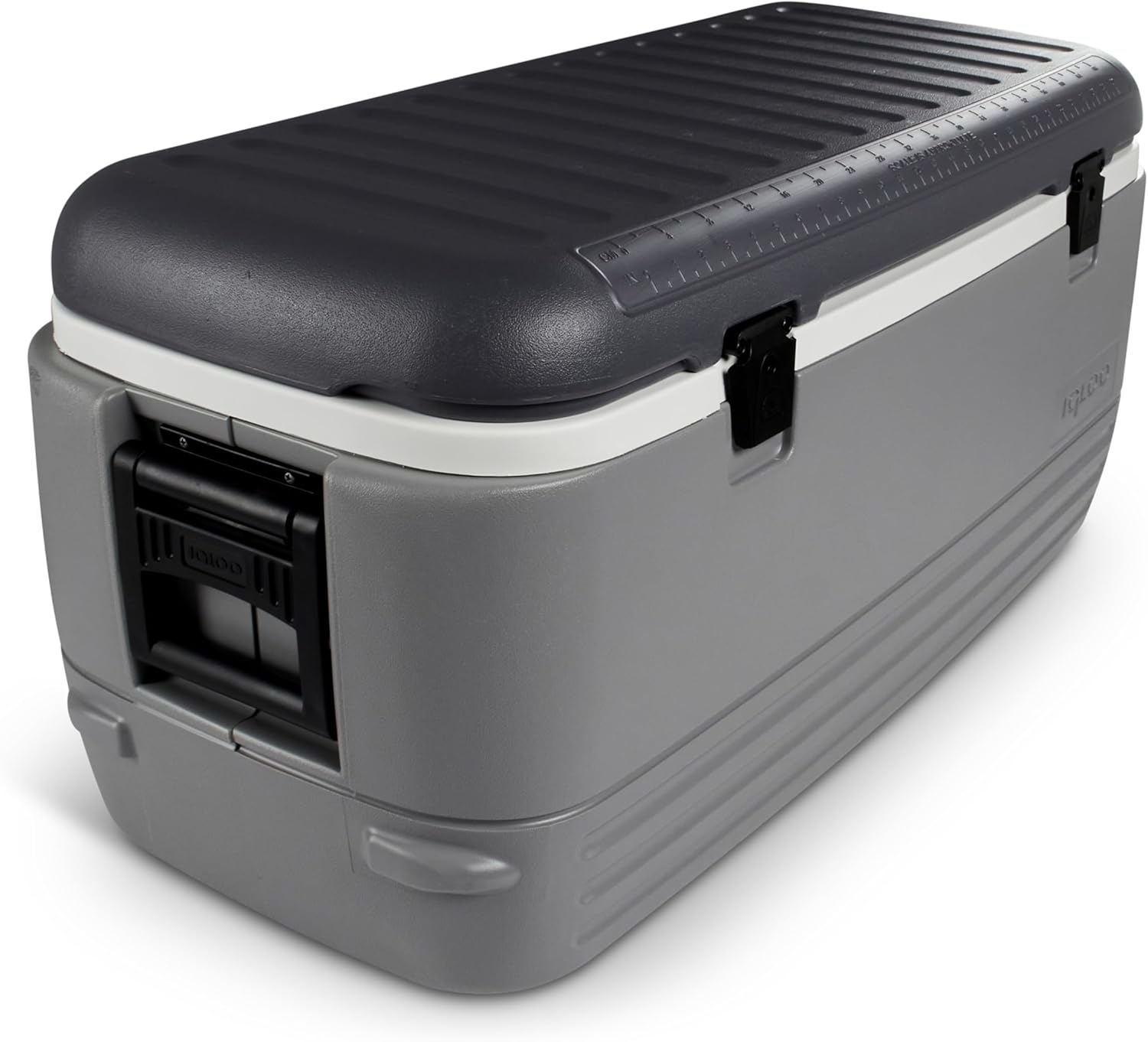
Igloo Polar Hard Cooler
Solid mid-range hard cooler with threaded drain and stain-resistant liner, built to handle weekend family trips without leaking or falling apart.
Why we love it
- Threaded drain plug hooks to a hose for easy cleanup
- Swing-up handles carry full loads across campsites
- Stain and odor-resistant liner stays fresh season after season
Pros
- Reinforced swing-up handles
- Dual snap-fit latches secure closure
- Threaded drain plug for hose hookup
- UV inhibitors protect lid from sun
- Stain and odor-resistant liner
Cons
- Standard hard cooler, not premium insulation
- No weight or capacity specs in listing
What Actually Matters When You Buy at This Price
Most coolers under $200 claim five days of ice retention. I have watched that claim die by afternoon on a high-desert weekend with kids opening the lid every ten minutes. The real question is not what a sealed box holds in a garage. It is what your cooler does when it lives in a car, gets opened constantly, and sits in direct sun for a long trip.
At this price ceiling, you are trading between size, ice retention, and durability. The box that holds the most ice is usually the one you do not want to carry full. The one with the best latches and gasket is often heavier and costs more to move around a campsite. You have to know which trade-off fits your trips.
Rotomolded walls versus foam injection
Rotomolded coolers have thicker, more durable walls and hold ice longer because the insulation wraps all the way around. They are heavier empty and much heavier full. A 52-quart wheeled cooler with rotomolded construction can keep ice for five days, but you will not carry that full across a gravel campground loop. Foam-injected coolers are lighter and good enough for most weekend trips, especially if you pack ice strategically and keep the box shaded.
Real usable capacity with ice in it
A cooler rated for 60 quarts does not hold 60 quarts of drinks once you fill it halfway with ice. The Coleman Chiller 48-quart holds 31 cans with 24 pounds of ice, which is your actual working space. That matters when you are trying to fit a week of food and drinks for a family of four. Measure against what you actually bring home, not the number on the box.
Latches, gaskets, and drain plugs
Snap latches fail in cold after a few seasons. Hinged latches with rubber gaskets stay sealed longer and are easier to operate with cold hands or gloves. A threaded drain plug with a tether keeps water from draining inside your car or minivan. The Coleman Classic rolling cooler has a tethered plug and recessed lid that is easier to grip when you are tired. These details matter more than the ice retention number on the label.
Weight when fully loaded
A 48-quart cooler with ice and food weighs over 70 pounds. Can one person move it full, or does it need two? Wheeled coolers add weight but solve the problem. A soft-sided or smaller hard cooler is easier to load into a high car roof rack or lift over a boat railing. Know whether you need a cooler that moves with wheels or one that you can carry by handle.
The best ice retention claim in the world means nothing if the gasket fails halfway through your trip.
Insulation thickness and material composition
Foam density and wall structure
Entry-level coolers use thin foam insulation, sometimes under an inch thick. Mid-range models go 1.5 to 2 inches. Higher-end boxes at this price point have extra-thick walls with denser foam that resists compression. Thicker foam holds ice longer, but it also weighs more and costs more. On a two-day trip, you will not notice the difference. On a five-day trip in July, you will.
Gasket quality and seal integrity
A cooler gasket is a rubber or foam strip that runs around the inside of the lid and seals it shut. After a season or two, gaskets compress and stop sealing as well. Some coolers use replaceable gasket strips. Most do not. If you open the lid a hundred times over a camping season, a high-quality gasket matters. You can test it before you buy: close the lid firmly and try to lift it by the edge. If it lifts easily, the seal is weak.
Hinge and latch hardware durability
Plastic hinges crack. Metal hinges with reinforced rivets hold up longer. Snap-shut latches are convenient but fail faster than lever latches or tie-down straps. I have had a cooler latch split in cold after three seasons of use. Look for latches that are bolted or riveted, not glued, and test them before you leave the store if the retailer allows it.
A cooler that holds ice for five days means nothing if you open it fifty times before the day ends.
What gets cut at the $200 line
Near the bottom of the budget
Under $50, coolers have single-wall construction, thin foam, and plastic latches. Ice lasts a day or two. The gasket is glued, not replaceable. These boxes work for a day trip to the lake or a cooler full of snacks for a concert. Do not expect them to survive a week in the sun or multiple seasons of weekly use. They are disposable gear.
The middle ground
Between $75 and $150, you get solid foam insulation, better latches, and reinforced handles. Ice lasts two to four days depending on how often you open it and how much sun it sits in. These are real family coolers. They will survive several years of regular use if you do not abuse the latches or drain plug. Most people buying their first cooler find what they need in this range.
At the limit
Right at $200, you are entering rotomolded territory with metal hinges, high-quality gaskets, and five-day ice retention claims. You also get weight. A 45-quart to 52-quart rotomolded cooler can weigh 20 pounds empty and over 80 full. This is your box if you base camp for a week, do not mind the weight, and want a cooler that will outlast ten years of hard use. It is overkill for weekend trips.
Tips
- Pre-chill the box the night before. A cooler filled with warm or room-temperature plastic is a battery drain on ice. Freeze it or pack it with ice the evening before your trip, then dump and repack fresh ice in the morning.
- Use block ice instead of cubes for longer trips. Cubed ice melts faster because it has more surface area. Block ice lasts longer and takes up less space. For a one-day trip, cubes are fine.
- Pack ice first, then food and drinks. A layer of ice on the bottom, food on top of it, then more ice around the sides. This keeps everything cold and prevents food from sitting in meltwater.
- Keep the cooler out of direct sun. A cooler in shade holds ice dramatically longer than the same box in full sun. Even a tarp or beach umbrella over it makes a difference.
- Crack the lid open between uses if you are not using the box. Moisture builds up inside. Cracking it open lets the interior dry instead of growing mold or mildew.
- Test the drain plug before you leave home. Screw it in and fill the cooler with water. If it leaks, you will find out in your driveway, not in your minivan.
FAQ
Do five-day ice retention claims hold up with a family constantly opening the lid?
No. A five-day rating is tested sealed and unopened in a lab, usually at room temperature, not in direct sun. A family cooler gets opened fifty times in that same period. Real ice life is two to three days with normal use, longer if you pre-chill and pack ice strategically, shorter if you leave it in the sun.
How much of the cooler space do I lose to ice?
A cooler rated for 80 cans with 50 pounds of ice holds roughly half the volume you see. If you want 40 cans of drinks for a week, you need a cooler rated for 80 or more. Learn to think in terms of ice-to-content ratio rather than raw quart capacity.
Can I use a soft-sided cooler instead of hard-sided for camping?
Yes, if your trips are one to two days. Soft coolers are lighter and pack into a car easier. Ice life is four to eight hours because they have thinner walls. For longer trips, you need a hard cooler or you will spend money replacing ice every afternoon.
What is the best way to clean a cooler so it does not smell?
Rinse the inside with fresh water and dry it completely before storing. Leave the lid cracked open so moisture does not trap inside. If mildew starts, soak the interior with a fifty-fifty vinegar and water mix for an hour, then rinse and dry. Do not store a wet cooler sealed.
Is dry ice safe in a plastic cooler?
No. Dry ice is cold enough to crack plastic coolers and damage gaskets. Use it in a rotomolded cooler or a cooler built specifically for dry ice if you need that level of cold.
How long do coolers last with regular use?
A foam-injected cooler at this price typically lasts four to six years if you do not abuse the latches. Rotomolded coolers can last ten years or more. Gaskets and drain plugs may need replacement after a few seasons, depending on use.




Write Your Review
No reviews yet. Be the first to share your experience!