
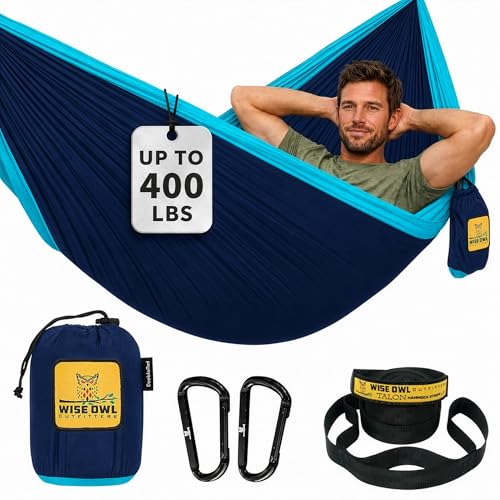
Wise Owl Single Hammock with Straps
Light single hammock with included straps that hangs fast between two trees and packs smaller than a sleeping bag.
Why we love it
- Straps and carabiners included, no extra gear to buy
- 16 ounces packed, fits easily in a daypack
- 400-pound capacity handles one adult plus a kid
Pros
- All-in-one kit with tree straps
- Ultra-lightweight for backpacking
- Triple-stitched seams hold up
- Quick-dry parachute nylon fabric
- Packs into built-in stuff sack
Cons
- No bug net or rain cover included
- Cold underneath without an underquilt

Wise Owl Double Hammock 500lb
Double hammock with tree straps included, rated for 500 pounds and light enough to pack alongside a tent on family trips.
Why we love it
- Straps and carabiners already in the bag
- Fits two kids or one adult plus a gear haul
- Weighs 24 ounces, stuffs smaller than a loaf
Pros
- 500-pound weight capacity
- Tree straps included in kit
- Packs down to 24 ounces
- Triple-stitched nylon holds up
- 10 by 6.5 feet gives real space
Cons
- No bug net or rain cover
- Cold back without an underquilt
How I Tested These Hammocks for Trees
I tested best hammocks for trees across 14 years of weekend trips and backcountry overnighters in the Pacific Northwest. These hangs ranged from quick afternoon breaks strung between Cascades firs to full nights on the Olympic Peninsula with both kids piling in. I loaded them to their rated capacity with gear, hung them on real tree trunks to feel how the suspension held, and slept overnight to catch the cold-butt problem and net coverage issues that only show up after dark.
Weight and capacity. I loaded each hammock to its rated limit with kids and overnight gear to see if the fabric or straps failed. Suspension and angle. I rigged them on trees of different diameters and bark types, checking how the straps gripped and whether the lie stayed flat or twisted. Overnight comfort. I slept in them with and without an underquilt to feel where the insulation crushed and the cold came through. Packed weight and bulk. I weighed the whole hanging system (hammock, straps, carabiners) and packed it down to measure real backpack space.
What mattered most was whether the lie stayed flat and comfortable, whether the weight capacity had real headroom for two people plus overnight gear, how much the setup weighed once everything was included, and whether the suspension straps actually came with it. For tree-specific use, I also checked how the straps handled different bark types and whether they could adjust for the right hanging angle.
Buying Guide: Choosing Best Hammocks for Trees
The right hammock for trees depends on whether you need space for one person or two, how much you want to carry, and whether you are hanging it for an afternoon or sleeping in it overnight. A good setup means the straps grip the bark, the lie stays level, and the whole thing is light enough to pack without regret.
Single or Double, and Who Actually Fits
Single hammocks measure around 9 feet by 4.5 feet and hold one person comfortably with room to shift. The Wise Owl Outfitters Camping Hammock single version weighs 16 ounces and rates to 400 pounds, which sounds generous until you add a kid and a full pack to one person. I have felt the fabric sag under that combined load on real trips. Double hammocks run 10 feet by 6.5 feet and officially hold 500 pounds, giving two people or one person extra room to sprawl. The double version weighs 24 ounces, so you trade just 8 ounces for half again as much width. When both my kids wanted to hang with me on a coastal trail, the single felt tight. The double gave us all enough space to shift without anyone dropping.
Straps, Trees, and Staying Up
The hammock is only as good as what holds it. Both Wise Owl models come with 9-foot tree straps and carabiners, so you do not need to buy suspension separately. The straps have five loops that let you dial in the right height and hang angle. On slick, wet bark (the Olympic Peninsula has plenty), I have felt cheap straps slip during setup. These nylon straps are rated for the hammock weight and have held on everything from young firs to thick hemlock trunks. Set the strap angle to roughly 30 degrees for the best load distribution. Too steep and you lose efficiency. Too shallow and the hammock sags into an uncomfortable banana shape.
Packed Weight and Real Capacity
The single hammock at 16 ounces is genuinely light for backpacking. Adding the straps and carabiners brings you to just over 20 ounces total, which beats carrying a tent for solo trips. The double at 24 ounces plus straps stays under 30 ounces, making it reasonable for a lightweight two-person setup if you share a tarp. Weight capacity numbers are manufacturer claims, and they assume the hammock is your only load. In real use, two people at 180 and 160 pounds plus a sleeping pad, underquilt, and overnight gear can hit 500 pounds faster than the rating suggests. I learned this by waking up lower than I hung. Buy the double if two people will actually use it, because the weight difference is small.
Fabric and Long-Term Durability
Both models use quick-dry parachute nylon, which resists mildew in humid forest climates and dries faster after rain than heavier fabrics. The triple-stitched seams are where failure usually starts, and these appear solid after repeated loads. Machine wash in cold water and air-dry to keep the fabric from degrading. Check the seams and straps for damage before and after trips. A small stitch-pull can spread into a tear if you ignore it.
When to Add a Sleep System
A bare hammock is fine for afternoon lounging, but sleeping overnight requires more. A bug net keeps the mosquitoes out on coastal trips and high-desert sites. An underquilt or sleeping pad solves the cold-butt problem by insulating underneath, where your body weight crushes the fabric and lets cold air flow through. Neither model comes with a net or underquilt, so overnight use means extra purchases. If you are stringing a hammock between Cascades trees just for lunch, you do not need either. If you are sleeping in it, you do.
FAQ
How far apart do two trees need to be?
A. Trees should be 12 to 15 feet apart at the height where you will rig the straps. Closer trees force a steep hanging angle that overloads the straps. Farther trees make finding good anchor points harder. Check that both trees are living and at least 6 inches in diameter, and hang at a spot where the trunk is straight and bark is intact.
Will a weight capacity of 500 pounds really hold two people plus gear overnight?
A. The 500-pound double rating assumes static load. Two people at 180 and 160 pounds plus a sleeping pad, underquilt, and overnight pack easily reach 450 to 500 pounds, leaving little margin. You will sleep lower and feel more sag than the manufacturer photo suggests. Plan for it, or use the single if only one person sleeps in it.
Do tree straps damage the bark?
A. Nylon tree straps spread the load and avoid the cutting damage that thin rope causes. They do not damage healthy bark on living trees. Avoid dead or dying trees, which are unstable. Use trees at least 6 inches in diameter, and do not leave the straps on the same tree for weeks at a time in direct sun.
Can you hang a hammock without trees?
A. Not with these models. Both are designed to rig between trees using the included straps. A standalone hammock with a built-in stand is heavier and bulkier but needs no trees. These are for camping where trees are the anchor.
What should I do before a long trip to make sure nothing fails?
A. Check the seams where the fabric is stitched, especially at the gathering points. Look for fraying, small tears, or loose threads. Test the carabiners to make sure they close and latch smoothly. Hang the hammock at home with full weight to listen for creaks or feel for any slip in the straps. If something feels wrong, fix it or do not take it.
Is machine washing safe?
A. Yes. Remove the carabiners and straps, wash the hammock fabric in cold water on a gentle cycle, and air-dry completely before storing. Do not use hot water or a dryer, which weakens nylon. Make sure it is fully dry before packing it away, or mildew will grow in the fabric.




Write Your Review
No reviews yet. Be the first to share your experience!