
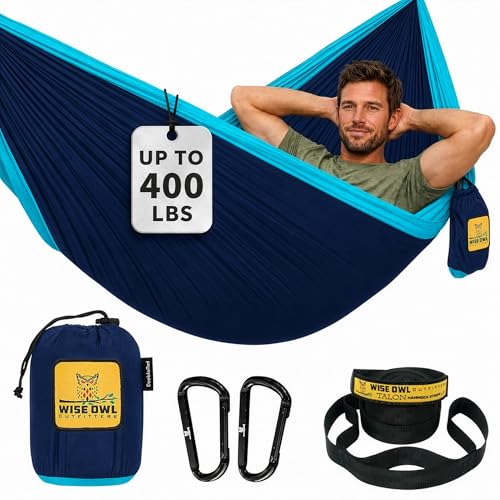
Wise Owl Single Hammock with Straps
Light single hammock with included straps that hangs fast between two trees and packs smaller than a sleeping bag.
Why we love it
- Straps and carabiners included, no extra gear to buy
- 16 ounces packed, fits easily in a daypack
- 400-pound capacity handles one adult plus a kid
Pros
- All-in-one kit with tree straps
- Ultra-lightweight for backpacking
- Triple-stitched seams hold up
- Quick-dry parachute nylon fabric
- Packs into built-in stuff sack
Cons
- No bug net or rain cover included
- Cold underneath without an underquilt

Wise Owl Double Hammock 500lb
Double hammock with tree straps included, rated for 500 pounds and light enough to pack alongside a tent on family trips.
Why we love it
- Straps and carabiners already in the bag
- Fits two kids or one adult plus a gear haul
- Weighs 24 ounces, stuffs smaller than a loaf
Pros
- 500-pound weight capacity
- Tree straps included in kit
- Packs down to 24 ounces
- Triple-stitched nylon holds up
- 10 by 6.5 feet gives real space
Cons
- No bug net or rain cover
- Cold back without an underquilt
How I Tested These Camping Hammocks
I spent 14 years hanging, sleeping in, and wearing out camping hammocks across the Pacific Northwest. These two have been strung between Cascades firs on quick breaks, rigged for lazy afternoons with both kids piled in, slept in overnight on cold nights with underquilts, and packed into backpacks for weight-conscious trips. I loaded them to their weight ratings with real gear, hung them on trees with different bark and angles, and slept long enough to feel whether the suspension held and the lie stayed flat.
- Loading and suspension: I rigged each one to weight rating with kids and camping gear to see if the straps held without slipping or stretching, and whether the fabric or seams showed strain.
- Lie angle and comfort: I spent full nights in each to check whether the hammock stayed flat or sagged into a banana shape, and how the suspension felt on my back and shoulders.
- Packed size and weight: I weighed the complete setup including straps, carabiners, and stuff sack, then packed it into a daypack to see how much real space it takes.
- Fabric and stitching: After repeated hangs and weather exposure, I checked whether the parachute nylon held up, the triple-stitched seams stayed intact, and the material resisted mildew and wear.
What mattered most was whether a camping hammock could handle two people plus gear without sagging or failure, how lightweight it stayed when packed, and whether the suspension system was included or an extra cost. For these lounging and camping hammocks, I looked at real room for one or two people, weight capacity headroom, and how the fabric width affected whether you could lie flat or ended up twisted.
Buying Guide for Camping Hammocks
Choosing the right camping hammock comes down to deciding between solo comfort and shared space, understanding what weight capacity actually means for two people plus gear, and knowing whether the suspension included in the package matches your trees. A hammock that sounds roomy on paper can feel cramped when two adults climb in, and a weight rating that looks healthy disappears fast once you add a sleeping bag, pad, and backpack underneath you.
Single or Double, and Who Fits
A single hammock measures around 9 feet by 4.5 feet and holds one person comfortably with room to shift position. The Wise Owl Outfitters Camping Hammock single weighs 16 ounces and supports 400 pounds, which is plenty for one adult until you add a sleeping pad and underquilt. For quick afternoon hangs or solo backpacking trips where weight matters, a single stays packable and light. A double hammock stretches to 10 feet by 6.5 feet, fitting two people side by side or one person who wants space to sprawl. The Wise Owl Outfitters Camping Hammock double handles 500 pounds total, which sounds generous until both kids and camping gear load it. I have felt the fabric sag noticeably with two growing kids inside, so the real headroom is less than the rating suggests. Pick a single if you camp alone or need to save weight. Choose a double if you want room for two, or if one person wants to sleep comfortably without feeling tethered.
Suspension That Actually Holds
The straps included with your hammock are your first failure point. Both Wise Owl models come with 9-foot tree straps, carabiners, and adjustment loops built in, which means you are not buying suspension separately. Tree straps need to be wide enough to protect bark and long enough to reach trees at a rough 30-degree angle from the hammock to the anchor point. When straps are too narrow or too short, you end up improvising with rope or webbing, which defeats the point of an all-in-one kit. I have felt a strap slip on wet bark when the angle was wrong, so dial in the height carefully using the adjustment loops. If trees are far apart or thin, you may need straps longer than 9 feet, which means a second purchase. Straps included saves money and hassle on the first hang.
Weight and Packed Size for the Trail
A single hammock that weighs 16 ounces and packs smaller than an eggplant makes sense for backpacking when every ounce counts. A double at 24 ounces is still light compared to a tent, but it takes up noticeably more pack space. If weight is your main concern, a single beats a double by 8 ounces, and you avoid the temptation to stuff extra gear or a second sleeper in the space. For car camping or short weekend trips where you are not counting ounces, the extra 8 ounces of a double buys you real room and the option to have a second person hang with you. The trade-off is packed bulk. Test how small each one actually folds before deciding based on the spec sheet alone.
From Lounge to Sleep System
These Wise Owl hammocks are gathered-end lounging and camping hammocks, not standalone sleep systems. To sleep comfortably overnight, you need an underquilt or sleeping pad underneath to stop the cold-butt problem. Your body weight compresses insulation below you, so the fabric itself offers no warmth. Many new hammock buyers skip this step, then wake up freezing on a Cascades night with nothing but cold air beneath them. A pad or underquilt adds weight and cost, but without it you are sleeping in the cold. If you plan overnight trips, budget for a secondary piece. Daytime lounging and short trail breaks need nothing but the hammock itself.
Fabric That Survives the Elements
Both models use parachute nylon, which is quick-drying and resists mildew better than heavier cotton blends. On wet coastal trips and humid Cascades nights, quick-dry fabric keeps the hammock from becoming a mold incubator in your pack. The triple-stitched seams on these models handle repeated use without fraying, though I have still patched small tears where carabiners caught during packing. Nylon is not bulletproof, but it outlasts cheaper single-layer fabrics and stays lighter. After repeated use, check stitching around the anchor points, where stress concentrates.
FAQ
Can two people really sleep overnight in a camping hammock?
A. Yes, but with trade-offs. A double hammock fits two people side by side, but sleeping two in one hammock all night is tighter than two separate hammocks. You both need an underquilt or pad to stay warm, and you move less freely. Teenagers or kids and one adult work better than two full-grown adults for comfort. If you are considering this for serious overnight camping, a single hammock per person is worth the extra weight and setup time.
How far apart do trees need to be?
A. Roughly 12 to 15 feet apart works well for most hammocks with included straps. Trees closer together can work if you shorten the strap adjustment, and trees farther apart require longer straps or a second purchase. Too-close trees force the hammock into a steep angle and put stress on both the straps and the anchor points. Too-far trees flatten the hang and require you to pull hard on the strap adjustment, which can slip. Test the 30-degree angle rule: if you draw an imaginary line from the anchor point down to the hammock, it should angle gently, not drop straight down or shoot out flat.
Do weight ratings account for two people plus gear?
A. Not fully. A 500-pound weight rating sounds like it handles two adults comfortably, but add sleeping bags, pads, and backpacks hanging underneath and you eat into that headroom fast. Two people at 180 pounds each plus 40 pounds of gear already consumes 400 pounds. With a 500-pound rating, you have 100 pounds of buffer, which feels less generous once the hammock is loaded. For two people sleeping overnight with full gear, treat the weight rating as a ceiling, not a comfort zone.
Will tree straps damage the bark?
A. Wide, webbed straps like those included with these models do far less damage than rope or thin cord. The 9-foot tree straps on both Wise Owl models spread the load across more bark surface, and parachute webbing is softer than rope. That said, leaving straps on a tree overnight or across the seasons can damage bark and kill the branch. Hang for the day or overnight without worry. If you are setting up a semi-permanent camp spot, rotate which trees you use, or remove the straps between trips.
What is the best way to clean and store a camping hammock?
A. Rinse off dirt with a hose, let it air-dry completely before packing, and store it dry in a cool place. The machines-washable fabric on these models can go in a gentle cold-water cycle if needed, but line-drying after a rinse is easier and safer. Never store a damp hammock in a packed bag, because mildew grows fast in compressed, moist fabric. Check straps and stitching for damage before storing, and toss it with the stuff sack or a dry bag to keep dust off until the next trip.
Can you hang a hammock without trees?
A. Not with these models. Both are gathered-end hammocks built to hang between two trees or solid anchor points like a porch beam. If you need to camp where trees are absent, you would need a freestanding hammock with a built-in stand, which is bulkier and heavier. These Wise Owl hammocks assume two solid anchor points about 12 to 15 feet apart.




Write Your Review
No reviews yet. Be the first to share your experience!