

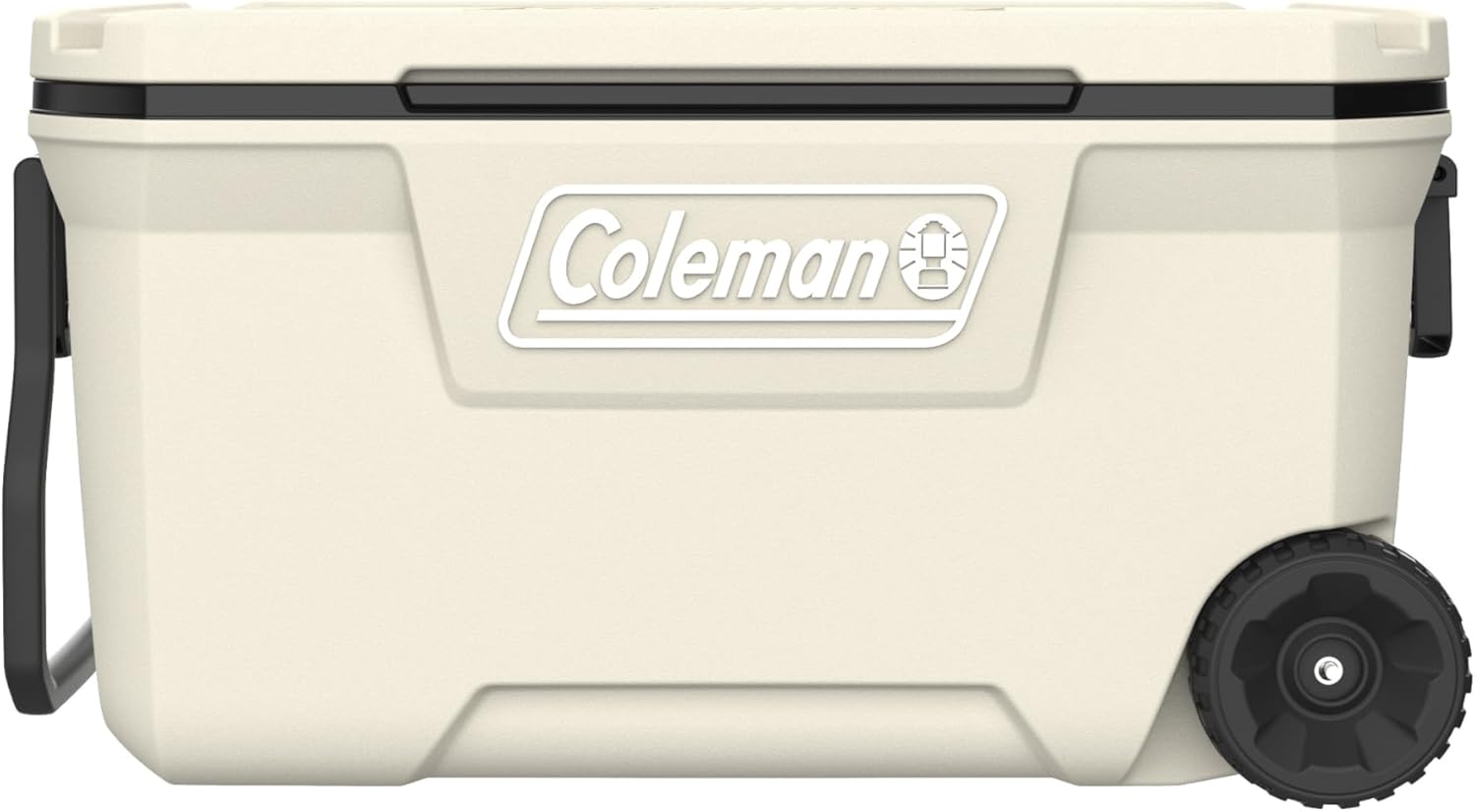
Coleman Classic Wheeled Cooler 80-Can
Wheeled hard cooler rated for five days of ice, built tough enough for family camping weekends with a lid that doubles as a seat.
Why we love it
- Six-inch wheels roll over gravel and grass
- Holds 80 cans with ice for a full weekend
- Lid seats 250 lbs, becomes extra camp seating
Pros
- All-terrain wheels for rough ground
- Tethered drain plug stays attached
- Molded cup holders keep drinks secure
- Hard shell lid rated for 250 lbs
- Dual tow and swing-up handles
Cons
- Heavy when loaded with ice
- Wheel performance varies in deep sand

Igloo Trailmate Journey 70Qt Wheeled
Wheeled 70-quart hard cooler built to handle hot high-desert weekends and campground loops without tipping or leaking.
Why we love it
- Ten-inch never-flat wheels roll over gravel
- Holds ice through a full weekend in heat
- Horizontal handle pulls 50% easier when full
Pros
- Never-flat ten-inch wheels
- Telescoping dual-trigger steel handle
- Holds 112 cans, seats two kids
- THERMECOOL foam insulation
- Made in USA
Cons
- Weighs 35.8 pounds empty
- Difficult to carry across rough terrain
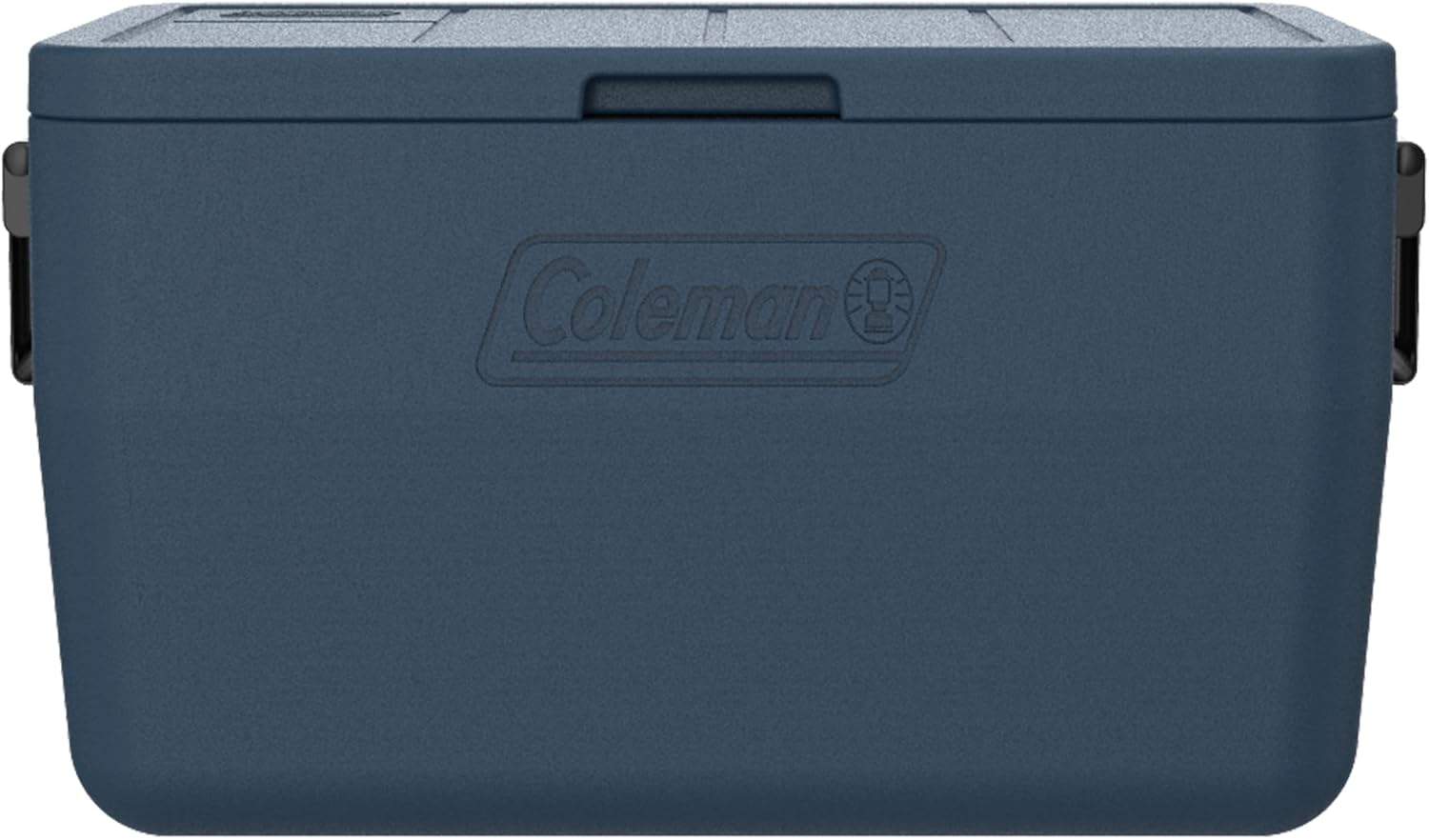
Coleman Chiller 48qt Cooler
Standard hard cooler rated for five days of ice retention, holds 31 cans with ice, and seats two adults on the reinforced lid.
Why we love it
- Ice rated to last 60 hours through hot weekend trips
- Lightweight at 7.6 lbs empty, easy to carry loaded
- Lid supports 200 lbs, doubles as extra seating
Pros
- TempLock foam insulation rated to 60 hours
- Fits 2-liter bottles standing upright inside
- Swing-up handles fold flat for vehicle storage
- Smooth surfaces wipe clean after use
- Made in USA with 1-year limited warranty
Cons
- Standard hard cooler, not rotomolded
- Lighter weight means thinner insulation walls

Feelfunn 61QT Dual Zone Electric Cooler
Plugs into your vehicle or wall to keep food frozen or refrigerated all weekend without needing ice, dual zones let you freeze meat while keeping drinks cold.
Why we love it
- Reaches freezing temps in 15 minutes, -4°F in 45 mins
- Runs on 12V car power, AC at camp, uses minimal battery
- Two independent zones: freeze one side, chill the other
Pros
- Dual-zone independent temperature control
- Fast cooling from ambient to freezing
- Runs on vehicle power or household AC
- 45dB quiet operation during drives
- Removable basket and LED interior light
Cons
- Heavy at 38.8 pounds when full
- Requires power source, not a passive cooler

EUHOMY 19QT Electric Cooler 12V
Compressor-powered fridge that runs off your car battery or home power, so you skip the ice refills on hot weekends.
Why we love it
- Cools to freezer temps without ice
- Runs 12V, 24V, or AC power anywhere
- App control and low 42dB noise level
Pros
- Compressor cooling, not thermoelectric
- Multiple power options (12/24V DC, AC)
- Reaches freezer temps in 15 minutes
- Magnetic lid seal and anti-shock design
- 3-level battery protection for vehicles
Cons
- Needs vehicle or AC outlet to run
- Heavier than passive ice coolers
Ice Retention Reality vs. Marketing Claims
Most best car camping coolers come with a spec sheet that tells only half the story. A manufacturer’s five-day ice retention claim assumes the cooler stays sealed in a lab. Real camping looks different: kids opening the lid every ten minutes, the box sitting in direct sun, ice melting faster than the data suggests. After 14 years of family trips through the Cascades and high desert, I have learned which coolers hold up and which ones fail by afternoon.
The difference between a reliable box and a frustrating one often comes down to details that specs do not capture. Gasket quality, whether the drain plug actually stays sealed, how the insulation thickness affects weight and capacity, and whether the lid truly closes without gaps. Picking the right cooler means understanding what those details mean for your specific trip length and group size.
Construction and Insulation Depth
Rotomolded coolers use thick foam injected between inner and outer shells, and that thickness is where ice retention actually happens. The Coleman Classic Series Insulated Portable Rolling Cooler holds ice for up to five days because its walls are substantially thicker than foam-lined boxes. However, that density adds real weight when loaded. The trade-off is worth it for multi-day trips where ice life matters more than portability. A thinner-walled cooler saves pounds but costs you ice, usually by a full day or more in warm weather.
Gasket and Latch Hardware
The gasket is the rubber seal around the lid, and it is where most coolers start to fail after a season. A poor gasket lets warm air in every time you open the lid, especially if the rubber hardens in cold storage or splits under repeated stress. The Igloo Trailmate Journey 70Qt uses molded seals designed for frequent opening without degradation. Check the latch hardware too: plastic latches that flex or hinge pins that bend are liabilities. Metal hinges and reinforced plastic latches outlast cheap snaps by years.
Drain Plug and Cleaning
Meltwater collects at the bottom, and a weak drain plug leaks into your truck bed or cargo area. A tethered drain plug that stays attached (like the Coleman’s design) prevents losing the plug entirely and reduces the mess of pulling it at a crowded campground. The interior should wipe clean easily. Textured or porous interiors hold algae and odor. A smooth, stain-resistant liner means five minutes with a damp cloth instead of scrubbing after every trip.
Capacity vs. Usable Space
A 48-quart box sounds roomy until you add 30 pounds of ice. That ice displaces roughly one-third of the nominal volume, leaving you with actual room for maybe 20 quarts of food and drinks. The Coleman Chiller 9/16/30/48/60qt Cooler fits 31 standard 12 oz cans with 24 pounds of ice, which is honest and usable space. Know whether you are choosing for total capacity or for realistic contents after ice is loaded.
A five-day ice rating tested sealed in a lab tells you almost nothing about Saturday morning when the kids are opening it every five minutes.
Wheeled vs. Carry-Only: Movement and Durability
A cooler that weighs 80 pounds when full cannot move on muscled alone. Wheels solve that problem for base camps and car camping where you roll it across gravel from the parking lot to the site. The Igloo Trailmate Journey 70Qt has 10-inch all-terrain wheels and a steel handle with locking and telescoping functions, which means you can roll or tow it up slopes and over rough ground without the wheels sinking or wobbling. The wheel assembly adds weight and complexity, though, so it fails faster if the pivot gets hit or the tires catch on sharp terrain.
Carry-only coolers stay simpler. The Coleman Classic Series has swing-up handles and no wheels, which means two people lift it together or you make multiple trips. That adds work on a beach or campground, but there are no wheels to jam or break. Choose wheels if you camp the same base camp for multiple nights and hate hauling. Skip wheels if you move locations daily or carry the cooler to remote spots where wheels would be useless.
Handle Design and Lift Points
Handles matter more than you think. Swing-up handles distribute the weight across two lifters and fold flat so the cooler slides into a truck bed without snagging. A single fixed handle or a handle that does not fold becomes a liability when loading and unloading. Test by gripping the handles of a full cooler before buying. Bad handles tire your hands within a few minutes and leave blisters after a half-day of moving it around camp.
Whether It Doubles as Seating
A reinforced lid rated for 200 to 250 pounds of weight becomes an extra seat or step stool at the campsite. This sounds like a bonus but it is a genuine convenience when you have kids climbing on it or when you need somewhere to sit while cooking. The downside is that the lid becomes another pressure point for stress and potential failure. Cheaper coolers with thin lids cannot support body weight without cracking the plastic.
Electric and Compressor Coolers: Power Draw and Temperature
A 12-volt electric cooler does not use ice. It plugs into your vehicle’s 12V outlet (or AC if you are parked at a campground with power) and runs a compressor or thermoelectric element to actively chill. This changes everything about how you pack and maintain it. The EUHOMY 12 Volt Refrigerator cools from 77 degrees Fahrenheit to 32 degrees in 15 minutes and consumes only 45 watts, which is low enough that it will not drain your vehicle battery if you run it with the engine off. The Feelfunn 12 Volt Refrigerator Car Fridge takes a similar approach with dual zones and multiple power modes, letting you drop the power draw to under 30 watts in ECO mode.
The trade-off is noise and complexity. A compressor is audible (though the EUHOMY and Feelfunn models run at 42 and 45 decibels respectively, which is quieter than older models). Thermoelectric units run silent but chill more slowly and cannot freeze solid. Choose a compressor unit if you want temperature control and can tolerate modest noise. Choose thermoelectric if silence matters and you only need chilling, not freezing.
Battery Protection and Runtime
Both electric models offer three-level battery protection that limits power draw to prevent you from draining your vehicle battery completely. Set the mode to low if you are parked with the engine off for several hours. The EUHOMY’s 19-quart capacity is compact for day trips or a couple of nights. The Feelfunn’s 61-quart dual zone is larger and more suited to longer trips where you want frozen food separate from drinks. Check whether the unit includes DC and AC power adapters because USB and wall outlets help at home or at a campground with hookups.
Noise and Vibration
Compressor units vibrate slightly. Both the EUHOMY and Feelfunn are designed to be firmly mounted in the vehicle using included straps or rope holes so they do not rattle over bumps. If you are running one while driving or trying to sleep near it, that hum becomes noticeable after an hour or two. Thermoelectric units eliminate that entirely, which is why some people tolerate their slower cooling. Think about whether you will run the cooler while driving or mainly use it at camp with the engine off.
An electric cooler with three-level battery protection means you can chill without worrying about limping home with a dead car battery.
Making the Right Size Choice
A cooler that is too big wastes fuel and cargo space. A cooler that is too small means ice runs out mid-trip or you cannot fit enough food for the group. For a family of four on a three-day camping trip, you need roughly 40 to 60 quarts of actual cooler volume (not including ice displacement). Two people on a long weekend need 20 to 30 quarts. The Coleman Chiller 48qt and the Igloo Trailmate 70qt cover most family and group scenarios. Smaller boxes like the EUHOMY 19qt suit day trips or a couple of people on an overnight.
Test fit before buying. Measure your vehicle cargo area and see whether the cooler will slide in without rocking or blocking the rear gate. A cooler that is 30 inches long by 18 inches wide by 16 inches tall takes up real estate. Check whether it will still close with the cooler loaded. If you are packing supplies, kids, and a large cooler into a car, you lose a lot of flexibility with an oversized box.
Tips From the Road
- Pre-chill your cooler the night before. A warm cooler wastes ice rapidly. Leaving it open in an air-conditioned room or filling it with ice for a few hours before your trip gets the plastic and insulation cold, so your fresh ice does not melt just bringing the whole box up to temperature.
- Use block ice instead of cubed whenever you can. Block ice melts slower than crushed or cubed because it has less surface area exposed to the warm cooler walls. You can also fit more total ice mass into a block-ice setup.
- Load drinks and perishables first, then ice on top. Packing it backwards means cold drinks sink to the bottom and stay there, unreachable without dumping out melted water. Put your cooler list in reverse order: drinks and dairy on the bottom, non-perishables on top, then ice as the final layer.
- Keep the cooler out of direct sun and close the lid after every use. Every time someone opens it, warm air replaces cold air. If the box sits in midday sun, the top 2 inches of contents warm up by 10 to 15 degrees. A beach umbrella or a spare tarp over the cooler cuts that loss in half.
- Leave the drain plug open while you are at camp. Meltwater sitting in the bottom is dead weight and degrades ice quality. If the cooler is shaded and you can open the plug without pooling water in your site, drain it nightly. This also reduces odor and algae growth.
- Check the gasket and latches before your first trip of the season. Rubber hardens over winter storage. If the gasket feels brittle, soak it in warm water for 10 minutes to restore flexibility. A cracked latch should be replaced before the trip, not discovered mid-weekend.
Common Questions
Do those five-day or seven-day ice retention claims actually happen?
Only if the cooler stays sealed and unopened in mild weather. In practice, a good rotomolded cooler holds ice for three to four days with frequent opening and afternoon heat. The claim assumes ideal lab conditions that never happen on a real camping trip.
Can I use a cooler to keep things frozen, not just cold?
An insulated cooler with ice will hold frozen items frozen for one to two days if you pack it right (bottom layer of frozen food, then regular ice on top, sealed). After that, the frozen food begins to thaw as the ice melts. An electric compressor cooler can hold frozen food indefinitely as long as the unit is plugged in and running.
What is the real usable volume after I add ice?
Plan for roughly 50 to 60 percent of the nominal capacity once ice is in. A 48-quart cooler gives you about 25 to 30 quarts of actual room for food and drinks. Check the product data for how many cans it holds with ice, because that is a better guide than the total quart rating.
Is drain plug leakage a common problem?
Yes, especially in trucks or minivans where movement and vibration loosen it. A tethered plug that stays connected solves most of that headache. Check the seal before every trip and replace it if it cracks or does not sit flush.
Will an electric cooler drain my car battery?
Not if you use the three-level battery protection and run it in ECO mode when the engine is off. These units draw 30 to 45 watts on low power, which is less than a cabin light. Running it on maximum power with the engine off for 12 hours straight can drain a battery, but normal camping usage does not.
How long does a cooler last before it needs replacing?
A well-maintained rotomolded cooler lasts 10 to 15 years of regular use. Gaskets fail first (they can be replaced), followed by latch hardware or hinge pins. A cheap foam-lined cooler fails after two to three seasons. Electric units last 5 to 10 years depending on how often you run the compressor and whether it gets dropped or sat on.




Write Your Review
No reviews yet. Be the first to share your experience!