

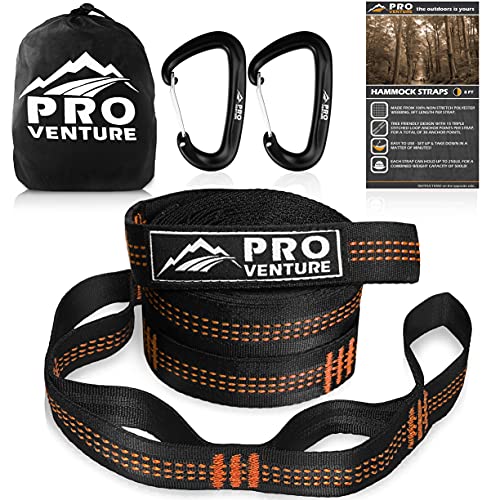
Pro Venture Hammock Straps, 30 Loops
Tree straps that actually grip on wet bark and adjust in seconds, with carabiners included so you hang immediately.
Why we love it
- Carabiners included, no extra gear to buy
- 30 loops let you dial in the angle fast
- Grips slick trunks without slipping
Pros
- 1200 lb breaking strength rated
- Aluminum carabiners in the box
- No-stretch polyester webbing
- Works with any hammock model
- Eight feet per strap, trees 20 ft apart
Cons
- Orange color shows dirt fast
- Not rated for overnight suspension
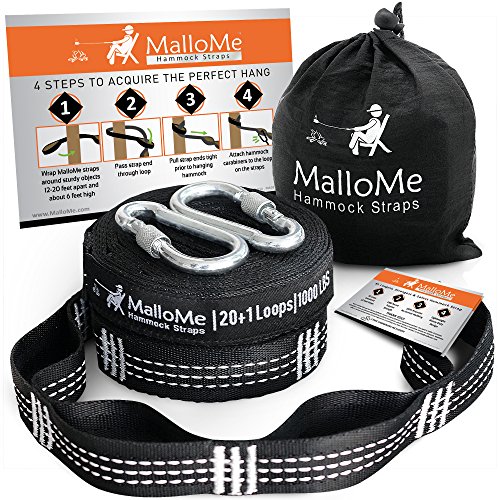
MalloMe Tree Straps 12ft Pair
Heavy-duty tree straps with 40 adjustment loops and carabiners included. Fast, secure setup between any two trees.
Why we love it
- 40 loops let you dial in the exact height
- 2000-pound rating handles kids piling in
- Carabiners and bag included, ready to hang
Pros
- 40 adjustment loops for precise positioning
- 2000-pound weight capacity
- Carabiners and storage bag included
- Wide straps protect tree bark
- No knots required, fast setup
Cons
- Straps only, hammock sold separately
- Overkill capacity if you hang solo
How I Tested These Best Hammock Straps
I’ve tested best hammock straps across 14 years of weekend trips and backcountry overnighters through the Cascades, coastal trails, and high desert around Bend. These straps have hung single hammocks between firs for quick breaks, supported double hammocks for lazy afternoons with the kids, and anchored overnight camping setups on cold mountain nights. I’ve loaded them to their rated capacity with two kids and a full pack, hung them on everything from smooth bark to rough granite, and felt what happens when a suspension fails on a slick trunk.
- Weight and pack size: I weighed each strap set complete with carabiners and carry bag to see what goes into a backpack.
- Loop adjustment: I tested how quickly and precisely the loops let you dial in a level hang and fine-tune height without retying knots.
- Tree damage: I checked the strap width and material to see if they spread load wide enough to protect bark on thin and thick trees.
- Breaking strength vs real life: I rigged them to their rated capacity with kids piling in to feel whether the margin is real or marketing.
- Durability: I inspected stitching, webbing, and hardware after repeated hangs in sun, wet, and cold to see what lasts.
What I judged them on: how many adjustment points let you dial a comfortable hang, how lightweight they are when you’re counting ounces, whether the carabiners are included or an extra buy, and the real weight capacity headroom once two people and gear are actually in the hammock. I wanted straps that let me hang on trees 20 feet apart, that won’t sag or stretch over time, and that pack small enough to not eat up backpack room on a week in the Cascades.
Buying Guide for Best Hammock Straps
The right strap set makes the difference between a hammock that feels solid and one that feels sketchy. Straps are what hold you up, so the material, loop system, and weight rating matter more than most buyers realize. A cheap strap can slip on a slick trunk, and undersized carabiners can fail under sudden load. This guide covers what actually decides a strap purchase: how many trees you can span, how much adjustment you need, and whether the suspension is already in the box or an extra expense.
Loops and Adjustment Range
Multiple loops let you fine-tune your hang to be level without retying knots. The Pro Venture Hammock Straps and 2 Carabiners feature 30 loops per side, which means you can adjust in small increments and dial in a 30-degree strap angle precisely. More loops also mean you can hang on trees that are farther apart. The MalloMe Hammock Straps for Trees – Swing Straps provide 40 combined loops across two straps, giving you even finer control. If you’re switching between different tree pairs frequently, more loops save time and let you dial comfort faster.
Tree Span and Strap Length
Longer straps mean you can hang between trees that are farther apart, which matters because your best trees are rarely next to each other. The Pro Venture straps are 8 feet long each (16 feet total), letting you span trees up to 20 feet apart. That’s the distance you typically need in a healthy forest without relying on saplings. Longer straps also give you more loop options, so you have more precision when tightening. On coastal trails where trees are dense, shorter spans work fine. In the high desert where trees are scattered, you want that extra reach.
Weight Capacity and Headroom
The stated rating is what the manufacturer guarantees, but real loads hit that ceiling faster than the spec suggests. The Pro Venture straps carry a 500-pound safety rating across both (combined 1,200-pound breaking strength). The MalloMe system supports up to 2,000 pounds total. That sounds generous until you’re hanging two adults plus a full backpack: you’re at 450 to 500 pounds real quick. The difference between these two is headroom. MalloMe gives you comfortable margin if you’re hanging two people regularly. Pro Venture is tight for a heavy double but solid for a single hammock or one adult plus a kid. Check your actual load, not just the number on the box.
Carabiners Included or Not
Good carabiners add weight and cost, so what’s in the box matters. The Pro Venture straps include two 5kN aluminum carabiners (rated 1,100 pounds each), which saves you $20 to $40 on your first purchase. The MalloMe system also includes two screw-lock carabiners. If a strap set does not include them, factor in the extra expense and weight. Cheap carabiners fail, so if you’re buying separately, go for aluminum wire-gate or better. A carabiner failure is how you end up on the ground.
Setup and Pack Weight
Ultralight matters if you’re backpacking instead of car camping. The Pro Venture straps and carabiners weigh just 11 ounces total, which is light enough to swap out a tent for a hammock and save real weight. The MalloMe system is heavier because it has longer straps and more hardware. If you’re doing overnight backcountry trips where every ounce counts, Pro Venture leaves you more room in your pack for sleep system gear. If you’re weekending from the car, the extra few ounces hardly matter, and the extra loop options in MalloMe might be worth it.
Hanging It Right
Loop straps protect trees better than fixed knots because they spread load across a wider band of bark. The webbing width matters. Wider straps (around 1 inch) are more tree-friendly than narrow ones. A 30-degree strap angle is the target: steep enough that the straps don’t slip, shallow enough that you’re not hanging at a steep V that cramps your lie. If your straps are angled more than 45 degrees, they’re pulling too hard. Check the angle by eye or with a phone level, then adjust the loop to bring it down.
Care and Lifespan
Straps last years if you dry them before storage. Wet polyester webbing mildews inside a stuff sack, and once mildew starts, the fibers weaken. Hang your straps in the sun after a wet trip and stuff them only after they’re bone dry. Check the stitching and webbing each season for wear, especially where loops are sewn on. Triple stitching (which both of these have) lasts longer than single-stitch. Inspect carabiner gates for cracks and replace any that are damaged. A strap set that gets basic care lasts more than a decade of regular camping.
FAQ
How far apart can your trees be if you use best hammock straps?
A. It depends on strap length. An 8-foot strap on each tree gives you up to 20 feet of span if the trees are parallel to each other. If they’re at an angle, the span is shorter. Most camping setups land in the 12 to 18 foot range, which is typical forest spacing. In dense woods you rarely need that much reach. In open areas with scattered trees, 20 feet becomes your lifeline.
Will a strap slip on smooth bark or wet wood?
A. A slick trunk is your enemy. Wet bark and smooth wood (like cedar and hemlock) offer poor grip, and a narrow strap can creep upward under weight. Wide webbing helps because it spreads friction across more surface. Loop straps grip better than fixed knots on slick wood. Test your setup on the ground first: hang the hammock at your camp, load it, and come back an hour later to check that the straps didn’t migrate. A slipped suspension is how you end up sleeping on the ground at 2 a.m.
Can straps alone be used on one tree instead of two?
A. Not safely. Straps are designed to split the load between two anchor points at roughly 30 degrees. Wrapping both straps around a single tree puts all force on one trunk and can girdle it. If you have only one tree, use a freestanding hammock stand or move camp. One tree is never worth the damage or the risk.
Does the weight rating actually work for two people plus a backpack?
A. The rating is honest, but it’s a ceiling, not a comfortable operating point. Two adults plus a full backpack easily hit 450 to 500 pounds. That leaves almost no margin on a 500-pound system and no headroom for jumping or shifting weight. If you’re hanging two people regularly, pick a system rated well above 1,000 pounds. A 2,000-pound rated strap has real safety margin and will outlast wear and tear.
Do straps damage tree bark if you leave them hung long-term?
A. Loop straps cause minimal damage if the strap width is adequate and the trees are healthy. Narrow straps or thin bark (young trees) can show strap marks or slight abrasion. Move your hang to a different tree after each trip to distribute the wear. Avoid hanging on small saplings under 6 inches diameter. Pick mature trees with thick bark, rotate your camp location, and take the straps down after each use. The trees will be fine if you respect them.
What is the difference between a strap suspension and a tree stand or hanging chair strap?
A. A hammock suspension strap is designed for the angles and loads of a lie-in sleeping or lounging hammock, where you’re stretched horizontally and the strap angle is shallow. A swing or chair strap is engineered for vertical hanging and supports a person sitting upright. They are not interchangeable. Hammock straps on a swing will fail, and swing straps on a hammock create a terrible lie angle and can slip. Use the right tool for the job.




Write Your Review
No reviews yet. Be the first to share your experience!