

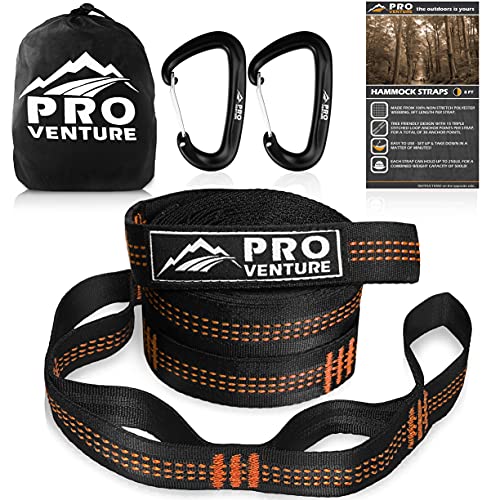
Pro Venture Hammock Straps, 30 Loops
Tree straps that actually grip on wet bark and adjust in seconds, with carabiners included so you hang immediately.
Why we love it
- Carabiners included, no extra gear to buy
- 30 loops let you dial in the angle fast
- Grips slick trunks without slipping
Pros
- 1200 lb breaking strength rated
- Aluminum carabiners in the box
- No-stretch polyester webbing
- Works with any hammock model
- Eight feet per strap, trees 20 ft apart
Cons
- Orange color shows dirt fast
- Not rated for overnight suspension

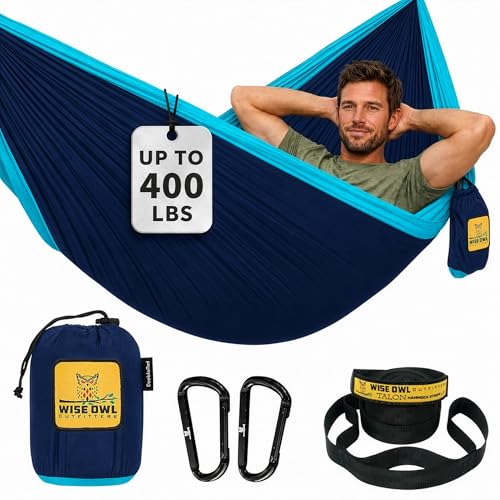
Wise Owl Outfitters Tree Straps
Heavy-duty tree straps with 38 adjustment loops and carabiners included, ready to hang any hammock in seconds without knots.
Why we love it
- 38 loops let you dial in the perfect hang angle
- Carabiners and pouch come in the box
- 1-inch wide straps don't chew up tree bark
Pros
- 500-pound combined weight capacity
- No-knot setup with carabiners
- Fits any tree size and hammock style
- Adjustable 38-loop system
- Includes carry pouch
Cons
- Poly webbing can slip on wet bark
- Single pair works for one hammock
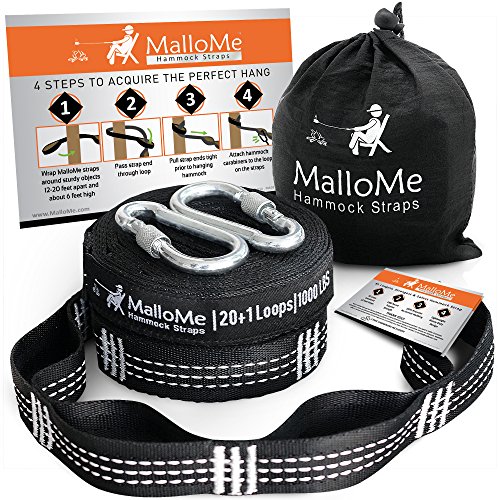
MalloMe Tree Straps 12ft Pair
Heavy-duty tree straps with 40 adjustment loops and carabiners included. Fast, secure setup between any two trees.
Why we love it
- 40 loops let you dial in the exact height
- 2000-pound rating handles kids piling in
- Carabiners and bag included, ready to hang
Pros
- 40 adjustment loops for precise positioning
- 2000-pound weight capacity
- Carabiners and storage bag included
- Wide straps protect tree bark
- No knots required, fast setup
Cons
- Straps only, hammock sold separately
- Overkill capacity if you hang solo

MalloMe Tree Straps 10ft Pair
Heavy-duty nylon straps with 24 loops for quick, secure hammock setup between any two trees.
Why we love it
- 1000-pound capacity handles two kids piling in
- 24 adjustment loops mean no knots, fast setup
- Wide straps protect tree bark on any trail
Pros
- 1000-pound load rating
- 24 combined adjustment loops
- No-stretch polyester construction
- Tree-friendly wide straps
- 20 feet total (two 10ft straps)
Cons
- Carabiners not included
- Requires your own hammock hardware
How I Tested These Best Hammock Tree Straps
I’ve tested best hammock tree straps across 14 years of Pacific Northwest camping, from Cascades overnight hangs to coastal trips and high-desert afternoons. These straps got real use: rigged between firs on quick breaks, loaded with two kids piling in, hung on slick wet trunks, and left up through rain and UV exposure. I checked them on single hammocks, doubles, and backpacking setups across dozens of trips and overnighters.
How I tested them: I loaded each strap system to the rated weight capacity with kids and gear to see if the suspension actually held without slipping or stretching. I hung them on trees of varying sizes and trunk textures to test real-world compatibility. I paid attention to the stitching and webbing after repeated hangs, checking for fraying or degradation. For overnight setups, I evaluated how the straps positioned the hammock for a level lie and how they worked with underquilts and tarps. I also weighed the complete system including carabiners to understand the pack penalty.
What mattered most was whether the straps stayed tight under load, whether they fit trees that are actually available, whether the attachment loops gave real adjustment, and whether they’d last seasons of use without absorbing water or slipping on wet bark. I ignored marketing weight claims and watched for what actually fails first: usually the suspension, not the hammock.
Buying Guide for Best Hammock Tree Straps
Tree straps are the first thing that fails on a hammock. Most people grab whatever is cheap, then discover a week into a trip that the suspension is stretching, slipping on wet trunks, or eating into tree bark. The real choice comes down to what you need the straps to do: hold steady weight, reach between far-apart trees, adjust fast, and not damage the bark. That last part matters more than most people think if you camp the same forest twice.
Strap Length and Tree Spacing
The longer the straps, the farther apart your trees can be, and the more flexibility you have on any given hang. Shorter straps work fine if you choose your trees carefully, but longer straps mean you’re not walking your entire camp looking for the one pair of firs that happen to be close enough. Pro Venture Hammock Straps and 2 Carabiners come in at 8 feet each (16 feet total), which gets you trees roughly 20 feet apart on a reasonable hang angle. If you routinely camp in open high desert or sparse forest, that’s tight. Wise Owl Outfitters Hammock Straps for Trees give you 10 feet each, and the MalloMe Hammock Straps for Trees – Swing Straps run 12 feet per side. Those extra feet matter when you’re at a site with no ideal pair waiting. Longer straps also pack smaller, which surprises most people.
Carabiners and Hardware
Included carabiners: Some strap kits throw in carabiners, others don’t, and that changes what you actually spend. Pro Venture includes two carabiners in the box, as does Wise Owl. The MalloMe version at $14.99 includes carabiners and a storage pouch, while their $12.98 model skips the carabiners entirely so you bring your own. If you don’t already own carabiners, that missing hardware becomes a separate $15 to $25 purchase, which wipes out the price advantage of the cheaper straps. The carabiners that come included are usually aluminum screw-lock type, which is reliable for hammocking and lighter than full locking gates.
Adjustment Loops and Fine Tuning
More loops mean finer adjustment of hang height and strap tension, which sounds like overkill until you’re trying to get level at a site where every tree is set at a different height or angle. Pro Venture gives you 30 total loops (15 per strap). Wise Owl offers 38 loops total, and MalloMe’s higher capacity models run 40 combined. The difference is real: fewer loops mean you step down in height by a few inches at a time, which can leave you sagging or tilted. I’ve hung hammocks on sites where I needed to fine-tune by a single loop height to get level, and having that option kept me comfortable enough to sleep. If you’re hanging a lot of different tree pairs or sharing sites with others, more loops earn their place.
No-Stretch Webbing and Durability
Cheap straps stretch under load, which kills your hang angle and puts you sagging by the third night. All the models here use no-stretch polyester webbing, which is the right call. What separates them is stitching quality and UV resistance. Pro Venture emphasizes triple-stitched construction and resistance to UV degradation and mildew. Wise Owl also highlights durable webbing that resists fraying and moisture. The MalloMe straps cover the basics with strong no-stretch material. After a few seasons in the sun, you’ll notice the difference in how well they hold up. I’ve had cheap straps start to slip on a wet trunk, and you don’t want to wake up figuring out why you’re tilted at 2 a.m.
Hanging Right and Tree Health
Wide straps distribute your weight across more bark, which means less damage to the tree. A 1-inch width is the park standard across most public lands. All of these models meet that standard, so you’re not cutting into the bark or girdling the tree. What matters more than the straps themselves is the hang angle: aim for roughly 30 degrees between strap and tree. Steeper angles pull harder on the bark and the strap anchor points. Shallower angles dig into your lay angle. The adjustment loops let you dial this in without fumbling with knots. After a hang, check the tree for marks. If the bark is dark or wet-looking, the straps were too tight or you left them on too long. Trees recover fine from a single night, but repeated pressure in the same spot can scar them.
Care and Storage
Webbing absorbs water and can mildew if packed away wet. Always dry your straps before storage, especially after coastal or rainy trips. Check the stitching regularly, particularly at the loops where stress concentrates. If you see fraying, it’s usually cosmetic early on, but address it so it doesn’t spread. Carabiners are almost impossible to break but benefit from a quick rinse to wash out sand and salt. Store everything in a cool, dry place away from direct sunlight when not in use. These straps last years if you treat them like gear instead of consumables.
FAQ
How far apart do trees actually need to be?
A. With 10-foot straps you can reach trees roughly 15 to 18 feet apart on a comfortable hang angle. With 12-foot straps you stretch to 18 to 20 feet. The math depends on the strap angle and your hammock setup, but practical rule: if you’re reaching the limit of your strap length, your strap angle is getting too shallow and you’ll sag. Pick trees that give you some slack in the straps.
Do tree straps damage bark?
A. No, not if the webbing is at least an inch wide and you don’t leave the straps on the same tree for weeks. Most parks require a minimum 1-inch strap width for exactly this reason. One night causes zero lasting damage. The straps distribute your weight, and the tree bark is tough. What kills bark is repeated pressure in the same spot or straps that are too narrow or too tight.
Can you use old straps indefinitely?
A. Eventually webbing degrades in UV light and moisture finds its way into the stitching. Most quality straps last 5 to 7 seasons of regular use before you notice real wear. Check for fraying edges, stiff or cracked webbing, and stitching that’s come loose. If the loops start to tear or the whole strap feels brittle, it’s time to replace them. Most people get way longer life out of them than they expect.
Do the weight ratings account for two people and gear?
A. The rated capacity is the total load the straps hold, but that number is usually a breaking strength, not a comfort limit. A 500-pound safety rating on straps means they can handle a 400-pound load safely, leaving a margin. Two adults plus gear regularly hits 400 to 500 pounds combined, which pushes you close to the limit. If you’re hanging doubles regularly with two people, pick straps rated for more capacity, like the MalloMe models at 1000 to 2000 pounds rated, which give you real headroom.
Can you hang a hammock without trees?
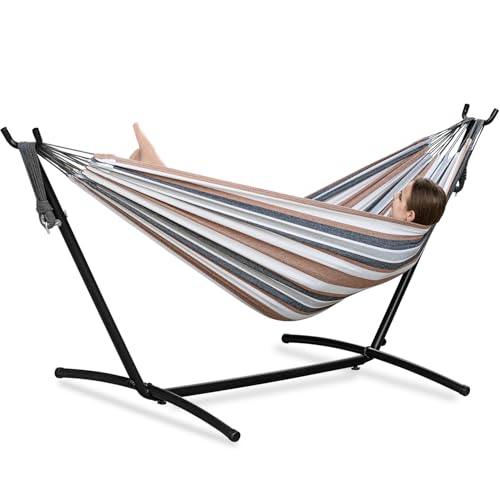
A. Not with these straps alone. Tree straps require two anchor points. If you’re somewhere without trees (beach, open desert, campground without suitable trees), you need a hammock stand instead. Stands are heavier and bulkier but solve the problem completely. Some people carry straps and a stand as backup, but that’s rare unless you’re road-tripping and never sure what’s available.
What’s the difference between a 500-pound and 2000-pound strap?
A. The rated capacity is how much load the strap can safely hold without failing. A 500-pound strap is fine for one person or a single hammock with light load. A 2000-pound strap gives you massive headroom for doubles, kids piling in, or anyone who wants to feel bulletproof. Higher capacity usually means thicker webbing and heavier carabiners, so you carry more weight for the peace of mind. Most single hammocks never need more than 500 pounds, but doubles and family hangs benefit from the extra margin.




Write Your Review
No reviews yet. Be the first to share your experience!