
How I Tested These Hammocks Under $50
I have tested best hammocks under $50 across 14 years of weekend trips and backcountry nights in the Pacific Northwest, from Cascades firs to coastal rain to high-desert afternoons. These tests included single hangs on quick trail breaks, double hammocks with both kids piling in, overnight sleeps with cold nights and bug pressure, and real-world loading to see where the suspension fails first.
Tree time. I hung each hammock on the actual trees you find on trips: Douglas firs, ponderosa pines, and wet coastal alders. I tested the suspension straps on bark that was slick or rough, checked the lie angle and whether your body stays flat or sags into a banana shape, and loaded them to their rated weight with kids and overnight gear to see if they actually hold. I slept in the overnight models to feel the cold-butt problem firsthand and to judge bug net coverage when mosquitoes are thick. I weighed the full hanging setup including straps and rain protection, because what matters is what goes in your pack.
What I judged them on: a lie-flat enough to sleep in without your hips or shoulders touching ground, weight capacity headroom so two people and a sleeping bag do not push past the limit, straps that grip trees without slipping on wet bark, and for the models with nets and tarps, actual sleep system coverage. For the ultralight picks, packed weight and size matter more than lounge comfort. I looked at the suspension included with each hammock, because a hammock with no straps means an extra $30 to $50 out of your $50 budget.
Buying Guide for Hammocks Under $50
A hammock under $50 forces you to choose: lounge comfort or overnight sleep system, single or double capacity, or whether suspension is even included. Most picks in this price range are gathered-end singles for daytime use, but a few stretch into camping territory with bug nets and tarps. The difference is not just comfort but whether you can actually sleep in it on a cold night.
Single or Double, and What You Give Up
A single hammock under $50 is the entry point. It weighs less, packs smaller, and costs the least. The trade-off is one person only, and if you load two kids or two adults in, the fabric sags into a deep valley and the suspension angle gets steep, which strains the attachment points. A double hammock costs more but gives real room for one person to sprawl, or genuine comfort for a smaller adult and a child on a lazy afternoon. At the $50 ceiling, you rarely find a double with suspension included, which eats your budget fast. Measure your actual use: solo day trips favor a single, family afternoons favor a double, and backpacking favors ultralight singles because the weight adds up.
Straps, Trees, and What Fails First
The suspension is often what gives up before the fabric does. A hammock under $50 usually ships with basic tree straps, or it ships with none and you buy straps separately. Tree straps rated to 300 pounds sound strong until you hang a hammock at a shallow angle on a slick trunk, and one strap starts to slip. Look for straps with gathered loops at both ends so you can tighten them to bark without sliding. If the hammock lists no straps included, add $25 to $40 to your actual spend, which can put you over your target. Some budget models use carabiners or continuous webbing, which work fine on rough bark but can slip on wet moss or lichen.
The Cold-Butt Problem and How to Solve It
Overnight hammock sleeping in cold weather hits one hard lesson: your body weight crushes the insulation below you, and cold air moves up through the fabric. A budget hammock under $50 rarely includes an underquilt, which is the real solution. Instead you lie on top of a sleeping pad, which slides around and gives uneven coverage. This is bearable for summer coastal trips with temperatures in the 50s, but a Cascades night in spring or fall will send cold through your back unless you bring a pad that stays put. If you want to sleep in a hammock under $50, budget another $30 to $60 for an underquilt later, or plan to use a closed-cell pad and accept the hassle.
Bug Nets, Tarps, and Why Cheap Sleep Systems Feel Incomplete
A hammock with a bug net and tarp stitched on costs more than a bare hammock, so at the $50 price point you are usually choosing one or the other, or neither. A net-only model protects you from mosquitoes but leaves your sleeping bag exposed to light rain and morning dew. A tarp-only model keeps rain off but lets bugs in. At this budget, accept that you may need to buy a net or a tarp separately, or look at a three-season model with both and expect to spend closer to $60 to $80. The trade-off is real: a tight budget hammock is often a lounger, not a full sleep system.
Packed Weight and Backpacking Reality
A hammock under $50 tends to use heavier fabric and thicker straps than ultralight backpacking models, so the full hanging weight often runs 2 to 4 pounds with suspension included. That is heavier than a lightweight backpacking tent, but it replaces the tent entirely, so you save ground footprint and setup time. If you are cutting ounces from every piece, step up to an ultralight model and spend $60 to $100. If you are learning to hang hammocks or hammocking with kids on weekend trips, the weight penalty does not matter yet.
Price and Value: Where the Cuts Happen
At the entry level, under $30, you get bare hammocks with thin nylon, basic straps that slip easily on wet bark, and single person only. They work for short afternoon use but feel risky overnight. In the $30 to $40 range, fabric improves, straps get better loops, and you might find a double. Above $40 and staying under $50, you may find a model with a bug net or tarp included, or better suspension, but rarely both. The ceiling of $50 is where straps usually drop out entirely, forcing an extra purchase. Know your real budget by adding straps if the hammock does not include them, and an underquilt or pad if you plan to sleep in cold.
FAQ
Can Two People Actually Sleep Overnight in a Budget Double Hammock?
A. Two adults can fit, but comfort depends on size. A 5-foot-tall person and a child fit well through a night. Two average adults will feel each other’s weight and roll toward the center, which gets old by 2 a.m. Most budget double hammocks are really rated for one adult and one kid, or one adult who wants sprawl room. If two full-size adults plan to share one overnight, plan to spend more for a true two-person camping hammock designed for that load.
What Happens to the Underside of My Back When I Sleep in a Hammock?
A. Your body weight compresses the fabric beneath you and lets cold air flow up through it. Without an underquilt or pad, your back gets cold while your front stays warm in the sleeping bag. In summer this is fine. In spring and fall in the mountains, it is miserable. An underquilt ($40 to $80) solves it by hanging below the hammock fabric. A closed-cell foam pad ($20) works too but shifts as you move. Plan for one or the other if overnight winter camping is your goal.
How Far Apart Do the Trees Actually Need to Be?
A. Roughly 12 to 15 feet apart is comfortable, and 9 to 18 feet works. Closer than 9 feet makes your straps angle steeply, which strains the anchor points and risks a suspension failure. Further than 18 feet requires longer straps or a risky low hang. Most Cascades and coastal forest trails give you trees in that range. High desert and meadows sometimes do not, which is why some backpackers carry a tent as backup.
Do the Weight Capacity Numbers on Budget Hammocks Match Real Use with Two People Plus Gear?
A. No. A 300-pound capacity sounds like it holds two people, but 300 pounds total includes your body, sleeping bag, quilt, pad, and any gear inside. Two people and a night’s gear can hit 350 to 400 pounds quickly, which puts you past the rated limit and strains the suspension. Buy a hammock with a capacity at least 100 pounds above your actual load, so a 400-pound capacity for two people and gear.
Are the Straps and Suspension Choices in This Price Range Good Enough, or Will They Slip?
A. Budget straps work on rough, dry bark. On slick moss, lichen, or wet trees, a basic strap can slip, especially if your hang angle is shallow. Look for straps with gathered loops at the ends so you can cinch them tight and feel them seat on bark. If a model ships without straps, buy separate ones rated to at least 400 pounds with reliable attachment loops. A slipping suspension is how you end up hanging lower than intended or waking up mid-night on the ground.
Can I Use a Hammock Without Trees, and How Much Does a Stand Add to the Cost?
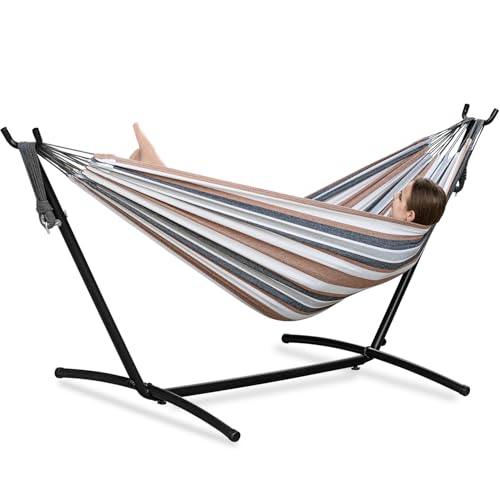
A. A freestanding hammock stand eliminates the need for trees and lets you hang a hammock in your backyard or a campground with no suitable trees. A standalone stand costs $60 to $120 new, though used options run cheaper. At that price, a $50 hammock plus a $100 stand puts you at $150 total. For car camping or backyard use, it works. For backpacking, the stand weight (8 to 12 pounds) makes it impractical unless you have a group splitting the load.




Write Your Review
No reviews yet. Be the first to share your experience!