

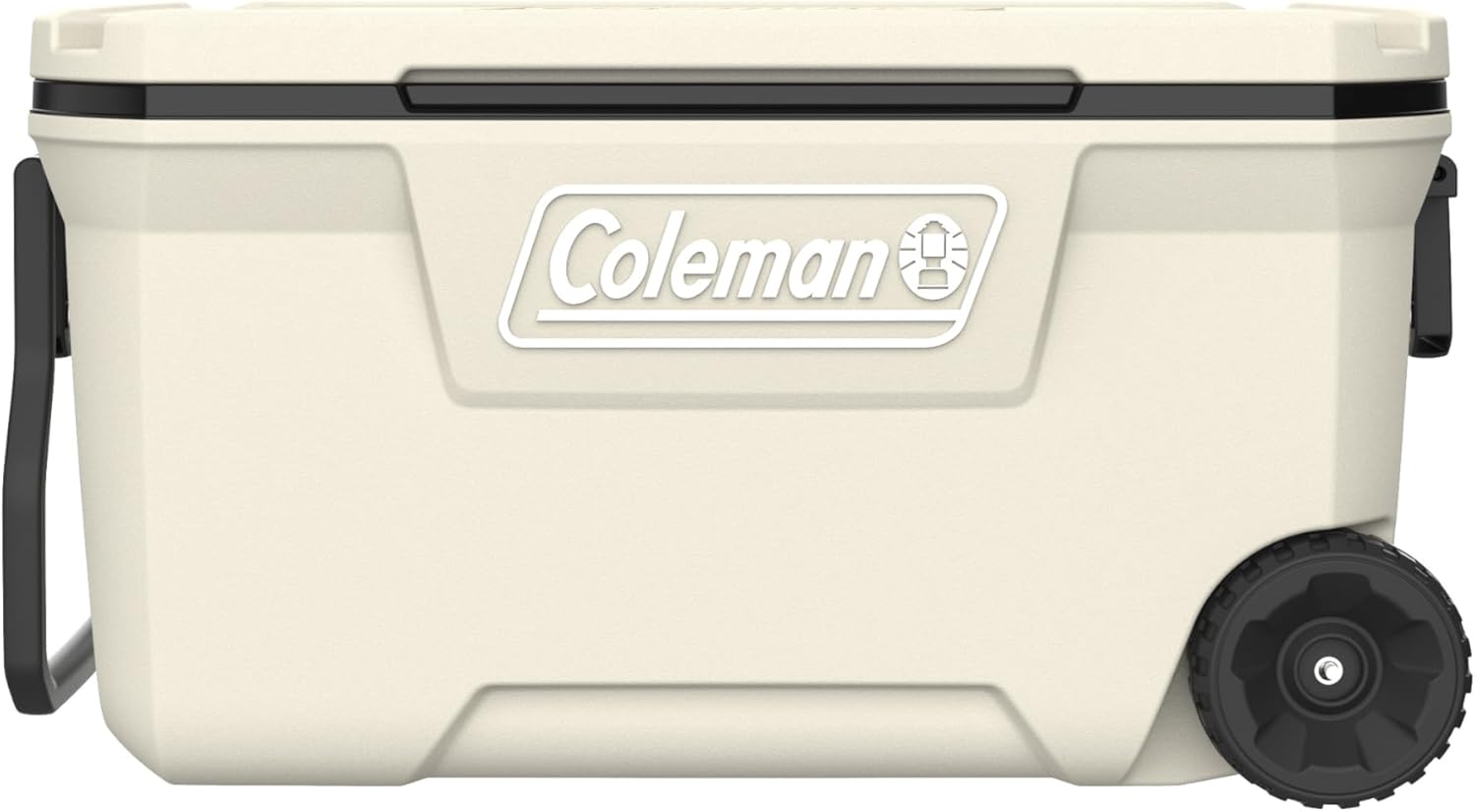
Coleman Classic Wheeled Cooler 80-Can
Wheeled hard cooler rated for five days of ice, built tough enough for family camping weekends with a lid that doubles as a seat.
Why we love it
- Six-inch wheels roll over gravel and grass
- Holds 80 cans with ice for a full weekend
- Lid seats 250 lbs, becomes extra camp seating
Pros
- All-terrain wheels for rough ground
- Tethered drain plug stays attached
- Molded cup holders keep drinks secure
- Hard shell lid rated for 250 lbs
- Dual tow and swing-up handles
Cons
- Heavy when loaded with ice
- Wheel performance varies in deep sand

Coleman Marine 52qt Cooler
Solid hard cooler rated for three days of ice in heat, with a lid you can sit on and cup holders molded right in.
Why we love it
- Fully insulated lid and body rated for 3 days
- Swing-up handles and seat-rated lid ease camp moves
- Cup holders and odor-resistant liner built in
Pros
- Rated for three days of ice retention
- Seat-rated lid supports up to 250 pounds
- Molded cup holders prevent spills
- UVGuard coating resists sun damage
- Swing-up handles for easier carrying
Cons
- Standard hard cooler, not rotomolded
- Heavy when fully loaded

Coleman Chiller 30-Qt Hard Cooler
Solid mid-size cooler for weekend trips with real ice retention and a handle that won't quit when it's full.
Why we love it
- Rated 48 hours ice retention in heat
- Reinforced lid doubles as campsite seating
- Wide grip handle carries full load easily
Pros
- TempLock foam insulation
- Holds 25 cans with ice
- Reinforced lid seats 200 lbs
- Made in USA, 130+ year brand
- 5.8 lbs empty, light to load
Cons
- Plastic construction less durable than rotomold
- No drain plug listed

Igloo Marine Ultra 54 Qt Cooler
Stainless steel hardware and UV-resistant shell handle the high desert sun. Holds ice through a hot weekend without leaking in the minivan.
Why we love it
- Stainless hinges and latches survive salt, sun, and sand
- Non-slip handles grip wet hands on trail or boat
- Fits 76 cans, sized right for a family weekend
Pros
- Stainless steel hinge and lid strap
- UV inhibitors protect from sun damage
- Hybrid latches balance durability and seal
- Non-slip swing handles
Cons
- Heavy at 10.6 pounds empty
- Plastic snap latches wear over time

Titan Deep Freeze 16 Can Cooler
Zipperless lid and a removable hard liner make this soft cooler practical for family weekend trips where the lid opens constantly.
Why we love it
- Flip-open lid beats wrestling a zipper with two kids
- SmartShelf keeps sandwiches from getting crushed
- Shoulder strap actually comfortable when loaded full
Pros
- Zipperless flip-open lid design
- Removable hard liner and SmartShelf
- Leak-proof interior contains spills
- Padded shoulder strap for carrying
- Wipes clean easily after trips
Cons
- Soft cooler, ice retention limits multi-day trips
- 16-can capacity tight for family of four
What Gets Cut at This Price
Finding best coolers under $100 means understanding what manufacturers save on to keep the cost down. The picks above span the full range of that budget. Most use foam insulation instead of rotomolded construction. Latches tend to be plastic where premium boxes use stainless steel. Gasket quality varies. None of these boxes will keep ice for a week the way a $300 cooler might, but several will hold it for a full weekend trip if you pack smart and keep the lid closed between meals.
The real difference at this price point isn’t between a good cooler and a bad one. It’s between matching the right box to your actual trip. A four-person day hike needs something completely different from a week-long base camp. Buying too much cooler wastes money and space. Buying too little guarantees a hot afternoon and disappointed kids.
Entry tier: the working cooler
At the bottom of this budget, you get basic foam insulation, simple plastic latches, and drain plugs that are prone to leaking if you’re not careful. The Coleman Chiller sits here. It holds ice for up to 48 hours and weighs just 5.8 lbs empty. You’re buying durability and practicality, not premium insulation. These boxes work for lunch coolers, day trips, and short weekends where you’re not counting on ice retention as your primary defense against heat.
Middle tier: the weekend box
Moving up a bit, you get better gasket design, reinforced latches, and foam that actually performs in real heat. The Coleman Marine Cooler keeps ice for 3+ days and adds odor-resistant liner treatment. The Igloo Marine Cooler uses UV inhibitors to protect against sun damage. These are still foam boxes, but they’re engineered to survive actual fishing trips, boating days, and high-desert weekends where sun exposure matters.
At the ceiling: capacity meets retention
Right at the $100 mark, the Coleman Classic Series Rolling Cooler holds ice for up to 5 days and fits 80 cans with ice. You’re paying for wheel assembly, dual handles, and the engineering to support 250 lbs on the lid. It’s heavier and bulkier than entry-tier boxes, but for a family camping trip where the cooler stays at camp, the trade-off makes sense.
Most ice retention claims are tested sealed and unopened. Real camping means opening the lid 20 times a day.
Gasket and Drain: The Real Failure Points
I have watched more coolers fail at the gasket and drain than at the insulation. The gasket is the rubber seal around the lid. It compresses over time, especially in the cold. A broken gasket means meltwater leaks into the vehicle. A drain plug that pops loose means the same thing, only worse because you don’t notice it until everything is soaked.
Gasket durability at this price
Entry-tier boxes often have gaskets that get brittle in freezing temperatures or harden in the sun. At this budget level, you’re not getting the premium elastomer compounds that stay flexible year-round. Pre-chill your cooler in a refrigerator the night before, not in a freezer. Freezing the gasket makes it crack easier when you close the lid. Also, never store a closed cooler in the garage during winter. Leave the lid cracked so the gasket doesn’t stay compressed for months.
Drain plugs that actually stay attached
Cheap drain plugs get lost. I have seen them disappear into coolers at camp, into truck beds, into gravel parking lots. The tethered drain plug on the Coleman rolling models is better than the loose kind, but even tethered plugs leak if they’re not screwed in tight. Before every trip, test the drain by pouring water in. If it drips, pull the plug out, clean the threads with a dry cloth, and reseat it. A little silicone grease on the threads helps too.
When Ice Retention Claims Don’t Match Reality
Manufacturers test ice retention sealed, unopened, in controlled lab conditions. No sunlight. No heat spikes. No kids opening the lid every ten minutes. That 48-hour claim on the Coleman Chiller assumes you buy a cooler, pack it with ice, and don’t touch it. Real camping is different. Every time the lid opens, you lose cold air. High-desert sun heats the exterior. Warm food goes in. A food thermometer reading of 40 degrees Fahrenheit is the safe threshold. Most boxes at this price will hold that threshold for 2 to 3 days if you keep the lid closed between meals and pre-chill everything first.
Pre-chilling is not optional
Spend the night before a trip with your cooler in the refrigerator, fully packed with ice and food. The insulation needs to start cold. A cooler at room temperature has to absorb all that heat before it can protect your food. On a hot high-desert weekend, a pre-chilled box will stay below 40 degrees through day two. A room-temperature box will fail by day one afternoon.
Block ice outlasts cubes
Cubed ice melts faster because it has more surface area. Block ice, or large ice chunks, melts slower and lasts longer. Buy one or two large blocks instead of bags of cubes. If your store doesn’t sell blocks, freeze water in milk cartons and use those. The ratio matters too. A cooler packed half ice and half food won’t keep things cold as long as a cooler packed two-thirds ice and one-third food. That extra ice mass absorbs heat and keeps the temperature down.
Keeping the lid closed for just one hour longer changes whether your food is safe or not by day three.
Sizing for Your Trip
A 16-can cooler (like the Titan backpack model) handles lunch for a family of four. A 25-can cooler gets a family through a day hike or a short car trip. A 45 to 80-can cooler is a base camp box for overnight trips. The Coleman rolling cooler at 167 cans is for a week-long family expedition or a large group. Bigger is not always better. A cooler that’s too large takes up vehicle space and never fully fills, leaving air pockets that waste ice. A cooler that’s too small forces you to open it constantly searching for space, which costs you cold.
The ice-to-contents math
Assume two-thirds of your cooler will be ice and one-third will be food and drinks. A 30-quart box gives you 10 quarts of actual storage space. That’s roughly enough for 4 days of supplies for one person, or 2 days for a family of four. If you’re planning a 5-day trip for a family, pack two coolers or buy a 60-quart model. One cooler is always insufficient once you factor in the ice.
Tips
- Pre-chill the night before. A cold cooler stays cold. Room temperature boxes waste ice.
- Use block ice, not cubes. One large block outlasts bags of cubes by a full day.
- Pack food first, ice last. This keeps the cold against your drinks and perishables where you need it.
- Test the drain plug before every trip. Leaks ruin vehicles. Tighten it until snug, not until it strips.
- Leave the lid cracked when storing. Gaskets that stay compressed year-round harden and fail faster.
- Keep the cooler out of direct sun at camp. Even foam insulation can’t fight four hours of high-desert heat beating down on the lid.
FAQ
Will a cooler under $100 actually keep ice for the number of days claimed?
Not if you open it like a family does. Manufacturers test sealed and unopened. Real ice retention is 2 to 3 days in hot weather if you pre-chill, pack smart, and minimize lid opens. A 5-day claim means you can go 5 days if conditions are cool, the box stays shaded, and you barely touch it. That is not a typical camping scenario.
Can I use a soft cooler instead of a hard box for the same trip?
Soft coolers keep ice cold for hours, not days. They’re ideal for day trips and lunch coolers. For overnight trips and base camps, a hard box is more reliable. Soft coolers also take up the space they hold, while hard boxes maintain their footprint whether full or empty.
What happens if the drain plug leaks inside my truck?
Meltwater pools under the cooler and soaks into seats and carpeting. It causes mold and rust. Before every trip, pour a cup of water into an empty cooler and watch the drain for 30 seconds. If it drips, clean the plug threads and reseat it.
Is it safe to leave food in a cooler overnight without ice?
Not above 40 degrees Fahrenheit. If your cooler warms above that threshold, bacteria grow. For overnight trips, add fresh ice at dinner or sleep with the cooler closed and sealed. If you’re in cool weather (below 50 degrees), you can skip ice overnight, but in summer heat you need it continuously.
Do I need to buy the same brand cooler for the next size up?
No. Pick based on the specs and your trip, not brand loyalty. Coleman, Igloo, and Arctic Zone all make solid boxes at this price. What matters is whether the box fits in your vehicle, handles your trip length, and has latches that won’t crack after a season of use.
Can I dry ice in a foam cooler?
Never use dry ice in a soft cooler or a cooler with a rubber gasket. Dry ice is much colder than regular ice and will crack the gasket and damage plastic components. Some hard coolers can handle it, but check the manufacturer specs first. Dry ice also requires ventilation because it produces carbon dioxide gas.




Write Your Review
No reviews yet. Be the first to share your experience!