

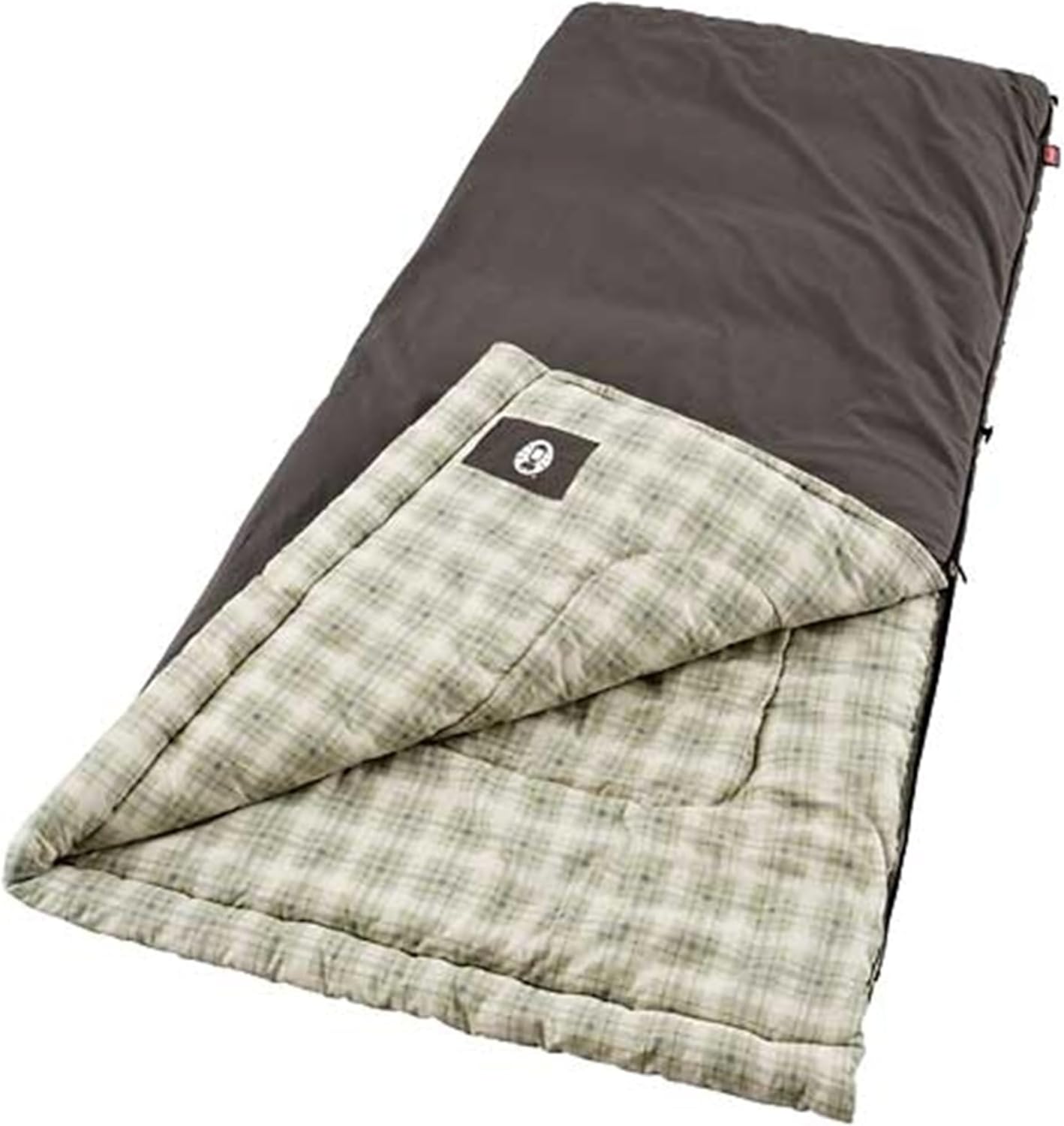
Coleman Heritage Big & Tall 10°F Bag
Roomy XL bag rated to 10°F with flannel comfort; machine washable and built tough for family camping.
Why we love it
- Fits tall adults or two kids bundled close
- Flannel liner beats scratchy nylon on skin
- Machine washable beats campfire smell
Pros
- 5 lbs Holofill insulation traps heat
- Flannel liner instead of cheap nylon
- No-snag zipper holds up to kids
- Machine washable for easy cleanup
- XL size fits adults up to 6'7"
Cons
- Heavy for backpacking trips
- Rectangular cut wastes heat around edges

BISINNA XXL 3-Season Sleeping Bag
Roomy rectangular bag that fits big adults and handles family camping without fussing over packed size or weight limits.
Why we love it
- Envelope cut gives real shoulder room for side sleepers
- Synthetic fill stays warm even when slightly damp
- Machine washable after muddy trips with the kids
Pros
- Roomy 90x39 inch interior
- Lightweight at 3.4 pounds
- Water-repellent shell
- Includes compression sack
- Synthetic fill dries quickly
Cons
- Rated to 50F extreme, plan layers below
- Bulky when packed for backpacking

Kelty Tru.Comfort Doublewide 20F
Two-person bag that actually fits kids without overheating the adults. Wide, removable top layer, and durable enough for minivan camping trips.
Why we love it
- Removable top layer lets you dial warmth
- Wide enough for a kid to crash between you
- Synthetic fill dries fast after damp trips
Pros
- Queen-width interior with 84 inches length
- Removable zip-off top layer for temperature
- Two-way foot vents customize comfort
- Machine-washable synthetic insulation
- Oversized hood fits two standard pillows
Cons
- Heavy at 9 lbs 8 oz for backpacking
- 20F rating is limit, not comfort zone

Coleman Big Basin 15°F Sleeping Bag
Roomy bag built for car camping with kids, keeps warmth in when it matters and handles wet gear without falling apart.
Why we love it
- Adjustable hood and draft collar trap heat on cold mornings
- Machine washable for quick cleanup after muddy trips
- Room to move around without sacrificing warmth retention
Pros
- ZipPlow snag-free zipper
- Double-batt offset quilt construction
- Fleece-lined footbox for extra warmth
- Two-way zipper for temperature control
- Ripstop cover resists wear and tears
Cons
- Bulky packed size for backpacking trips
- Runs on the heavier side for frequent hiking use
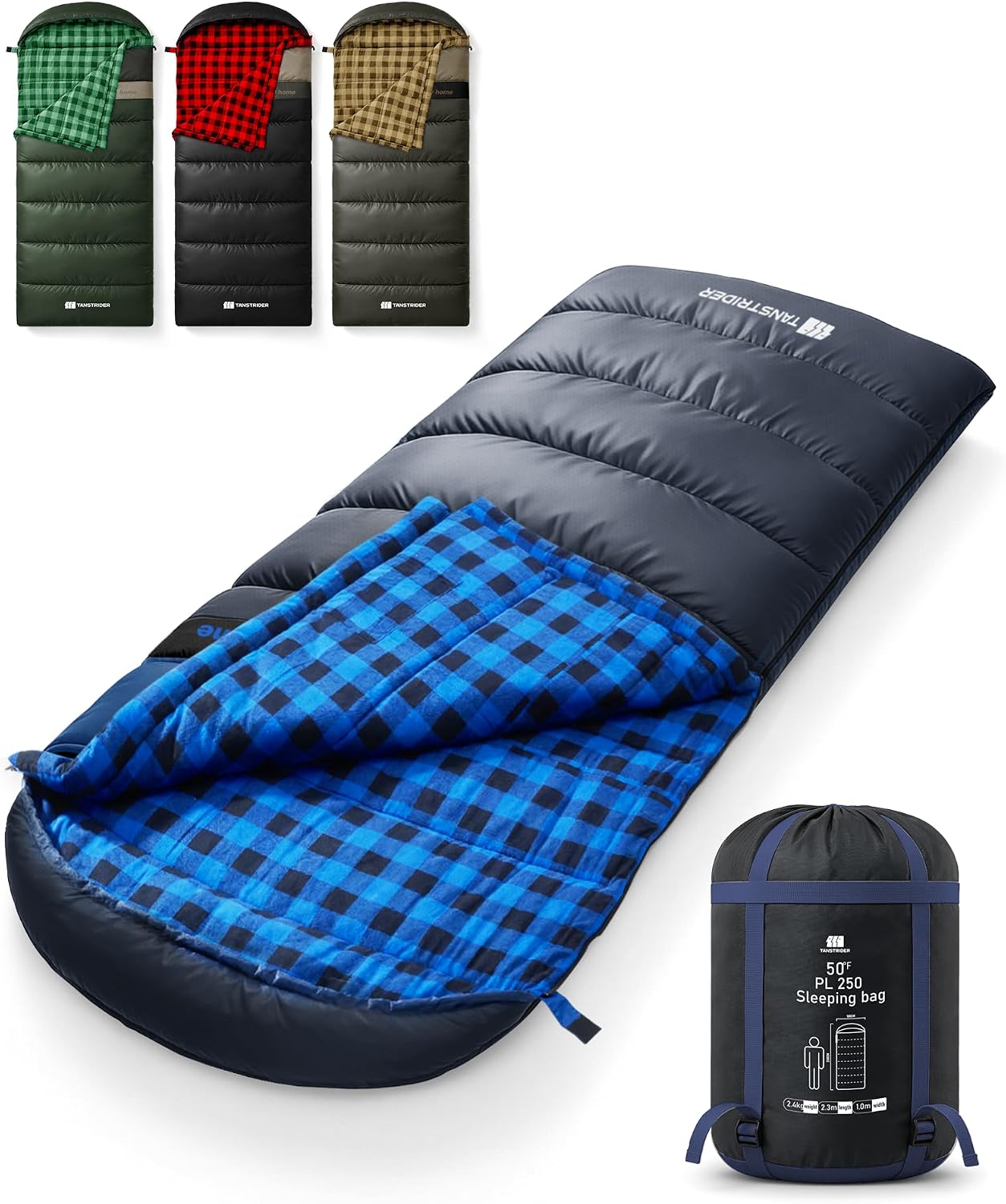
TANSTRIDER XXL Flannel Sleeping Bag
Oversized rectangular bag with flannel lining and machine-washable construction, built for side sleepers and families who want comfort over ultralight specs.
Why we love it
- Unzips flat to double as a picnic blanket or tent mat
- Flannel lining stays warm and soft through shoulder-season trips
- Machine washable, so campfire smell washes right out
Pros
- Generous 90x39 inch rectangular design
- Two-way zipper for foot ventilation
- Waterproof polyester exterior shell
- Flannel lining for comfort
- 5.3 lb carry weight for car camping
Cons
- 40-50°F rating limits winter use in cold climates
- Rectangular cut is bulkier than tapered mummy bags

VENTURE 4TH 3-Season Sleeping Bag 30F
Rectangular 3-season bag that handles frosty state-park nights and survives getting stuffed wet into the minivan. Solid choice for family camping.
Why we love it
- Two-way zipper lets kids adjust warmth
- Water-resistant shell dries fast after damp trips
- Rectangular cut gives more room than mummy bags
Pros
- 30F temperature rating for shoulder season
- Water-resistant polyester shell
- Two-way zipper for temperature control
- Machine washable synthetic fill
- Includes compression sack
Cons
- Heavy for backpacking trips
- Synthetic fill bulkier when packed
Room to Stretch Matters More Than You Think
Best wide sleeping bags solve a problem that standard-cut bags ignore: shoulder room and hip space. A tight bag that crushes your hips or pins your arms traps dead air where your body should radiate heat into insulation. That wasted space makes the bag perform worse than its rating, and you spend half the night adjusting position instead of sleeping. Wide bags fix this at the source.
Most of the picks here run 39 to 40 inches wide at the shoulders, compared to 32 to 35 inches in a standard rectangular. That is the difference between rolling in your sleep and lying rigid. The extra girth also means the insulation stays lofted across the full width, not compressed where your body contacts the fabric.
Interior Width and Shoulder Girth
Width alone does not guarantee comfort. A bag might measure 39 inches inside but taper sharply at the shoulders, or maintain that width but feel loose around the feet. The VENTURE 4TH Backpacking Sleeping Bag for Camping – Single, XXL & Double maintains its 39-inch measurement from shoulders to feet, which matters for side sleepers who move. The Cotton Flannel XXL Winter Sleeping Bags for Adults Big and Tall runs 39.4 inches and stays consistent too. Both are designed for active sleepers, not just bigger frames.
Insulation Type and Temperature Reality
Synthetic insulation dominates this list because it handles the moisture wide bags accumulate. A wider bag traps more vapor from your breath and skin. Synthetic does not lose loft when damp, which is critical for Pacific Northwest camping. The VENTURE 4TH uses hollow-fiber fill rated for 30 to 70 degrees Fahrenheit, a three-season range. Down bags like the Coleman Heritage Big & Tall 10-Degree Flannel Sleeping Bag exist in this list too, but they demand drier conditions and more careful storage between trips.
Rectangular Design and Thermal Efficiency
Wide bags stay rectangular because that shape delivers the width. A mummy cut narrows at the feet and shoulders to trap heat, but it also compresses the insulation where you need width most. Rectangular bags let warm air move freely inside, which sounds wasteful but actually works when the bag is paired with a quality sleeping pad. The pad blocks ground cold, and the bag’s full loft around your body does the job. You lose some efficiency, but you gain comfort and usability.
Weight and Packed Volume
Wide bags weigh more and pack larger than mummy cuts because there is simply more fabric and more insulation. The Cotton Flannel XXL carries 5.3 pounds; VENTURE 4TH in XXL runs around 3.5 pounds. If you car-camp or base-camp, weight is irrelevant. If you backpack, wide bags work best on trips where comfort trumps pace, like family hiking or weekend mountain stops where you stay in one place. Choose accordingly.
A wide bag that maintains consistent shoulder-to-foot width beats a narrow bag with a stitched gusset every time.
Interior Dimensions and How to Measure Fit
A bag is only comfortable if it actually fits your frame. Specs are honest, but they measure flat on a table, not on a person moving inside at 2 a.m. Check three zones before buying: shoulder width when your arms are at your sides inside the bag, hip width at your widest point, and foot room so your toes do not jam the toe box.
Lay the bag on a bed and climb inside at full length. If your shoulders touch both sides, it is too narrow. If there is more than a hand-width of space on either side of your body at the hips, it is too wide and will not trap warmth efficiently. Tall sleepers should measure from heel to crown. Most bags top out at 84 inches; some run 90 inches. The extra 6 inches matters if you are over 6 feet 2 inches.
Testing Fit at Home Before the Return Window Closes
Unpack the bag in your bedroom and sleep in it for a full night before committing. Do this even if the return window is only 30 days. Your real sleeping position comes out at hour four, when your body settles and pressure points emerge. Lie on your side, the way you actually sleep outdoors. Feel whether the bag supports your hip or lets it sink into the padding. Try rolling onto your back. Check if the hood seals around your face without pressing on your nose. If it does, the bag is too narrow.
Paired Sleeping Pad and Temperature Reality
A wide bag cannot deliver its temperature rating without the right sleeping pad underneath. The pad blocks cold radiating from the ground. An R-value of 2.0 to 3.0 handles three-season camping in the Cascades. For 10 to 15-degree bags, jump to R-value 4.0 or higher. A temperature rating assumes you are on a pad with R-value 3 or better. Without that, a three-season bag becomes a summer bag, and a 20-degree bag becomes a 35-degree bag. Check the manufacturer specs; most state the assumed R-value.
Lay the pad and bag together on your camping surface at home. Climb in and feel for cold spots where your body touches the ground without padding. High-loft bags handle thin pads better than low-loft bags because they maintain insulation thickness. Wide bags sometimes roll off a narrow pad, so pair them with pads at least 25 inches wide. Inflatable pads are more stable under a wide bag than closed-cell foam.
Your sleeping pad matters as much as the bag itself. Skip the pad upgrade and no bag rating will save you.
Washing and Long-Term Storage for Your Setup
Wide bags accumulate dirt and odor faster because they trap more vapor. Cotton liners and flannel shells absorb sweat. Machine wash on a gentle cycle if the care tag allows it. Most synthetic bags in this list are fully machine washable. Dry flat or in a commercial dryer on low heat. Never compress a bag for more than a few months at a time. Compressed insulation does not fully reflate after long storage, especially down. Hang it on a rod or lay it uncompressed in a mesh bag between seasons.
Down bags demand hand washing or a professional cleaner after heavy use. Holofill and other synthetics forgive washday mistakes and come clean quickly. If you camp 20 to 30 times per season, plan to wash the bag twice annually. A compressed, unwashed bag can lose 10 to 15 percent of its effective warmth within a year.
Questions I Get Asked
Why does a wider bag feel warmer if it has more air inside?
It does not have more dead air. It has more usable space where your body sits inside the insulation. A tight bag forces your shoulders to compress the fill, reducing its loft by 20 to 30 percent. A wide bag keeps that loft intact around your whole body, so the insulation works at full capacity. The tradeoff is that you need a good sleeping pad to block ground cold, because a wider bag cannot wrap tightly around the edges.
Can I use a best wide sleeping bag in summer?
Yes, if it is a three-season rating like the VENTURE 4TH. Open the full two-way zipper and sleep on top of the bag. The 30 to 70-degree range covers July and August on most Pacific Northwest mountains. If the bag is 10 or 15-degree rated, it is too warm for summer and will feel clammy if you try to vent it. Save cold-rated bags for cold seasons.
What is the difference between XXL and regular wide bags?
XXL bags typically add 3 to 5 inches of width and run 4 to 6 inches longer. They are built for people over 6 feet tall or those who need more hip and shoulder clearance. A regular wide bag at 39 inches works for most adults up to 6 feet 2 inches. Beyond that, XXL prevents pressure points and gives you actual room to shift position without compressing the insulation.
Do temperature ratings account for a wider interior?
No. The rating assumes a standard rectangular shape. A wide bag maintains that rating if you pair it with the right sleeping pad, but the larger interior means slower warm-up. You and the insulation need a few minutes longer to reach equilibrium. Climb into a wide bag 15 minutes before sleep, not five minutes before. The rating is achievable; the path there just takes longer.
What happens when you compress a down wide bag for months?
The down clusters never fully re-loft. You regain maybe 70 to 80 percent of the original loft after a good wash and dry. That lost 20 to 30 percent becomes a permanent reduction in warmth. Synthetic bags bounce back to full loft, which is one reason they dominate this list for people who store bags in closets year-round.
Can I couple two wide bags together?
Only if both zippers align on the same side and the bag model is designed for coupling. Most wide bags do not have coupled zippers because the wider format makes coupling difficult. Check the product specs before assuming you can zip two together. If you want a couple bag, the Kelty Tru.Comfort Doublewide is built for exactly that use.


Write Your Review
No reviews yet. Be the first to share your experience!