

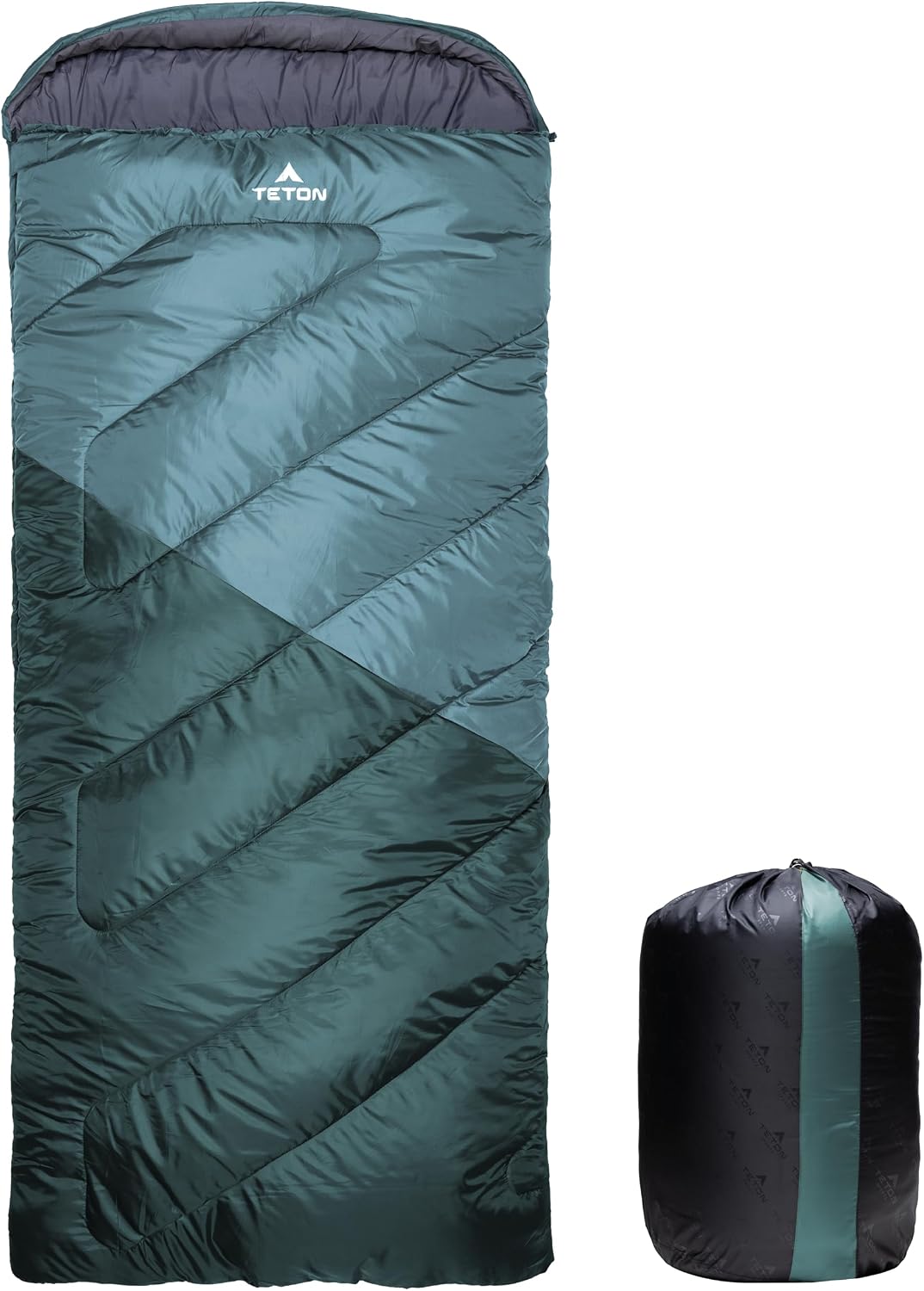
Naturehike Lightweight 32F Sleeping Bag
Ultra-compact synthetic bag that packs down small enough for a kid's backpack and handles damp Pacific Northwest conditions without getting soggy.
Why we love it
- Compresses to grapefruit size for tight minivan packing
- Synthetic fill stays warm when damp, unlike down
- Lightweight enough kids can carry their own bag
Pros
- Ultra-compact compression sack included
- Lightweight synthetic fill machine washable
- Roomy 80x33 inch cut fits growing kids comfortably
- Durable double-reinforced seams hold up to rough packing
Cons
- 32F comfort rating runs cold on frosty nights
- Synthetic bulk doesn't match true backpacking bags

Naturehike CW295 Down Bag 42F
Ultralight 650-fill down bag that packs to the size of a water bottle, rated for spring and fall nights without the ultralight-solo-hiker price tag.
Why we love it
- Weighs 1.3 lbs, fits anywhere in the minivan
- 650-fill down compresses to fist size, expands fluffy
- RDS certified down stays ethical and loft-rich
Pros
- 650-fill down insulation
- Individual down channels prevent shifting
- Water-repellent shell fabric
- Two-way YKK zipper zips to a second bag
- Ultralight at 1.3 pounds
Cons
- Rated limit temp, not comfort zone
- Down loses loft if it gets damp

QEZER 600 Fill Down Bag 45F
Lightweight down bag rated for shoulder-season camping. Good packability, but temperature limit means layering on chilly nights.
Why we love it
- Packs to fist-size for car or kid backpack
- 600-fill down compresses small, stays light
- Mummy cut with wide foot box, less cramped
Pros
- 600-fill down insulation
- Compact 1.61 lb packed weight
- Wide trapezoidal foot box
- Dual zippers, couples mode
- Tear-resistant nylon shell
Cons
- 45F comfort, 36F limit only
- Down loses loft when damp

iClimb 3M Thinsulate 32F Mummy Bag
Lightweight synthetic mummy bag that keeps kids warm on frosty nights and survives wet minivan trips without fussing over down.
Why we love it
- Synthetic fill stays warm even when damp
- Only 2.4 lbs, packs to the size of a loaf
- Machine washable, survives family camping chaos
Pros
- 3M Thinsulate synthetic insulation
- Draft collar and footbox design
- Ultralight at 2.4 pounds
- Two-way YKK zippers
- Fits people up to 6 feet 10 inches
Cons
- 32F limit rating, not comfort
- Synthetic bulk compared to down

NewDoar Ultralight 50-70F Bag
Lightweight summer bag that zips to a double and actually packs small enough for a kid's backpack.
Why we love it
- Zips together with a second bag for family warmth
- Only 1.5lbs, stuffs into a minivan or kid pack easily
- Machine washable after damp trips and sandy campsites
Pros
- Two-way zipper for venting or doubling up
- Includes compression sack for tight packing
- Lightweight for teens and smaller adults
- Unzips flat as a summer blanket
Cons
- 50F comfort rating is warm weather only
- Not insulated for shoulder-season mountain trips

BORULL Ultralight 50F Sleeping Bag
Lightweight rectangular bag that packs small and keeps kids warm on cool nights without breaking the bank.
Why we love it
- Packs to soccer ball size, fits anywhere in the van
- Machine washable fill handles wet gear and repeat trips
- Roomy 79 inches fits growing kids comfortably
Pros
- Ultralight at 1.5 pounds
- Whole-piece continuous fill stays distributed
- Dual-side zipper with auto-lock
- Affordable entry bag for families
- Machine washable synthetic fill
Cons
- Limited warmth below 32 degrees
- Not ideal for serious backpacking trips
What Ultralight Actually Costs You
The gap between a best ultralight backpacking sleeping bag and a standard bag is not just the ounces you save. Every gram you drop means a choice: thinner shell fabric that tears easier, narrower temperature range, less durable zippers, or fill that compresses harder and recovers slower. After 14 years of packing bags damp, watching down clump, and helping friends buy the wrong rating for the season they actually camp in, I have learned that ultralight is a trade. You get weight. You give up something else.
The bags above all pack under 2.5 pounds and stuff to the size of a loaf of bread or smaller. But they are not all built the same. Some use synthetic fill that bounces back after compression. Others use down that needs careful storage. Some fit tall people. Others are narrow and suit only average builds. The picks here show what ultralight looks like at different price points and with different compromises.
Packed Size Versus Usable Weight
A bag that weighs 1.5 pounds but packs to 11 inches long and 6 inches wide takes up less backpack volume than one that weighs 1.8 pounds but compresses to 5 inches by 10 inches. The Ultralight 1.5lbs Sleeping Bag 50-70°F for Warm Weather hits 1.5 pounds and packs to 11.8 by 6.5 inches. The Lightweight Compact Adult Sleeping Bag for Backpacking, Camping & Hiking also weighs 1.5 pounds but compresses to just 7.9 inches. Both matter. One saves weight on the scale. The other saves space in the pack. Know which one you need before you buy.
Down Versus Synthetic in Ultralight Form
Down compresses harder than synthetic. A 650 fill power down bag like the Naturehike Ultralight Backpacking RDS Down Sleeping Bag for Adults, 650 Fill Power at 1.3 pounds will pack smaller than a synthetic bag of the same weight, but it loses loft when wet and needs dry storage between trips. Synthetic bags bounce back after months in a stuff sack and handle damp better. The iClimb 3M Thinsulate bag uses synthetic and weighs 2.4 pounds, heavier than down but durable and forgiving. If you camp in the wet Pacific Northwest, synthetic wins. If you camp in dry high desert and can store carefully, down saves ounces.
Temperature Rating and What It Actually Means
A 50-degree comfort rating does not mean the bag keeps you warm at 50 degrees. It means an average sleeper in a base layer, on a sleeping pad with an R-value of 2 or higher, stays warm at that temperature without shivering all night. Below that number is the limit rating, where survival is possible but sleep is not. The NewDoar bag claims 50 to 70 degrees comfort and works for warm weather. The Naturehike down bag claims 42 degrees comfort and 6 degrees limit, making it a three-season bag. If you mostly camp in summer, a narrow range saves weight. If you camp spring through fall, you need wider range or you will buy two bags.
Shell Durability and What Gets Cut
Ultralight bags use 20-denier nylon or thinner. That is half the thickness of a standard backpacking bag. It tears on sharp objects and wears through faster at the foot and shoulder. The BORULL bag uses 20-denier nylon and includes dual-side zippers with auto-lock to prevent accidental snags. The Naturehike down bag uses 20D400T nylon, which is slightly heavier but more durable. Check the denier number and inspect the seams in photos. Lower denier saves weight but means you handle the bag more carefully and retire it sooner.
Ultralight is not lighter if you have to replace it twice as often.
Fill Power, Loft Recovery, and Actual Warmth
Fill power measures how much space one ounce of down or down-alternative occupies. A 650 fill power down bag holds more air per ounce than a 600 fill power bag. But fill power is only part of the story. How much down is actually in the bag matters just as much. The Naturehike down bag uses 295 grams of 650 fill power down. The QEZER down bag uses 14.11 ounces (about 400 grams) of 600 fill power down. The QEZER bag has more total down, so it is warmer, but also heavier. The Naturehike bag is lighter because it uses less fill but higher quality down.
After a season of compression in a stuff sack, down loses loft. Synthetic does not. If you compress a down bag for months without airing it out, the down stays somewhat clumped when you unpack it. You have to spread it out and let it breathe for hours to restore full loft. Synthetic bags like the iClimb 3M Thinsulate bag recover loft immediately when unpacked. For a backpacker who packs the bag tight and moves on, this matters less. For a car camper who stores a bag compressed all winter, synthetic is easier.
Real Weight Matters When Every Ounce Counts
A 1.3 pound down bag saves a full pound over a 2.4 pound synthetic bag. Over a week long trip, that is seven pounds less to carry. Over a two week trip, it is fourteen pounds. But the down bag is narrower in temperature range and needs more careful storage. The synthetic bag is heavier but works in wet conditions and forgives poor storage. If you hike long distances and camp light, the ounces add up. If you camp close to the car or in established campsites, the weight difference matters less than durability.
The BORULL and NewDoar bags both hit 1.5 pounds, which is the sweet spot for many backpackers. Light enough to feel the weight savings, heavy enough that the shell is not tissue thin. The Naturehike down bag at 1.3 pounds is ultralight but requires down-specific care. The iClimb synthetic bag at 2.4 pounds is the heaviest here but the most forgiving.
Ultralight saves you weight on the trail but costs you durability at home.
Matching the Bag to Your Actual Trip
Before you buy, write down the three trips you take most often. What season? What elevation? What is the overnight low temperature you actually see, not the worst case you might encounter. A bag rated 50 degrees comfort works for summer car camping and three season backpacking in the Cascades. A bag rated 42 degrees comfort works for spring and fall. A bag rated below 20 degrees is overkill for most Pacific Northwest camping and adds weight you do not need.
Check the interior dimensions too. The BORULL bag is 79 inches long and 30 inches wide. The Naturehike down bag comes in short (74.8 inches) and medium (78.74 inches) sizes. If you are over 6 feet tall, the short size will cramp your feet. If you sleep on your side and roll around, a 30 inch width is tight. Lie down in the bag at a store if you can, or order from a retailer with a good return window and test it at home first.
Pair the bag with a sleeping pad that matches its temperature rating. A bag rated 42 degrees needs a pad with an R-value of at least 2.5 to 3. A pad with R-value 1.5 will let cold air underneath and make the bag feel 10 degrees colder than rated. If you sleep cold, add a liner or wear more layers inside. If you sleep hot, an ultralight bag with full unzip capability lets you open it like a blanket.
Tips From the Trail
- Store it uncompressed between trips. Hang it in a closet or lay it flat in a storage bag. Compression for months at a time breaks down the fill, especially down, and the bag never fully recovers loft.
- Wash it by hand in cool water. Machine washing can strip the water repellent coating on the shell and damage seams. Use mild detergent and rinse until the water runs clear. Dry it flat or hang it in a warm room, never in direct sun.
- Test the fit at home before a trip. Lie in the bag on your sleeping pad in your bedroom. Roll around. Check that the draft collar closes tight around your neck and the zipper runs smoothly. A problem found at home is easy to fix. A problem found on the trail costs you sleep.
- Inspect the shell before packing. Run your hands over the seams and the foot box. Feel for small holes or tears. A pinhole in ultralight nylon can grow into a rip with one night of use. Patch it at home with seam sealer and ripstop tape.
- Ventilate down bags after unpacking. If a down bag has been compressed for weeks, unpack it and hang it in a warm room for a few hours before use. The down will fluff up and the bag will be warmer.
- Use a compression sack only for transport. Pack the bag into its sack for the drive to the trailhead. Unpack it as soon as you arrive at camp. Do not leave it compressed overnight.
Common Questions
Does a temperature rating guarantee I will sleep warm?
No. The rating assumes you are wearing a base layer, on a sleeping pad with adequate R-value, in still air, and not moving around. If you sleep in cotton pajamas, on a thin foam pad, or in a breezy tent, you will be cold at the rated temperature. The rating is a starting point, not a promise.
Can I use an ultralight bag year-round?
Only if you choose a bag with a wide temperature range and pair it with layers. A bag rated 42 to 70 degrees works for spring, summer, and fall if you add a liner in spring and fall. A bag rated 50 to 77 degrees is summer only. Check the specs before buying.
What is the difference between fill power and total down?
Fill power is how fluffy the down is per ounce. Higher fill power means more air per ounce, so you need less total down to reach a target warmth. Total down is the actual weight of down in the bag. A bag with 300 grams of 650 fill power down is warmer than a bag with 200 grams of 650 fill power down, even though the fill power is the same. Check both numbers on the spec sheet.
How do I know if a packed size claim is realistic?
Packed size is measured when the bag is compressed by hand or in a stuff sack, not when it is loose. A bag that claims 10 by 7 inches packed will be that size when you squeeze it, but it will expand to twice that when you first unpack it and let it breathe. Do not expect a bag to pack smaller than the claimed size on the first trip. It takes a few compression cycles for the fill to settle.
Should I buy down or synthetic for the Pacific Northwest?
Synthetic is safer. The region is wet and unpredictable. Synthetic bags handle damp better and dry faster if they get wet. Down loses most of its loft when wet and takes days to dry. If you camp in dry seasons only and store carefully, down is lighter. If you camp year-round or in variable weather, synthetic is more forgiving.
Can I use an ultralight bag for car camping?
Yes, but you are wasting its design. Ultralight bags are built to save ounces at the cost of durability and comfort. In a car, you can carry a heavier bag that lasts longer and packs less carefully. Save the ultralight bag for trips where every ounce counts.


Write Your Review
No reviews yet. Be the first to share your experience!