


PTEROMY 3-Season Sleeping Bag
Machine-washable synthetic bag rated 50-80F, built for families who need warmth that survives the minivan and a real wash cycle.
Why we love it
- Machine washable, no loft loss after cleaning
- Two-way zipper lets kids ventilate when overheated
- Drawstring hood keeps small heads warm on frosty nights
Pros
- Machine washable synthetic fill
- Two-way zipper for temperature control
- Adjustable drawstring hood and neck
- Compact with included compression sack
- Velcro draft collar keeps heat in
Cons
- 50-80F comfort range limits cold-weather use
- Heavier than mummy bags for backpacking

ORTHOMTEX 3-4 Season Sleeping Bag
Rectangular bag that zips to a double and machine washes, built for family car camping and the occasional wet minivan trip.
Why we love it
- Zips to another bag for couples or kids
- Machine washable after muddy state park trips
- Unzips flat as a quilt on warmer nights
Pros
- Rectangular cut gives room for kids
- Two-way zipper for flexible venting
- Zips together with matching bag
- Machine washable synthetic fill
- Compression sack included
Cons
- 4 pounds is heavy for backpacking
- 32F rating is a limit, not comfort

MalloMe Sleeping Bag 50-80°F
Lightweight, waterproof sleeping bag that handles Oregon shoulder-season camping and fits kids and adults without the ultralight-backpacker price tag.
Why we love it
- Waterproof HEX-TECH shell sheds rain on wet dispersed camping trips
- Compression sack packs into minivan with all the other family gear
- Roomy enough for kids to sleep comfortable, not cramped
Pros
- Waterproof HEX-TECH outer shell
- Anti-snag zipper with no catches
- 3-pound weight, easy to carry
- Bottom zipper for foot ventilation
- Adjustable hood fits different sizes
Cons
- 50-80°F range limits cold mountain trips
- Polyester fill isn't down insulation

ECOOPRO Warm Weather Sleeping Bag
Budget envelope bag that fits two kids or an adult, rated for warm weather but genuinely compact for family car camping.
Why we love it
- Squeezes two small kids or one adult comfortably
- Rolls down to 11 inches, fits in the minivan easy
- Machine washable after muddy trail weekends
Pros
- Fits two children side by side
- Ultra-lightweight at 1.45 lbs
- Waterproof nylon outer shell
- Compresses small for tight packing
Cons
- 55-60°F rating limits shoulder-season use
- Thin material won't handle heavy abuse

SWTMERRY 3-Season Sleeping Bag 41-77F
Lightweight synthetic bag rated for spring through fall camping, machine washable and budget-friendly for family trips.
Why we love it
- Machine washable, no dry cleaning hassle
- Compact packed size fits minivans easily
- Budget price won't break the family fund
Pros
- Lightweight at 1.35kg
- Waterproof outer shell
- Double-filled synthetic insulation
- Includes compression sack
- Available in multiple colors
Cons
- Rated 41F limit, not true 3-season cold
- Bottom zipper design less secure
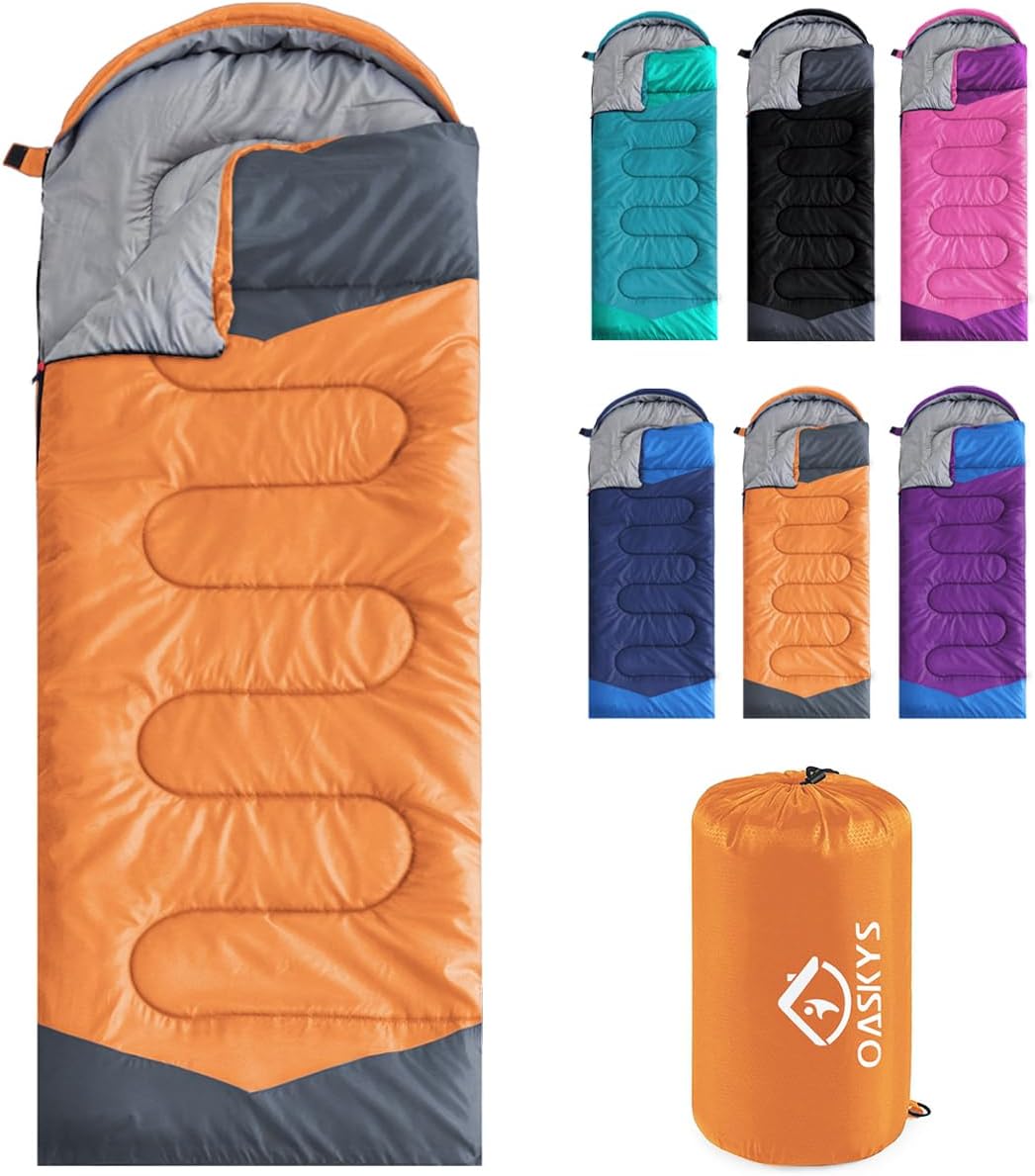
oaskys 3-Season Sleeping Bag 50-68F
Rectangular bag with two-way zipper and waterproof shell, solid for shoulder-season state park nights with kids.
Why we love it
- Two-way zipper converts to quilt for temp control
- Waterproof outer keeps dew and dampness out
- Compression sack fits easily in a packed minivan
Pros
- Two-way zipper for temperature regulation
- Waterproof 210T nylon outer shell
- Includes compression sack with straps
- Anti-snag zipper design
- Half-circle hood with drawstring
Cons
- Rated limit, not comfort range
- Bulky packed size for backpacking
What Temperature Rating Actually Means in June
Summer camping throws most sleeping bag buyers into the same trap. Best summer camping sleeping bags are not about the highest number on the tag. They are about matching the comfort range to the nights you actually sleep through. A 50-degree comfort rating sounds cold for July, but when you are at 7,000 feet in the Cascades or on the Oregon coast, that number is realistic. The mistake is buying a winter bag because it was on sale, then sweating through a midsummer trip with a bag rated for survival at 20 degrees.
Summer bags sit in a narrow window. Too much insulation and you overheat. Too little and a cool mountain night will keep you awake. The picks above share synthetic fill and lightweight shells because those materials handle moisture without clumping and pack small enough to carry on a three-day loop. What separates them is how honestly they rate their comfort zone.
Comfort Temperature Versus Limit Temperature
Manufacturers publish two numbers, and almost nobody reads the second one. The comfort rating is where an average sleeper stays warm without tossing around. The limit rating is survival, not sleep. A bag rated 40 degrees comfort is not the same as a bag rated 40 degrees limit. Most summer camping happens in the 50 to 70-degree comfort range. If you are buying for June through September in the Pacific Northwest, a 50-degree comfort bag will handle the cold nights without trapping heat on warm ones. Check the specs, not the marketing headline.
Synthetic Fiber Versus Down for Damp Air
Synthetic fill stays lofty when wet, which matters on the coast or after a tent condensation night. Down compresses to nothing and takes hours to dry. For summer, synthetic wins. All six picks use polyester or hollow-fiber synthetic, which is why they are all here. Down bags belong in the cold, dry backcountry. Summer bags near water or in humid valleys need synthetic, period.
Weight and Packed Size for Day Trips
Summer camping often means car camping or a short backpack where weight is not the limiting factor. But the PTEROMY Sleeping Bag at 1.35 kilograms and the ECOOPRO Warm Weather Sleeping Bag at 1.7 pounds show that summer bags compress smaller than you might expect. If you are hiking into a campsite, even a lightweight summer bag saves pack volume. Envelope-style bags compress better than mummy cuts, and that matters when you are stuffing a bag into a hiking pack alongside food and water.
Zipper Design and Ventilation Options
A two-way zipper lets you open the bag from the bottom on warm nights without unzipping from your chin to your toes. Look for a full-length side zipper and a bottom vent. The ORTHOMTEX sleeping bag has a two-way slider and a zipper guard that prevents snagging. That detail matters when you are half-asleep and fumbling in the dark. A separated bottom zipper lets your feet breathe without breaking the seal around your shoulders, which is essential on nights where the temperature swings from 55 degrees at midnight to 70 by dawn.
Summer bags need to breathe. A full-length side zipper and bottom vent are not luxuries.
Synthetic Fiber Quality and Washability
Summer bags take abuse. They sit damp in tents, get compressed into car trunks, and occasionally end up muddy. Every pick here is machine washable, which is the only way to keep a synthetic bag alive past two seasons. Hollow-fiber polyester does not clump like down does, but it still needs proper care to maintain loft.
Fill Denier and Shell Durability
The outer shell matters more than the fill weight for summer bags. Look for 210T to 290T nylon or polyester. That number is the denier, the thickness of the individual threads. Higher denier resists tears and punctures from branches and rough ground. Lower denier saves weight but tears easier. Most summer bags use 210T to 230T as a balance. The shell also needs to be water-resistant, which means a coating that sheds rain without trapping moisture inside. Breathable fabrics let condensation escape instead of pooling against your skin.
Stitching and Thermal Bridging
Double S-shaped stitching or baffle construction prevents cold spots where the thread passes through both layers of fabric. A single-stitch seam is a thermal bridge. Heat leaks out at every stitch line. Baffles are internal walls that separate the top and bottom of the bag so heat cannot escape where the thread goes through. Summer bags do not need elaborate baffles because the insulation is thin, but stitching quality still matters. Cheap bags use straight stitching and lose warmth at the seams. Good bags use offset or box stitching to minimize the path heat travels to escape.
Testing Loft After Storage
Before you buy, ask yourself if you will actually store the bag uncompressed. Synthetic fill recovers loft faster than down, but it still needs space. A bag compressed in a stuff sack for six months will be flatter than one stored in a mesh bag in a closet. Check the reviews to see if people report the bag fluffing back up after unpacking it. If the fill is low-quality, it stays flat. If it is decent polyester, it bounces back within an hour or two of being shaken out.
Seasonality and Temperature Overlap
Summer in the Pacific Northwest does not mean June through August everywhere. High elevation stays cold until mid-July. Coastal areas cool off by August. Three-season bags rated 40 to 50 degrees comfort cover most summer trips in the region, but some picks are labeled for three to four seasons, which means they stretch into spring and fall. Know your trip elevation and date before buying. A bag rated 50 degrees comfort works great for July at 5,000 feet. The same bag is too warm for a July trip at 10,000 feet or an August trip at sea level where the nights stay above 60 degrees.
Spring and Fall Overlap
If you camp in May or September, you need a bag that handles 40 to 60-degree nights without overheating on warm afternoons. Most of the picks here work for that range. A dedicated summer bag rated 50 to 70 degrees is too warm for shoulder season. A four-season bag rated down to 0 degrees is overkill and heavy. The sweet spot for Pacific Northwest camping is a three-season bag rated 40 to 50 degrees comfort, which handles June through September and gives you a few weeks of shoulder season use.
Pad Pairing and Ground Insulation
A summer bag is only half the insulation system. The pad underneath you matters as much as the bag on top. A thin foam pad or inflatable pad with low R-value will let ground cold seep up and make the bag feel colder than its rating. For summer camping, an R-value of 2 to 3 is enough. For May or September trips at higher elevation, move to R-value 4 or higher. The bag’s rating assumes you are on a decent pad. Sleep on bare ground and even a 30-degree bag will not keep you warm at 40 degrees.
A summer bag needs a pad with R-value 2 to 3 minimum, or the rating means nothing.
Getting the Fit Right Before the Return Window Closes
A bag that is too big sleeps cold because dead air space does not hold heat. A bag that is too tight restricts your movement and creates pressure points that cut off circulation. Most summer bags are designed for adults up to six feet tall and around 200 pounds. If you are taller or wider, check the dimensions before ordering. Envelope-style bags are roomier than mummy cuts, so they suit different body types.
Length and Shoulder Width
Measure from the top of your head to the bottom of your feet while lying down. Add four inches for comfort. That is your minimum bag length. Most bags are 75 to 80 centimeters wide at the shoulders. If you are a side sleeper or carry extra width, a bag that is 80 centimeters or wider prevents you from getting pinched. The PTEROMY bag is 80 centimeters wide and 220 centimeters long, which fits adults up to six feet seven inches. That is roomier than average. If you are six feet or shorter, a standard 75-centimeter width is fine.
Testing the Fit at Home
Unzip the bag fully and lay it out flat on your bed. Lie down in it and zip it up. Can you move your shoulders without the bag pulling tight? Can you pull your knees up slightly without the foot box feeling cramped? Can you roll from your back to your side without the bag twisting around you? If you answer no to any of those, the bag is too small. Return it and size up. A return window is usually 30 days, so test the fit immediately after it arrives.
Drawstring and Hood Fit
Summer bags often have a half-circle hood instead of a full mummy hood, which is fine for warm nights. Pull the drawstring around your face and make sure it cinches without crushing your head. The opening should frame your face and neck, not squeeze your temples. A hood that is too small will be uncomfortable on cool mornings. A hood that is too loose lets heat escape and lets bugs in. Adjust it and see how it feels.
Tips From the Trail
- Store it uncompressed between trips. Hang it in a closet or lay it flat in a storage bag. Compression sacks are for travel, not storage. Synthetic fill recovers loft faster than down, but it still needs breathing room.
- Wash it every two to three seasons, not after every trip. Machine wash in cold water on a gentle cycle with mild detergent. Dry it on low heat or air dry. Hot water and high heat damage synthetic fibers and coatings.
- Shake it out before packing. A bag that has been compressed for weeks will be flatter than it should be. Unroll it and let it sit for an hour or two so the fill fluffs back up. You will sleep warmer in a lofted bag than a compressed one.
- Pair it with the right pad. A thin pad under a summer bag will make you cold no matter what the tag says. Use a pad with R-value 2 to 3 at minimum for summer trips at moderate elevation.
- Leave the zipper guard in place. Do not remove it to save weight. It prevents the slider from snagging the fabric and jamming the zipper in the middle of the night.
- Close the bottom zipper when you are not using the ventilation. Leaving it open all night wastes heat. Open it only when you need to cool down.
Common Questions
Does a 50-degree comfort rating mean I can sleep outside at 50 degrees?
No. A 50-degree comfort rating means an average sleeper stays warm and comfortable at 50 degrees with normal sleepwear and a decent pad underneath. If you run cold, you might need a bag rated 10 degrees warmer. If you run hot, you might be fine with one rated 10 degrees cooler. Comfort is personal. The rating is a guideline, not a guarantee.
Can I use a summer bag in the spring or fall?
Yes, if you add a liner or wear more layers. A summer bag rated 50 degrees comfort will work down to around 40 degrees if you wear a base layer and sleep on a good pad. Below that, you need a warmer bag. For shoulder season camping, buy a three-season bag instead of a summer bag plus a liner. A three-season bag is more versatile.
How long does a synthetic summer bag last?
With proper care, five to seven years of regular use. Synthetic fill does not degrade as fast as down, but it does compress over time. Storage in a compressed state speeds up the degradation. Washing too often or with hot water also shortens the lifespan. Store it uncompressed, wash it gently when needed, and you will get more seasons out of it.
Should I buy a bag that zips to another bag?
Only if you actually plan to couple two bags. Most people buy a coupling-compatible bag and never use the feature. If you camp as a couple and want to sleep together, yes, buy two bags with compatible zippers. Otherwise, skip it and save the weight and cost.
What is the difference between a 210T and a 290T shell?
Higher denier (290T) is thicker and more durable but heavier. Lower denier (210T) is lighter and thinner but tears easier. For summer bags, 210T to 230T is the practical range. A 290T shell adds weight without much benefit for summer use. Choose based on where you camp. If you camp on rough ground or brush, go with 230T or higher. If you camp on established sites with soft ground, 210T is fine.
Can I wash a summer bag in the washing machine?
Yes, all the bags here are machine washable. Use cold water, a gentle cycle, and mild detergent without bleach. Do not use fabric softener. Dry on low heat or air dry. High heat damages the synthetic fibers and the water-resistant coating on the shell. Hand washing is safer but takes longer. Machine washing is fine if you follow the instructions.


Write Your Review
No reviews yet. Be the first to share your experience!