


Outvora M180 Wearable 50F Bag
Rectangular bag that unzips flat, wears like a poncho, and zips to a second one for couples or families needing extra warmth.
Why we love it
- Unzips completely flat for family blanket use
- Arm holes let you move around camp without losing heat
- Two bags zip together for shared warmth on cold nights
Pros
- Extra-wide cut suits active side sleepers
- Full-zip design converts to oversized blanket
- Zips to matching bag for couples camping
- Machine washable synthetic fill
- Compact 2.87 lb weight for car camping
Cons
- 50F comfort rating suits mild seasons only
- Arm holes trade some warmth for mobility
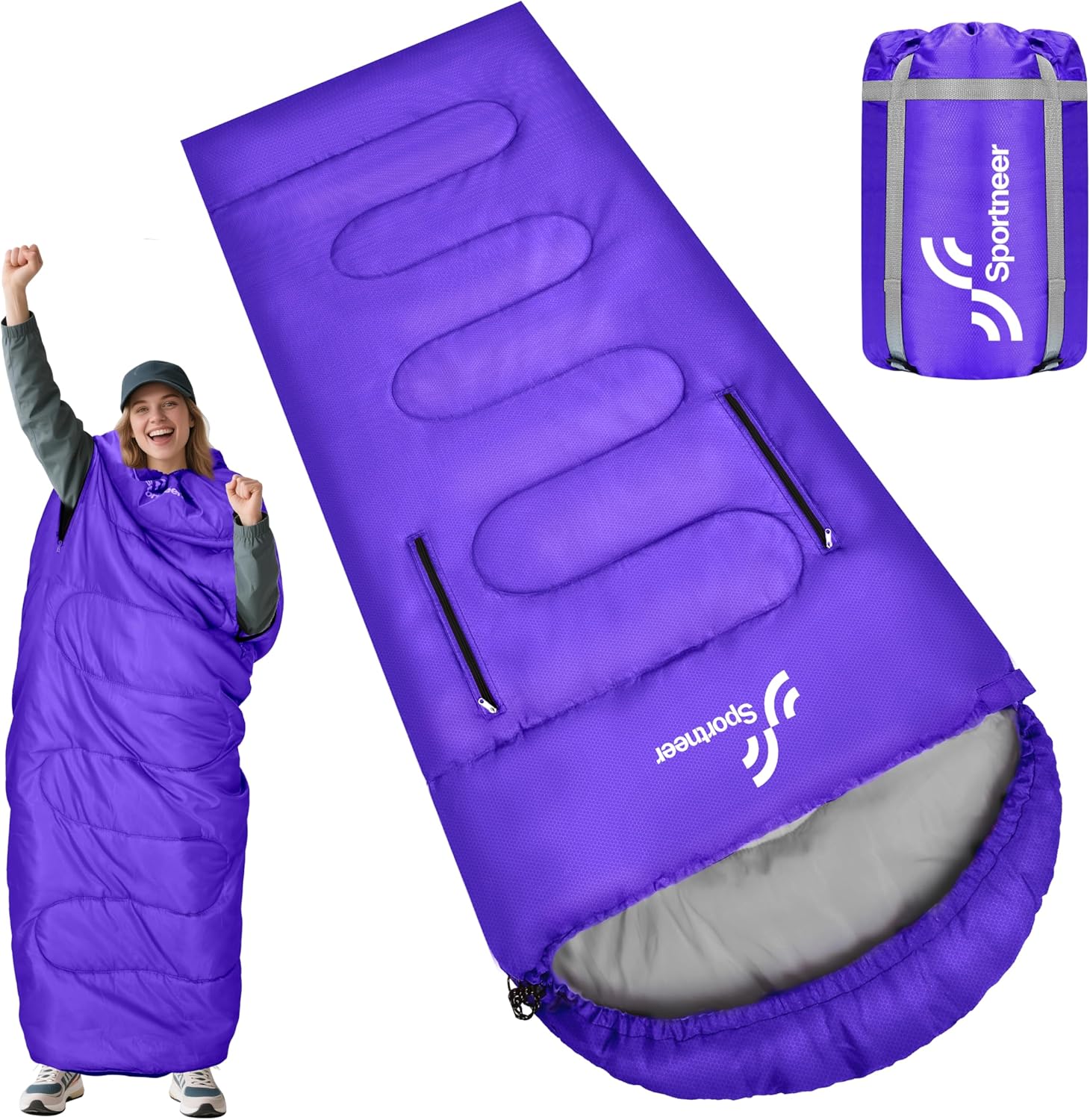
Sportneer Wearable Sleeping Bag 50-80F
Wearable sleeping bag designed for family camping and stadium use, with arm zippers for mobility and warmth rated 50-80 degrees.
Why we love it
- Move freely without unzipping fully
- Machine washable synthetic fill dries fast
- Packs to 15.7x9.5 inches, fits car trunks
Pros
- Arm zippers for hands-free movement
- Wearable design keeps torso warm
- Lightweight at 3.3 pounds
- Machine washable polyester shell
- Compression sack included
Cons
- 50-80F rating limits cold trips
- Wearable fit not mummy-shaped warmth

Guide Gear Sportsman 30F Bag
Sleeping bag with built-in arms designed for hunters and campers who need mobility and warmth in cold weather.
Why we love it
- Arms stay warm while sitting by the fire
- 80-gram insulation rated to 30 degrees
- Includes stuff sack for easy minivan packing
Pros
- Permanently attached arms for mobility
- Hood and drawcord seal in warmth
- Weather-resistant polyester shell
- 30-degree temperature rating
- Affordable price point
Cons
- Arms reduce packed compactness
- Heavier than standard bags

Naturehike XXL Oval Sleeping Bag
Roomy oval bag with arm zippers and protein-fiber warmth, sized for families who need elbow room and versatility on weekend trips.
Why we love it
- Unzip fully to use as a blanket or wear like a cape
- PFAS-free, machine washable, dries fast after damp trips
- Zips together with a matching bag for couples or kids
Pros
- Wearable design with arm zippers for mobility
- Roomy oval cut, roomier than standard single bags
- Machine washable synthetic fill
- PFAS-free fabric and cotton satin lining
- Three temperature ratings available (28F to 54F)
Cons
- Heavier than backpacking bags at 5.5 to 7.7 pounds
- Larger packed volume, best suited for car camping
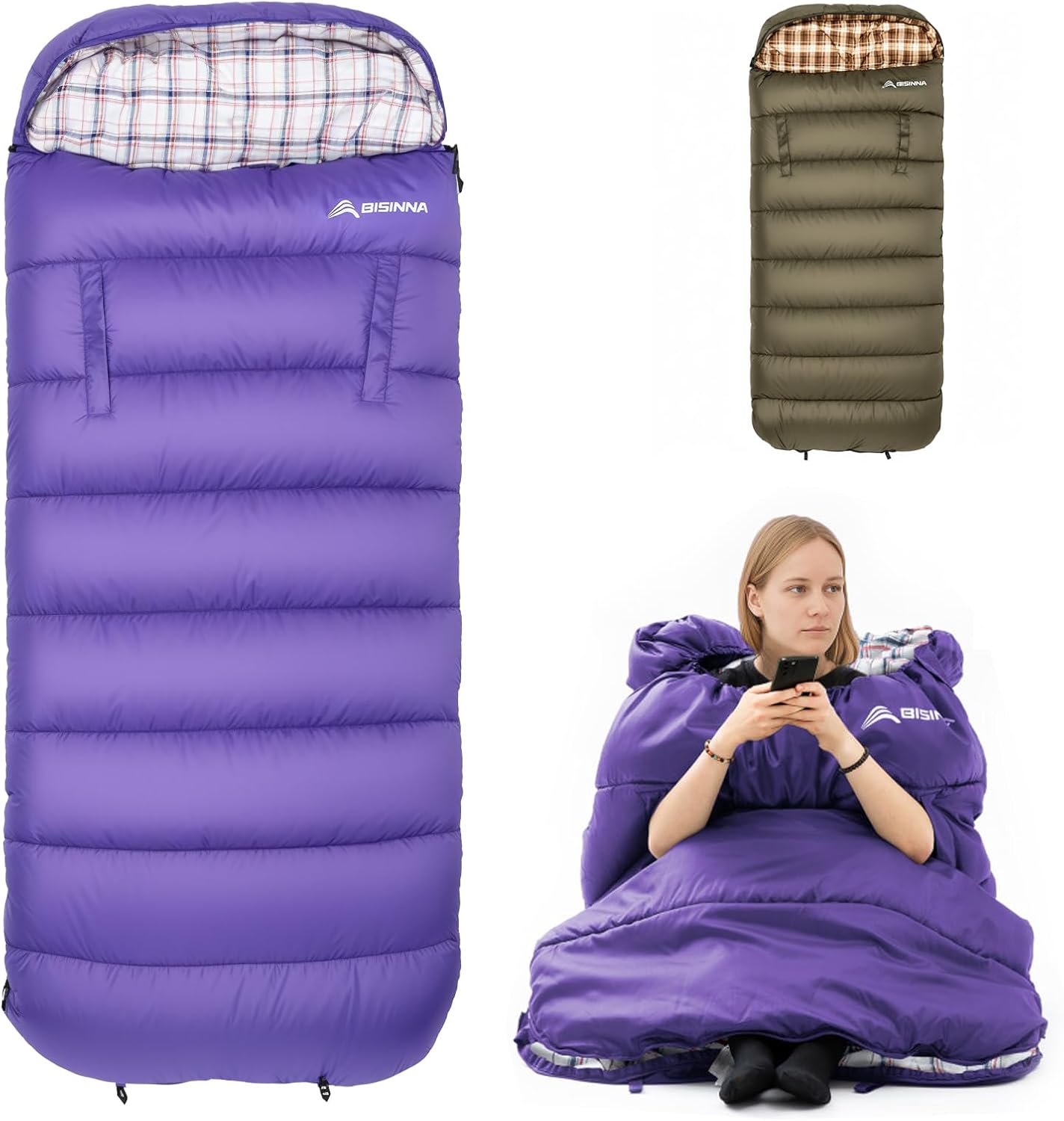
BISINNA XXL Wearable Flannel Bag
Roomy flannel-lined bag with arm holes and bottom zipper for car camping families who need extra space and comfort over packability.
Why we love it
- Arm holes let you move around without leaving warmth
- Flannel lining is soft on kids' skin on cool nights
- Extra-large 90x39 cut fits two adults or adult plus child
Pros
- Wearable design with arm holes and zipper
- Flannel interior lining for comfort
- Two-way zipper with anti-pinch strip
- Includes compression sack
- Anti-snag zipper for durability
Cons
- 5.9 lbs is heavy for backpacking
- Rated 14F to 41F, not true winter cold

Orvantis 20-50F Wearable Sleeping Bag
Rectangular bag with arm openings and hood lets you stay warm around camp without feeling locked in a mummy cocoon.
Why we love it
- Arm openings mean you can read, use your phone, or tend the fire while staying warm
- Roomy 86-inch length fits tall adults without the confined feeling of a mummy bag
- Cotton insulation stays functional even when damp from humid coastal trips
Pros
- Wearable design with arm and head openings
- Spacious rectangular cut for side sleepers
- Cotton fill handles coastal moisture better than down
- Compression sack packs down for minivan trips
- 20-50F range covers most shoulder-season camping
Cons
- Arm openings let heat escape in real cold
- Heavier and bulkier than mummy bags for backpacking
Arm Access Changes What a Sleeping Bag Can Do
Best sleeping bags with arms solve a problem most traditional bags ignore: you need your hands and shoulders free while you are still inside the insulation. After 14 years of watching my kids twist out of mummy bags at midnight to grab a water bottle, or my wife wedge an arm out of the zipper to adjust a pad, I stopped fighting the design and started understanding what it actually delivers. Arm openings and side zippers turn a bag from a cocoon into a wearable layer that lets you move, sit up, and function without abandoning warmth.
The bags in this list share that core feature, but they split hard on construction, seasonality, and how much insulation they carry. Some are built like sleeping sacks you can walk in. Others are traditional rectangular bags with zipped arm ports. That difference matters for how you actually use them, and where they fit in your rotation.
Arm Zippers Versus Arm Holes
Arm holes are simple cutouts, usually reinforced around the edge. They stay open all the time, which means cold air flows through them if you are not using them. The upside is weight and simplicity. A bag like the Wearable Sleeping Bag for Adults with Arm Holes keeps things light and packable because there is no zipper mechanism to maintain. Arm zippers seal the openings when your arms are inside, trapping heat and controlling air leakage. They add weight and complexity but hold warmth better in cold conditions. The Naturehike XXL Oval Sleeping Bag for Adults with PFAS-Free Fabric uses this approach, with dual zippers that let you seal one side or both depending on how you are positioned.
Seasonality and Temperature Rating
Temperature ratings on wearable bags run from 50 degrees down to 20 degrees or lower. A 50-degree bag is a shoulder-season piece, good for spring and fall or mild winter nights at lower elevation. A 20-degree bag is a genuine cold-weather system that requires a proper pad and layering underneath. The gap between them is not just insulation thickness. It is draft collar design, hood coverage, and whether the arm openings are positioned to create cold spots. Check what the bag actually promises in the fine print, not just the headline number, because arm zippers and holes behave differently in wind.
Fill Type and Moisture Behavior
Synthetic fill is the standard in wearable bags because it tolerates damp conditions better than down. If an arm opening lets moisture in, or if you are sleeping in humid air, synthetic keeps loft. Down loses insulation when wet and takes forever to dry. Most of the bags here use synthetic, which makes sense for the category. They compress less efficiently than down, so a synthetic wearable bag is bulkier in a pack than a down mummy, but you gain reliability on damp trips and easier care.
Interior Room and Thermal Efficiency
Wearable bags come in rectangular and oval cuts. Rectangular gives you more interior space and lets you move around inside, which some people prefer. Oval is more tapered, which means less dead air space and better heat retention for the insulation weight you carry. The trade-off is that oval bags feel snugger, and if you are a side sleeper or a person who thrashes at night, that taper can create pressure points. An XXL rectangular bag like the Wearable Flannel XXL Sleeping Bag gives you room to shift without feeling trapped.
Arm access means nothing if the bag is too cold or too hot for your actual season. Match the rating to what you camp in, not to what sounds tough.
Zippers, Seams, and Draft Control
A wearable bag with arm zippers is only as warm as its draft sealing. The main body zipper needs a full draft tube on the inside to stop heat loss along the seal. The arm zippers need reinforced stitching because they take a lot of flex stress. Seams on a bag you move around in get stressed differently than seams on a traditional mummy bag you mostly lie still in. Reinforced stitching at stress points, especially where the arm zipper meets the side seam, keeps the bag from leaking heat or separating under load. Check the construction photos before buying. A bag with visible stitching gaps or a thin draft tube will lose warmth every time you move.
Connectable zippers are a feature on some models. If you buy two bags with compatible zippers, you can zip them together into one larger system. This is useful for couples or for families who want to combine smaller bags into a larger sleeping surface. The catch is that the zipper compatibility is brand-specific, so you have to buy the right models. A single bag with a strong, well-sealed main zipper and arm zippers is more important than the option to combine later.
Weight, Packed Size, and What You Trade Off
Wearable bags are heavier and bulkier than equivalent mummy bags because the rectangular or oval shape does not pack down as tightly, and arm zippers add weight. A three-season synthetic wearable bag typically runs 2 to 3 pounds, while a traditional mummy in the same temperature range might be 1.5 to 2.5 pounds. That extra weight buys you the freedom to move and the arm access, but it matters if you are backpacking long distances or if pack weight is a constraint. For car camping, truck sleeping, or base camp use, the weight difference is irrelevant. For a thru-hike or a multi-day backcountry trip, you need to decide whether arm access is worth carrying the extra load.
Packed volume is another consideration. A rectangular bag with arm zippers does not compress as small as a stuff-sack mummy. If you are fitting a bag into a tight pack or a truck cab, measure the packed dimensions before buying. Some bags ship with a compression sack. That sack helps, but it does not eliminate the bulk. A lightweight synthetic wearable bag compressed into a sack is still larger than a down mummy compressed the same way.
The arm zippers add weight. Decide if moving freely while you sleep is worth the extra ounces you carry.
Fit, Sizing, and Common Mistakes
Wearable bags come in standard, XL, and XXL sizes. This is not the same as clothing sizing. A bag marked XL is not cut for tall people the way a tall sleeping bag is. It is wider and longer overall. If you are 6 feet tall, a standard 90-inch rectangular bag will not cover your feet. An XXL at 91 inches might still come up short depending on your exact measurements. Check the interior dimensions, not the label. Measure your torso length, hip width, and foot length, then compare them to the bag specs. A bag that is too small will compress insulation at your feet and shoulders, making it sleep colder than the rating says. A bag that is too large wastes insulation volume on dead air space around you.
Arm hole positioning matters more than people realize. If the holes are too high on your shoulder, they create a cold spot when you move your arm. If they are too low, your arm rubs the edge constantly and the reinforcement tears. Try the bag on if you can. Lie down and reach your arm through the hole while someone else watches where the hole sits on your shoulder. If it feels like it is pinching or creating a draft, that bag is not the right fit for your body.
Getting the Fit Right Before the Return Window Closes
Order a wearable bag and test it at home before your first trip. Lay it out on your bed or the floor and lie down inside it with the clothing you actually plan to wear camping. Move your arms in and out of the openings. Reach for your water bottle. Adjust your pad. Sit up and see if the bag rides up or creates pressure points. Arm holes that feel fine when you are standing often feel wrong when you are lying down. Spend 20 minutes in the bag at home. You will learn more than you will from any review.
Check the zipper action while the bag is laid out. Open and close both the main zipper and the arm zippers several times. They should move smoothly without catching or binding. A zipper that sticks in the store will be worse after a few months of use. Listen for grinding or scraping sounds. If you hear them, the zipper teeth or slider is damaged. Return it immediately.
Measure the arm hole diameter and the reinforcement width. The hole should be large enough that your arm passes through without pressure, but not so large that cold air pours in around your shoulder. The reinforcement should be at least 2 inches wide all the way around the hole. Thinner reinforcement tears easily.
If the bag is connectable, test the zipper coupling with the compatible model if you have access to it. Make sure the zippers align and lock together smoothly. A misaligned coupling defeats the whole purpose. If you are buying a bag primarily for the coupling feature, verify the compatibility before you commit.
Tips From the Trail
- Store the bag uncompressed and unzipped. Arm zippers take stress when the bag is compressed. Hang the bag in a closet or lay it flat in a storage bin with the zippers open so they can relax. Compressed zippers develop stiffness and grinding.
- Wash synthetic fill bags in cold water on gentle cycle. Hot water breaks down synthetic fibers faster. Skip the dryer. Lay the bag flat or hang it to air dry. Machine drying damages zippers and seams.
- Test arm zippers monthly during the off-season. Open and close them a few times to keep them loose. A zipper that sits locked for months gets stiff. A few minutes of motion keeps them moving smoothly.
- Pair the bag with an insulating pad rated for the temperature you plan to use. Arm access does not change the fact that ground cold comes from below. A 20-degree bag over a thin pad will sleep cold. Use a pad with an R-value of at least 3 for shoulder season and 5 or higher for winter.
- Do not rely on arm holes for ventilation in warm weather. Arm holes leak heat in cold conditions, but they do not cool the bag effectively in summer. If you are camping in warm weather, use a lighter bag or a quilt without arm zippers.
- Inspect seams and stitching before the first trip. Run your finger along the main seam and the arm zipper seams. Feel for gaps or loose threads. A seam that comes apart on the trail is a major problem. Address it before you leave home.
Common Questions About Wearable Bags With Arm Access
How much warmth do arm zippers actually add compared to arm holes?
In still air, arm zippers reduce heat loss by about 10 to 15 percent compared to open holes, depending on how much of the opening you seal. In wind, the difference is larger because holes create convection currents. In calm, protected conditions, the difference is small. If you camp mostly in sheltered spots, arm holes are fine. If wind is common where you camp, arm zippers are worth the weight.
Can you use a wearable bag with arms as a regular sleeping bag?
Yes. Keep your arms inside the bag and close the arm zippers or ignore the holes. You lose the arm access feature, but the bag functions as a normal rectangular bag. You do not get the thermal efficiency of a tapered mummy shape, so the bag will sleep slightly colder than a mummy rated for the same temperature. But for car camping or base camp use, this trade-off is acceptable.
What is the difference between connectable and non-connectable bags?
Connectable bags have zippers designed to lock together with a compatible partner bag, creating one larger sleeping surface. Non-connectable bags have standard zippers that do not couple. Connectable bags cost slightly more and require you to buy the exact matching model. If you are sleeping alone or with a partner who already has a bag, non-connectable is simpler and cheaper. If you are building a family system from scratch, connectable bags offer flexibility.
Do wearable bags with arms work for side sleepers?
Rectangular wearable bags work fine for side sleepers because the interior space lets you shift position without compressing insulation unevenly. Oval wearable bags can pinch at the shoulder if the taper is aggressive. Test the bag on your side before buying. If you are a committed side sleeper, choose a rectangular cut.
How do you prevent moisture buildup inside an arm zipper?
Keep the zipper clean and dry. After a damp trip, open the arm zippers fully and let the bag air dry completely before storing it. Do not compress a damp bag into a stuff sack. Moisture trapped in a compressed zipper promotes mold and corrosion. If you camp in very humid conditions, wipe the zippers dry at night before closing them.
Can you repair a torn arm hole reinforcement?
Small tears can be patched with adhesive fabric repair tape. Larger tears require sewing. If the reinforcement is separating from the shell fabric, you can glue it back with flexible fabric adhesive and then stitch it. This is a field repair, not a permanent fix. Once home, take the bag to a gear repair shop for a proper re-stitching of the reinforcement. A torn arm hole gets worse with use.



Write Your Review
No reviews yet. Be the first to share your experience!