


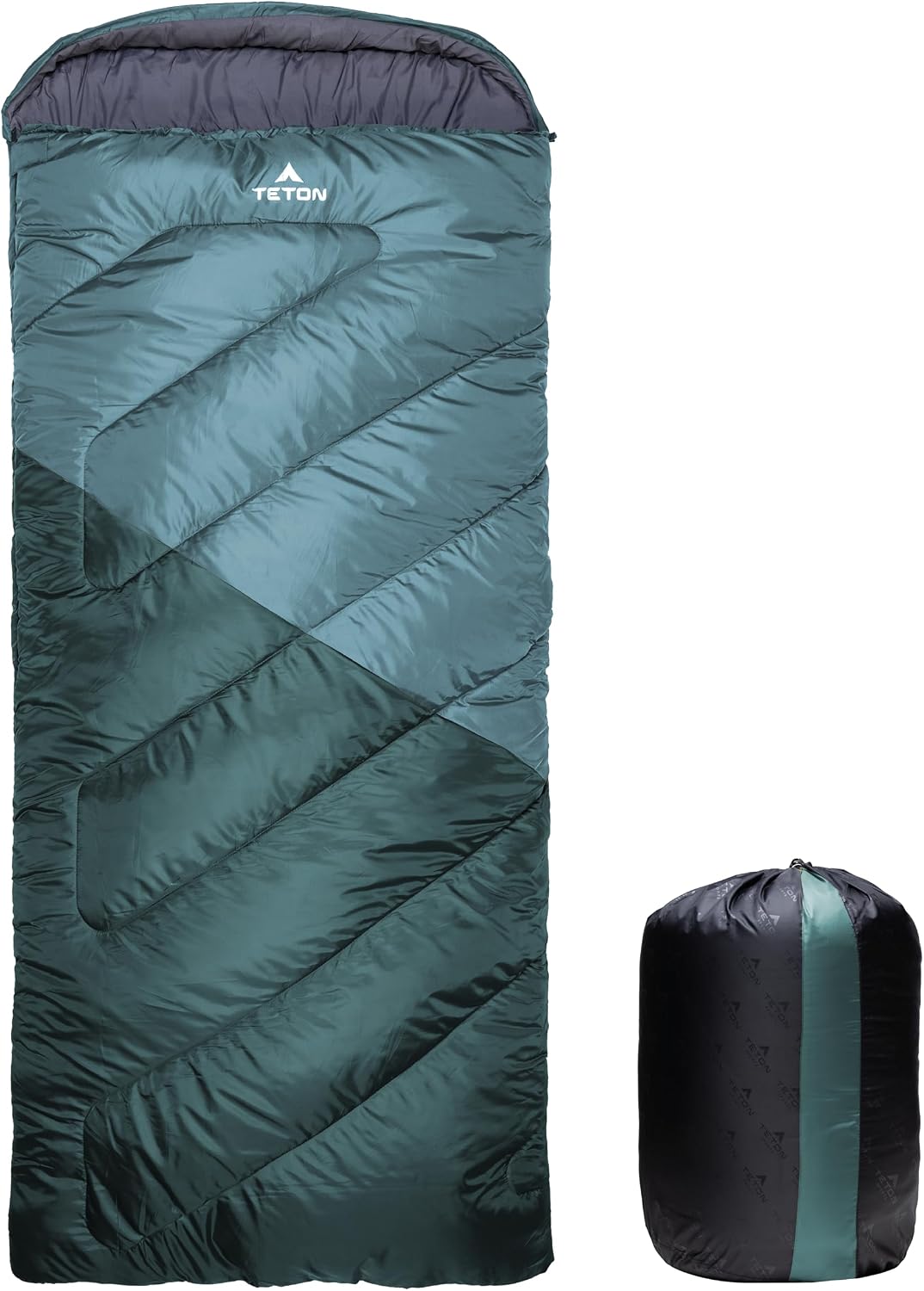
Teton TrailHead 20F Sleeping Bag
Synthetic mummy bag that stays warm when damp and packs small enough for the minivan, at a price that won't hurt the family budget.
Why we love it
- Synthetic fill handles wet coastal trips better than down
- Draft collar and hood seal warmth on frosty mornings
- Stuff sack keeps gear organized in a packed car
Pros
- Lightweight synthetic insulation
- Full-length anti-snag zipper
- Oversized mummy fit for comfort
- Draft collar and hood included
- Compression sack in the box
Cons
- Synthetic bulk adds packed volume
- 20F rating is survival limit, not comfort

Sierra Designs Cloud 20 Zipperless
Zipperless comfort bag that keeps kids warm without the mummy-bag squeeze, and the pad sleeve stops middle-of-the-night rolling.
Why we love it
- Zipperless design lets restless kids move freely
- Pad sleeve keeps bag from sliding off your mat
- 800 fill down compresses small for the minivan
Pros
- Zipperless comfort design
- Integrated pad sleeve
- 800 fill DriDown insulation
- Self-sealing foot vent
- Insulated hand pockets
Cons
- 20-degree rating is a limit, not comfort
- Pricey for a family bag

QEZER Down Mummy 600 Fill 0F Bag
Compact down mummy rated to 0F, packs small enough for backpacking but warm enough for frosty state-park nights with the kids.
Why we love it
- 600-fill down compresses to 13x6 inches
- Dual zippers let you zip two bags together
- Mummy cut with trapezoidal foot box fits kids
Pros
- 600-fill down insulation
- Dual side zippers for couples or kids
- Compact packed size for minivan trips
- Trapezoidal foot box design
- Tear-resistant nylon shell
Cons
- Down loses loft if it gets damp
- Rated limit, not comfort temperature

ORTHOMTEX 0-25F Sleeping Bag
Waterproof synthetic bag rated 0-25F with zippered combo design; machine washable and kid-tough for family camping.
Why we love it
- Zips to another bag for shared warmth on cold nights
- Machine washable synthetic fill dries fast after damp trips
- Two-way zipper lets you vent on warm evenings or seal tight
Pros
- Waterproof outer shell
- Zips to matching bag for doubles
- Machine washable synthetic fill
- Adjustable hood with drawstring
- Two-way zipper for temperature control
Cons
- Synthetic fill bulkier than down
- Rated temperature is limit, not comfort zone

BUERTSOUTDOOR 680FP Down Bag 44F
Ultralight down bag that packs to nothing and keeps you warm on shoulder-season camping trips without weighing down your pack.
Why we love it
- Weighs just 1.85 lbs, easy for kids to carry
- Compresses to fist-size for tight minivan packing
- Zips to another bag for couples or family warmth
Pros
- 680-fill premium down insulation
- Compression sack included
- Temperature rated 44 to 59 degrees
- Envelope design zips together
- Durable 400T nylon shell
Cons
- Rated limit, not comfort zone
- Down loses loft if it gets wet

REDCAMP Cotton Flannel Sleeping Bag
Cotton-flannel rectangular bag rated for cold nights, zips together with a second bag, and handles family camping trips where packability matters less than warmth and washability.
Why we love it
- Cotton flannel lining breathes better than nylon
- Two-way zips let you connect two bags together
- Dirt-resistant exterior wipes clean after wet trips
Pros
- Two-way zipper for connecting bags
- Cotton flannel lining is soft on skin
- Rated down to 5 degrees Fahrenheit
- Machine washable synthetic fill
- Includes compression stuff sack
Cons
- Bulky packed size for backpacking
- Heavier than synthetic alternatives
Understanding the 20-Degree Rating
A 20-degree sleeping bag for backpacking sits at the threshold where three-season trips become possible. The number itself is a survival limit, not a comfort promise. When you see 20 degrees on the tag, that is the ISO limit rating: the coldest temperature at which a standard adult in a standard sleep system (pad, layers, hat) is expected to survive the night. Comfort is typically 20 to 30 degrees warmer, which means a true 20-degree bag keeps you comfortable somewhere in the 40 to 50 degree range. The gap between what the label claims and what your body feels at 2 a.m. is where most backpackers get burned.
The picks above show the range of approaches to hitting this rating. Some use down fill, some synthetic, and a few use hybrid strategies. The construction details matter more than the fill type alone. A mummy cut with a full draft collar and a pad sleeve will perform better than a roomier rectangular bag rated to the same number.
ISO Comfort Versus ISO Limit
ISO 23537 defines two numbers for every bag. The comfort rating is where an average person sleeps warm without extra layers. The limit rating is where that same person survives but does not sleep well. A bag labeled 20 degrees is giving you the limit. If you plan to sleep comfortably at 20 degrees, you need a bag rated closer to 0 or 10 degrees, or you need to add a liner and wear more inside the bag. Pad R-value also shifts this number: a sleeping pad with R-value 3 or higher can add 10 to 15 degrees of effective warmth to your sleep system.
Down Versus Synthetic at This Rating
Down dominates the 20-degree backpacking market because it compresses smaller and weighs less for the same warmth. The Sierra Designs Cloud 20 Degree DriDown Sleeping Bag uses 800 fill power down, which means each ounce of down traps more air. Down loses effectiveness when wet, and drying it in the field is slow. Synthetic bags like the Teton 20F hold warmth even damp and dry faster, but they pack bulkier and weigh more. If your trips cross wet coastal terrain or you camp near water, synthetic makes sense. If weight and pack space drive your choice, down wins.
Mummy Cut Versus Roomier Shapes
A mummy bag tapers at the shoulders and feet, trapping body heat in a smaller air space. At 20 degrees, this efficiency matters. A rectangular or semi-rectangular bag rated to the same temperature will be colder because warm air escapes around your body. Mummy bags feel restrictive to side sleepers and people who move a lot in their sleep. The QEZER Down Mummy Sleeping Bag uses a snug mummy cut with a trapezoidal foot box that gives toe room without losing warmth. If you sleep still and on your back, a mummy cut is your thermal advantage. If you thrash around, you sacrifice efficiency for comfort.
Weight Penalty for the Rating
Reaching 20 degrees requires enough insulation that the bag becomes noticeable in your pack. A synthetic 20-degree bag often weighs 3 to 4 pounds. Down bags run 2 to 2.5 pounds for the same rating. The BUERTSOUTDOOR Down Sleeping Bag hits the weight target at 1.85 pounds by using ultralight nylon fabric and 680 fill power down, but the shell is delicate and not suitable for rough use. If you are carrying the bag 10 miles over uneven terrain, that extra half-pound per day adds up. If you are car-camping and shuttling it to a base camp, weight matters less.
A 20-degree rating is survival, not comfort. Pair it with a good pad and expect to sleep warm 20 to 30 degrees warmer than the tag claims.
Fill Power, Loft, and Real-World Warmth
Fill power measures how many cubic inches one ounce of insulation occupies. Higher fill power means more air trapped per ounce, which translates to lighter bags and better compressibility. Down bags at 20 degrees typically use 600 to 850 fill power. The QEZER bag uses 600 fill, the Sierra Designs uses 800 fill, and the BUERTSOUTDOOR uses 680 fill. On paper, 800 is better. In reality, the difference between 600 and 800 is noticeable only if you are comparing two otherwise identical bags. Construction, loft depth, and how the down is baffled matter as much as the number itself.
Loft is the thickness of the insulation layer when the bag is laid flat and fluffed. More loft means more trapped air and more warmth. A bag compressed in its stuff sack loses loft temporarily. After you unpack it and let it sit for an hour, the down or synthetic re-expands. If a bag stays compressed for weeks between trips, down can lose permanent loft from the weight crushing the clusters. Synthetic bounces back faster but never quite reaches original loft after repeated compression.
Check the loft depth before buying by looking at the bag’s dimensions when laid flat. A 20-degree bag should show 3 to 4 inches of thickness in the walls and bottom. If the spec sheet does not list this, ask the seller or measure one in person. A thin bag with a 20-degree rating is probably cutting insulation in other places to hit the number.
Pad Pairing and System R-Value
Your sleeping pad’s R-value (thermal resistance) is not optional at 20 degrees. A cheap foam pad or an inflatable pad with R-value 2 or lower will let ground cold seep into your back, and no bag will compensate. You need R-value 3 or higher, which means a foam pad at least 2 inches thick or a quality inflatable pad. Pair a 20-degree bag with R-value 3 to 4, and your system sleeps warm at actual 20-degree nights. Pair it with R-value 2 or less, and you will wake up cold.
Some bags now include a pad sleeve on the bottom, which secures the pad to the bag and prevents sliding. The Sierra Designs Cloud has an integrated pad sleeve that keeps the insulation aligned with the pad. This is a convenience feature more than a thermal one, but it does prevent the bag from bunching up and creating cold spots. If your pad does not have a sleeve, a simple carabiner or strap can anchor it.
Layering inside the bag also shifts the effective temperature. Wearing a hat, socks, and a base layer can add 10 to 15 degrees of perceived warmth. A 20-degree bag with full layers and a good pad becomes a 0 to 10-degree system in practice.
A 20-degree bag alone is not enough. Pair it with R-value 3 or better and wear layers inside to reach true 20-degree performance.
Zipper, Draft Collar, and Thermal Sealing
Heat escapes through three weak points: the zipper, the neck opening, and the foot end. A full-length zipper on the side lets you open the bag for ventilation on warmer nights, but it is a thermal leak. A draft collar (a tube of insulation around the neck opening) reduces this loss. A zipper draft tube (a fabric tube that runs along the zipper line) blocks air from moving along the seam. At 20 degrees, both matter. The Teton 20F has a zipper draft tube and a vaulted footbox. The QEZER bag has a hood that cinches down to seal the neck opening.
Check whether the bag has a two-way zipper. This lets you open the foot end separately on warm nights without exposing the whole bag. The ORTHOMTEX bag has a two-way slider, which is useful for temperature regulation but adds weight and complexity. For a dedicated 20-degree bag, a single full-length zipper with a good draft collar is sufficient.
Tips From the Trail
- Fluff your bag before bed. Let it sit outside the stuff sack for 30 minutes to an hour after you unpack it. This restores loft and maximizes warmth. A compressed bag loses 20 to 30 percent of its insulating power.
- Store it uncompressed at home. Keep the bag in a mesh storage sack or hanging in a closet. Long-term compression damages down clusters and synthetic fiber crimp. Take it out of the stuff sack the day you get home from a trip.
- Wash it only when necessary. Down bags should be hand-washed in cool water with specialized down soap, then dried on low heat for several hours. Synthetic bags tolerate machine washing on gentle cycle. Over-washing breaks down both fills faster.
- Dry it completely before packing. A damp bag mildews and loses loft. If it gets wet in the field, hang it in the sun or near a fire (not touching heat). At home, tumble it on low heat with wool dryer balls to help re-fluff.
- Use a sleeping pad liner in wet conditions. A thin liner inside the bag protects the insulation from ground moisture and sweat. It adds minimal weight and extends the bag’s life by years.
- Pair it with a sleeping pad sleeve. If the bag does not have one, use a simple strap or carabiner to anchor the pad. This prevents the bag from sliding off the pad at night, which exposes your back to cold.
How to Choose Based on Your Trip Style
A 20-degree bag is built for shoulder seasons and high-altitude summer trips where nights dip below freezing. If most of your backpacking happens in June through September below 6,000 feet, a 30-degree bag is lighter and more versatile. If you camp in the Cascades or Rockies from April through October, or if you do winter camping above 8,000 feet, a 20-degree bag becomes essential. The weight penalty is real, but the warmth margin keeps you safe on unpredictable nights.
Backpacking weight matters more than car-camping weight. A 20-degree bag that weighs 2.5 pounds is noticeably heavier than a 30-degree bag at 1.8 pounds. Over a 10-mile hike, that 0.7-pound difference is real. However, if you are planning a three-week Cascades traverse where nights routinely hit 30 degrees or lower, the heavier 20-degree bag is the right choice. If you are doing weekend trips in the Willamette Valley foothills, a lighter 30-degree or 40-degree bag saves weight without risk.
Synthetic bags make sense if you camp near water, in coastal areas, or during seasons with high humidity. Down bags are the choice for dry climates and for backpackers who can keep their gear protected. Neither is universally better. The decision depends on where you sleep and how much moisture you expect to encounter.
Common Questions
Does the 20-degree temperature rating mean I will be comfortable at 20 degrees?
No. The 20-degree rating is the ISO limit, not the comfort rating. You will survive at 20 degrees in a 20-degree bag, but you will not sleep well. Comfort is typically 20 to 30 degrees warmer, so expect to sleep comfortably in the 40 to 50-degree range. If you want true comfort at 20 degrees, you need a 0 to 10-degree bag, or you need to add layers and a good pad.
Can I use a 20-degree bag in summer?
Yes, but it will be too warm on many nights. A bag with a full-length two-way zipper and a foot vent lets you open the bag for ventilation. If your summer trips are in the mountains above 7,000 feet or in the far north, a 20-degree bag is appropriate. If you camp at lower elevations where nights stay above 50 degrees, you will overheat and wake up sweaty.
How much does a good 20-degree sleeping pad cost to pair with this bag?
A quality inflatable pad with R-value 3 to 4 runs around $100 to $150. A closed-cell foam pad is cheaper but heavier. You do not need the most expensive pad, but you do need one that actually insulates. A cheap $30 pad will leave you cold even with a 20-degree bag.
What should I wear inside a 20-degree bag to stay warmest?
Wear a hat, wool socks, and a base layer top and bottom. A hat reduces heat loss from your head by 40 percent. Socks keep your feet warm without restricting circulation. A base layer traps body heat without adding bulk. Avoid cotton. Merino wool or synthetic materials dry faster and insulate even when damp.
How do I restore loft to a down bag after compression?
Unpack the bag and let it sit outside the stuff sack for at least one hour. If you are at home, tumble it on low heat in the dryer for 15 to 20 minutes with wool dryer balls. The agitation helps the down clusters re-expand. Do not use high heat, which can damage the shell fabric. A bag that has been compressed for weeks will take longer to fully re-loft.
Is a zipperless bag warmer than a zipped bag at 20 degrees?
A zipperless quilt or comforter design eliminates the zipper seam, which is a thermal weak point. The trade-off is that you cannot open the bag for ventilation, and you cannot zip two bags together. For a dedicated 20-degree bag that you will use in cold conditions, a zipperless design is slightly warmer. For a versatile three-season bag, a good zipper with a draft collar is more practical.


Write Your Review
No reviews yet. Be the first to share your experience!