


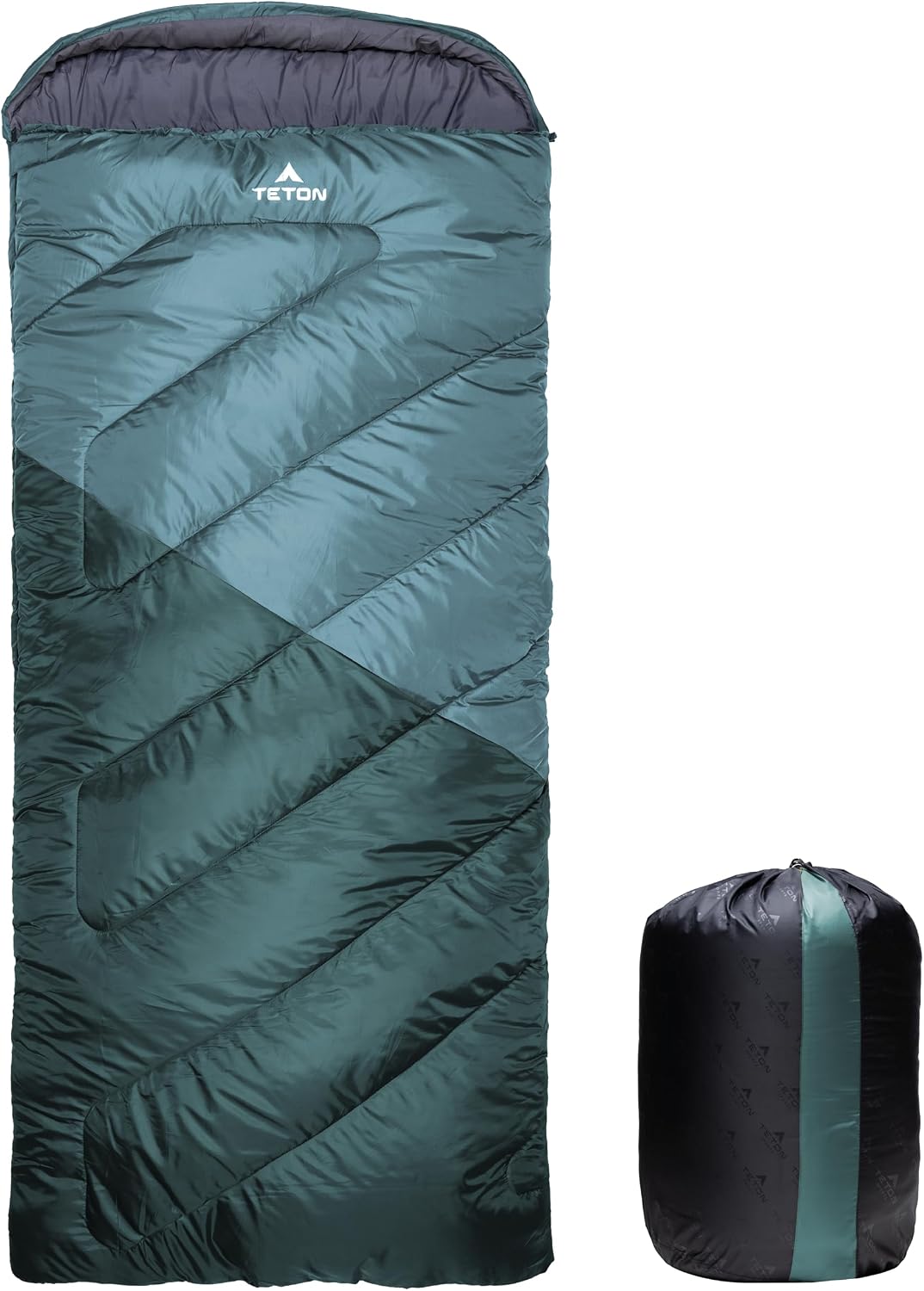
Teton Celsius 25F Sleeping Bag
Flannel-lined bag that keeps kids warm and doesn't fall apart after a wet Oregon weekend.
Why we love it
- Flannel lining beats synthetic slickness on cold nights
- Two-way zippers work with gloves and tired kids
- Unzips flat to blanket when the cabin gets stuffy
Pros
- Soft flannel lining
- Water-resistant taffeta shell
- Draft tubes at shoulders and zipper
- Stuff sack included
- Interior pocket for keys and phone
Cons
- Heavier than ultralight options
- SuperLoft fill needs a quality pad underneath

Sea to Summit Boab Synthetic 30F
Roomy synthetic bag that keeps kids warm on frosty state-park nights and survives stuffed wet into the minivan.
Why we love it
- Full-length zipper converts to blanket for restless kids
- Synthetic fill handles damp coastal trips without losing warmth
- Four sizes include Regular Wide for comfortable side sleepers
Pros
- Roomy rectangular cut, not mummy-tight
- Full-length zipper with footbox opening
- Synthetic insulation performs when damp
- Shoulder snap and dual sliders for ventilation
- Machine washable, recycled materials
Cons
- Heavier than down or ultralight options
- Rated limit, not comfort temperature

Sea to Summit Hamelin 30F Synthetic
Synthetic bag that handles damp Pacific Northwest weather without the down-soaking risk, rated for shoulder-season trips with room to move.
Why we love it
- Stays warm when damp, unlike down
- Converts to quilt for camp mobility
- Packs light for family backpacking
Pros
- Body-mapped insulation targets core warmth
- Full-length side zipper doubles as quilt
- Synthetic fill performs wet or dry
- Shoulder snaps let kids wear it around camp
- Contour shape fits side sleepers
Cons
- Bulkier packed than equivalent down
- 30F rating is limit, not comfort zone

NEMO Forte 35F Synthetic Bag
Synthetic 3-season bag built for side sleepers and families who need warmth that works even when damp.
Why we love it
- Spoon shape gives kids room to move without losing heat
- Synthetic fill stays warm when wet, unlike down
- 100% recyclable at end of life, guilt-free gear
Pros
- Spoon-shaped cut for side sleepers
- Performs well when damp or wet
- Thermo Gill vents extend temperature range
- 100% recycled synthetic fill and fabrics
- Pillow pocket for jacket stuffing
Cons
- Synthetic fill bulkier than down equivalent
- 42F comfort rating, not a true cold-weather bag

MalloMe Everyday 3 Season 50-80F
Synthetic bag that handles spring through fall camping with kids, packs small, and survives being stuffed wet into the minivan.
Why we love it
- Waterproof shell sheds rain on damp coastal trips
- 3 pounds keeps it packable for weekend hikes
- Rectangular cut gives kids room to move around
Pros
- Waterproof HEX-TECH shell
- Anti-snag zipper
- Compression sack included
- Machine washable synthetic fill
- Adjustable hood and foot zipper
Cons
- Not rated for cold mountain nights below 50F
- Heavier than ultralight backpacking bags

JEAOUIA Sleeping Bag 50-68F 3LBS
Budget sleeping bag that works for shoulder-season family camping and car trips, though the temp rating runs warm and the fill won't handle real cold.
Why we love it
- Foot zipper lets you dial temps without full unzipping
- Compresses small enough for the minivan or backpack
- Machine washable, no babying required after trips
Pros
- Affordable at under $25
- Lightweight at 3 pounds
- Drawstring hood seals in warmth
- Two-way zipper opens from feet
- Compact packed size
Cons
- Temp rating tops out at 68F, runs warm
- Hollow fiber fill won't handle real cold nights
Synthetic Fill Holds Warmth When Wet
The case for best synthetic sleeping bags rests on one hard fact: synthetic fiber keeps its loft when damp. Down clumps. Synthetic does not. After fourteen years camping coastal trails where morning fog soaks everything, and high desert nights where the temperature swing wrings moisture out of the air, I have lost count of how many times synthetic insulation made the difference between a night of solid sleep and a cold, restless one. The bags in this list all use polyester or hollow-fiber fills that maintain loft even when wet, paired with shells that shed moisture without trapping it inside.
What makes synthetic the harder call is weight and packed size. Synthetic bags weigh more and compress less than down. For a weekend trip from the truck, that trade-off does not matter. For a four-day backpack, it does. These picks represent the realistic sweet spot: bags light enough to carry, durable enough to survive repeated trips, and honest about what they actually deliver at 2 a.m.
Hollow Fiber vs. Continuous Filament
Hollow fiber is the older synthetic tech. Fibers are crimped and trapped air stays inside each filament. It compresses more easily than continuous filament and is cheaper to make, but it also breaks down faster under repeated compression. A hollow-fiber bag gets softer and less lofty after a few seasons of heavy use. The JEAOUIA Sleeping Bag uses this construction and reflects that cost savings.
Temperature Rating as a Floor, Not a Promise
Synthetic bags are conservatively rated. A 20-degree synthetic bag will keep you alive at 20 degrees, not comfortable. Comfort is another 5 to 10 degrees warmer. The Sea to Summit Boab carries a 30-degree rating and a 2-season designation. Use a 30-degree synthetic bag for temperatures no lower than 35 degrees if you are relying on it alone. With a sleeping pad rated R4 or higher and a hat, you can push lower. Without them, you will be cold.
Bag Shape Affects Usable Warmth
Rectangular bags have loose interior volume around your shoulders and hips, so heat escapes. A tapered or contoured bag hugs your body shape and traps dead air where it belongs. The Boab uses a tapered cut and loses less heat than a traditional rectangle of the same weight. A mummy-cut bag hugs even tighter but restricts movement and feels claustrophobic if you are not used to it. Most of these picks split the difference with a semi-tapered shape.
Draft Collar and Zipper Tube Stop Cold Leaks
Cold air sneaks in around the shoulders where the zipper runs. A draft collar is a tube of insulation that sits above the zipper and seals that gap. A draft tube runs along the inside of the zipper itself. Both matter. A bag without either will feel drafty even if the insulation is thick enough. Check the spec sheet. If the manufacturer does not mention draft features, assume they are minimal.
A synthetic bag rated 30 degrees is honest about surviving that temperature, not comfortable in it.
Weight and Packed Size Trade Against Durability
Synthetic bags are heavier than down because the fibers are denser and less efficient at trapping warmth per ounce. A lightweight synthetic bag around 2 pounds is usually compromised somewhere: thinner shell, lower loft, or less durable fabric. A solid synthetic bag lands between 2.5 and 4 pounds depending on the temperature rating. The Sea to Summit Hamelin weighs 2.3 pounds and uses body-mapped loft to cut weight without cutting corners on shell durability. That precision costs more.
Packed volume matters less in a car-camping bag and more if you are fitting a sleeping system into a 55-liter pack. Synthetic compresses to roughly 20 to 25 liters when stuffed tight. Do not expect a garbage bag to hold it after three or four seasons. Compression bags work, but they wear the fabric and can degrade the loft if left compressed for months.
Denier Tells You About Shell Toughness
The outer shell is measured in denier. Higher denier means thicker, tougher fabric. A 50-denier shell is light and packable but tears on sharp brush. A 200-denier shell resists puncture and abrasion but adds weight. Most quality synthetic bags use 75 to 150 denier. Below that, expect snags and small tears to accumulate. The Boab uses 50-denier bluesign-approved fabric with a DWR (durable water repellent) finish, so it sheds moisture even at lower denier.
Stitching Quality Determines Seam Longevity
Cheap bags use single-needle stitching and short stitch length. Seams fail first, usually at the footbox corners or where the draft tube meets the side seam. Better bags use box-stitch or double-stitch at stress points. Look at photos before buying. If you cannot see the actual stitch pattern, contact the seller. Seams that split mid-trip are expensive to fix and often permanent failures in field conditions.
Zipper and Coupling Systems Define Real Usability
Two bags can zip together along a coupler system to form a larger sleeping space. That works only if both bags have the same zipper type and orientation. More useful is the ability to fully unzip a bag into a blanket for temperature regulation. The Boab has a full-length side zipper that opens the entire footbox, turning the bag into a wide blanket for warm nights. That flexibility alone justifies the price for variable-season camping. A mummy bag with a top-only zipper cannot do that.
YKK zippers are the industry standard. They cost more and they hold up. Off-brand zippers snag and fail under dust and damp. A snag at 3 a.m. in the dark with cold hands is a genuine problem. Check the spec. If it says YKK, it is likely good. If it says nothing, it is probably not.
YKK zippers cost more upfront and save frustration on every camping trip.
Caring for Synthetic Between Seasons
Synthetic bags do not need special storage like down. Do not compress them for months. Store them uncompressed in a cool, dry place, loosely stuffed in a mesh bag if space is tight. Hanging is fine too. The key is air circulation to prevent mustiness. Wash synthetic bags gently by hand in cool water with mild detergent, rinse thoroughly, and dry flat or hang-dried. Machine washing breaks down the fibers faster. Do not tumble dry. Sun exposure fades color but does not hurt the insulation. A sunny day drying is fine.
Synthetic does not recover loft the same way down does after compression. If a synthetic bag sits compressed in a stuff sack for a year, it will be noticeably less lofty when you unpack it. That is permanent. Store it loosely and it will maintain loft for many seasons. The difference between a bag stored right and one stored wrong can be 5 to 10 degrees of warmth.
Washing Does Not Damage Synthetic Like It Damages Down
Synthetic insulation is tough. Hand wash, no problem. Gentle machine wash, also fine. The bigger risk is the shell fabric. Harsh detergents and hot water break down the DWR finish faster. Use cool water, let the soap do the work, and rinse long enough that the rinse water runs clear. If you wash in a machine, use delicate cycle and skip the spin.
Drying After a Damp Trip
Hang the wet bag in the shade in moving air. A fan pointed at it speeds things up. Do not put it in direct sun for days, and do not hang it in humid air where it will just absorb moisture again. Partially wet is fine overnight. Fully soaked needs 24 to 48 hours to dry completely. Once it is dry, store it uncompressed. The longer a damp bag sits compressed, the more risk of mildew and permanent odor.
Pairing With the Right Sleeping Pad Makes the Rating Real
A sleeping pad is not optional for a synthetic bag. The insulation inside the bag does not matter if you are losing heat to the cold ground. Your body weight compresses the insulation inside the bag too, squashing loft and reducing warmth. A sleeping pad rated R3 or higher pairs with a 20-degree synthetic bag and gets you close to the rated number. An R2 pad drops you 5 to 10 degrees. An R1 pad (like a thin closed-cell foam mat) drops you another 5 to 10 degrees.
Test the pairing at home if you can. Pitch the tent in the yard, use the bag and pad in the cold night air, and learn how you sleep before you rely on it on a real trip. If you are cold after an hour, add a layer under the bag or swap the pad. Do not assume the bag failed. The system failed.
Sleep Position Changes the Equation
Side sleepers compress the bag more on one side, creating a cold spot on the other. A bag rated 20 degrees for a back sleeper might feel like 25 degrees for a side sleeper in the same conditions. Contoured and semi-tapered bags compensate by mapping more loft under the hips and shoulders. Rectangular bags do not, so side sleepers often size up one rating level.
Add a Liner to Extend the Rating by 5 to 10 Degrees
A liner inside the bag traps heat and adds loft without requiring a heavier bag. Liners are cheap, washable, and pack to almost nothing. A silk or cotton blend liner adds 5 to 10 degrees of effective warmth depending on material and construction. Worth considering if you camp across variable seasons or like sleeping cool.
Tips From the Trail
- Fluff the bag before bed. Synthetic insulation settles and migrates during packing. Pull the bag out of the stuff sack 30 minutes before sleep and work it open with your hands, shaking and redistributing loft along the full length. That alone can add 5 degrees of warmth.
- Sleep warm by staying dry. Sweat is your enemy. Wear a base layer that wicks, avoid heavy fleece inside the bag, and sleep without socks if your feet run hot. Cotton holds moisture. Wool or synthetic base layers dry faster.
- Keep the hood tight. Heat escapes through your head. Tighten the hood drawstring so only your face is exposed. A hat inside the bag, especially a synthetic one, traps warmth without adding bulk.
- Never compress the bag wet. Moisture trapped in compressed synthetic takes weeks to dry and risks mildew. If the bag is damp, let it air out before stuffing it into the pack for the ride home.
- Check the seams before the first trip. Look at the footbox corners, the draft tube attachment points, and where the side seams meet the top and bottom panels. If stitching looks loose or incomplete, contact the seller before use. Seams fail early or not at all.
- Store loose, not compressed. A stuff sack is for transport. At home, keep the bag in a mesh bag or hang it in a closet. Permanent compression flattens loft permanently.
Questions About Synthetic Bags
How Much Warmth Does a Synthetic Bag Really Lose When Wet?
Synthetic loses roughly 10 to 20 percent of its warmth when damp, depending on how wet and how long it has been wet. Down loses 70 to 90 percent. That is the entire reason to choose synthetic for coastal and wet trips. Synthetic is the practical choice when you cannot guarantee a dry bag every night.
Can I Machine Wash a Synthetic Sleeping Bag?
Yes, but gently. Use a large commercial washer if yours at home is small, set it to delicate or hand-wash cycle with cold water, and use mild detergent. Skip the spin cycle. Hang dry after. Do not tumble dry. Machine washing accelerates wear on the shell and can degrade the DWR finish, but it is not a disaster if you do it once a season.
How Long Does a Synthetic Bag Last Before the Insulation Breaks Down?
With good care (loose storage, gentle washing, no compression), a quality synthetic bag lasts 5 to 10 years of regular use. Cheaper hollow-fiber bags start feeling soft and less lofty after 3 to 5 years. The difference is in fiber quality and how the bag is stored, not the use itself. Store it wrong and it ages faster.
Is a 30-Degree Synthetic Bag Warm Enough for Three-Season Camping?
A 30-degree bag is comfortable down to roughly 35 to 40 degrees with a good pad and a base layer. For spring and fall, add a liner. For true shoulder season (April, May, September, October in the Cascades), a 20-degree synthetic bag covers you. A 30-degree bag is summer and low-altitude trips.
Why Does a Synthetic Bag Weigh More Than a Down Bag With the Same Rating?
Synthetic fibers are less efficient at trapping warmth per ounce. The same insulation layer in down is maybe half the weight of synthetic. You gain reliability in wet conditions and lose carried weight. For backpacking, weigh that trade-off against the type of terrain and weather you actually encounter.
Can a Synthetic Bag Develop a Mildew Smell After Packing It Damp?
Yes. Synthetic is resistant to mildew but not immune. A damp bag packed wet can smell sour or musty after a week. Air it out completely before packing, or hang it in the sun during the day and stuff it when fully dry. If it develops an odor, wash it thoroughly and dry it fully before storage.


Write Your Review
No reviews yet. Be the first to share your experience!