

Naturehike Lightweight 32F Sleeping Bag
Ultra-compact synthetic bag that packs down small enough for a kid's backpack and handles damp Pacific Northwest conditions without getting soggy.
Why we love it
- Compresses to grapefruit size for tight minivan packing
- Synthetic fill stays warm when damp, unlike down
- Lightweight enough kids can carry their own bag
Pros
- Ultra-compact compression sack included
- Lightweight synthetic fill machine washable
- Roomy 80x33 inch cut fits growing kids comfortably
- Durable double-reinforced seams hold up to rough packing
Cons
- 32F comfort rating runs cold on frosty nights
- Synthetic bulk doesn't match true backpacking bags

Naturehike CW295 Down Bag 42F
Ultralight 650-fill down bag that packs to the size of a water bottle, rated for spring and fall nights without the ultralight-solo-hiker price tag.
Why we love it
- Weighs 1.3 lbs, fits anywhere in the minivan
- 650-fill down compresses to fist size, expands fluffy
- RDS certified down stays ethical and loft-rich
Pros
- 650-fill down insulation
- Individual down channels prevent shifting
- Water-repellent shell fabric
- Two-way YKK zipper zips to a second bag
- Ultralight at 1.3 pounds
Cons
- Rated limit temp, not comfort zone
- Down loses loft if it gets damp

QEZER Down Mummy 600 Fill 0F Bag
Compact down mummy rated to 0F, packs small enough for backpacking but warm enough for frosty state-park nights with the kids.
Why we love it
- 600-fill down compresses to 13x6 inches
- Dual zippers let you zip two bags together
- Mummy cut with trapezoidal foot box fits kids
Pros
- 600-fill down insulation
- Dual side zippers for couples or kids
- Compact packed size for minivan trips
- Trapezoidal foot box design
- Tear-resistant nylon shell
Cons
- Down loses loft if it gets damp
- Rated limit, not comfort temperature

ORTHOMTEX 3-4 Season Sleeping Bag
Rectangular bag that zips to a double, machine washes easy, and keeps kids warm through frosty state park nights.
Why we love it
- Zips to another bag for couples or family warmth
- Machine washable after wet minivan trips home
- Rectangular cut gives kids room to move and settle
Pros
- Zips with matching bag into double
- Machine washable synthetic fill
- Two-way zipper for ventilation
- Rated 32-77F for 3-4 season use
- Compression sack included
Cons
- 4 pounds is car-camping weight only
- Comfort rating, not extreme cold limit
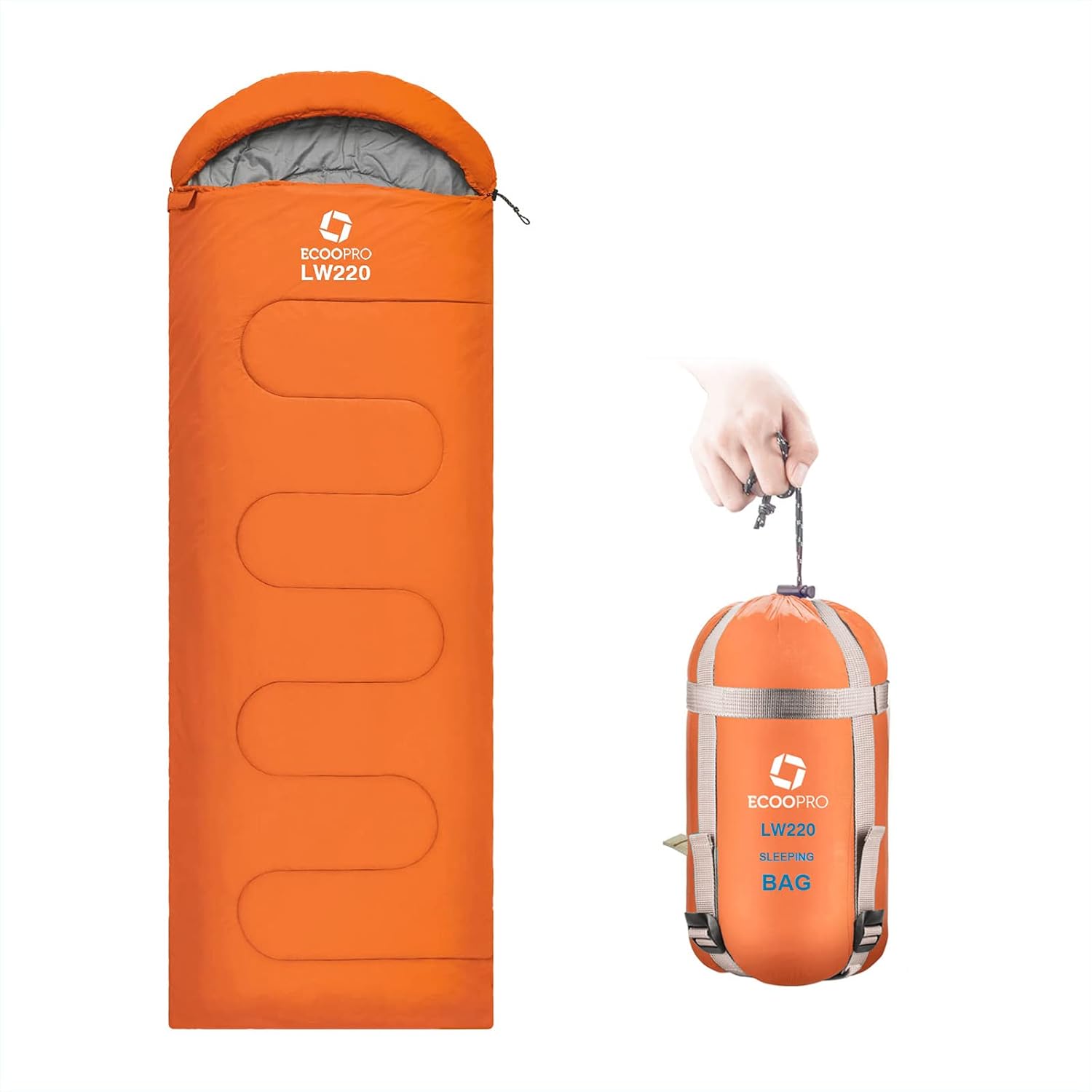
Warm Weather Sleeping Bag - Portable, Waterproof
There's nothing like camping out under the stars or snuggling up next to a girlfriend or boyfriend in a tent; especially when you have a warm, comfortable sleeping bag to keep you just the right temperature. Introducing the ECOOPRO Warm Weather Sleeping Bag made for kids, teens and adults. our sleeping bag is ideal for temperatures 55-60 degrees Fahrenheit and up. A combination of durable nylon covering and comfort-soft TC cotton lining, you'll enjoy a more restful night's sleep no matter where you use our sleeping bag.Easy To Carry And Pack Up Are you looking for a small and compact sleeping bag? Are you looking for a sleeping bag that can be used by both adults and children? Are you anxiety that sleeping bags are difficult to roll back in the bag? Are you worrying about how to save travel luggage space? In response to these problems, our sleeping bag can help you a lot.Multifunctional Sleeping Bag You Even Never Found Office Nap Comfortable and Soft materials provides an intimate touch which will relieve fatigue after work, short breaks can improve work efficiency. Family Camping This sleeping bag is suitable for kids and adults. You don’t have to spend more time to choose two different sizes of sleeping bags. What you need is more time to enjoy the happy time of your family camp. As a Blanket in Winter Don't worry that this sleeping bag will be useless in winter, you can use it as a blanket, bed sheet or children's play mat. A sleeping bag that will not be placed in the utility room you should have. Outdoor Hiking Portable and lightweight sleeping bag not only relieves your luggage pressure, but also brings you comfortable sleep, why not consider it?Blue Envelope Sleeping Bag Small Sleeping Bag Down Camping Sleeping Bag Mummy Down Sleeping Bag Inflatable Sleeping pad Add to Cart Buying Options Buying Options Buying Options Buying Options size 83" L x 30" W 86" L x 30" W 86" L x 30" W 78"L x 30" W 73" L X 22" W X 2" H folded size 7.5"-11.4" Tall 7.5"-11.4" Tall 7"-12" Tall 7"-12" Tall 13" X 4" weight 1.45 lbs 1.45 lbs 2 lbs 2 lbs 1.4 lbs temperature 55-60°F 55-60°F 32-50°F 32-50°F no data Material polyester polyester polyester polyester polyester Machine Washable ✓ ✓ ✓ no data no data
Why we love it
- Nylon
- Imported
- 【Ultra Comfort & Durable】Outer material: Nylon (Waterproof and Durable), Lining:100% Polyester (Breathable and skin-friendly), Premium Polyester keeps the temperature from 55 to 60℉ and provides a ultra-comfort sleep environment to people.

Teton Celsius 25F Sleeping Bag
Flannel-lined bag that keeps kids warm and doesn't fall apart after a wet Oregon weekend.
Why we love it
- Flannel lining beats synthetic slickness on cold nights
- Two-way zippers work with gloves and tired kids
- Unzips flat to blanket when the cabin gets stuffy
Pros
- Soft flannel lining
- Water-resistant taffeta shell
- Draft tubes at shoulders and zipper
- Stuff sack included
- Interior pocket for keys and phone
Cons
- Heavier than ultralight options
- SuperLoft fill needs a quality pad underneath
Weight Matters More Than You Think
Best ultralight hiking sleeping bags force a choice you cannot avoid: how much warmth you are willing to carry, and what you sacrifice to keep the pack light. Every gram counts on a trail, and the difference between a 3-pound bag and a 1.3-pound bag is the difference between enjoying a ridge traverse and hating it. Most people buying ultralight gear underestimate how much packed volume affects their actual hiking experience, not just their shoulders.
The bags above range from true ultralight (under 2 pounds) to lightweight-adjacent, and they split between down and synthetic in ways that matter on the trail. A down bag compresses smaller but demands a dry night. A synthetic bag tolerates damp and stays lofty even when squeezed. Knowing which trade-off suits your trips is what separates a bag you use and a bag that sits in the closet.
Packed Weight and What It Reveals
Ultralight means under 2 pounds, full stop. The Naturehike Ultralight Backpacking RDS Down Sleeping Bag hits 1.3 pounds in the short size, which is genuine ultralight. That weight comes from 295 grams of 650-fill duck down in a 20D nylon shell. The shell is thin enough to feel fragile until you realize the seams are double-reinforced and the fabric is tear-resistant. A lighter bag means a thinner shell, which means more attention to how you pack and where you sleep.
The Naturehike Lightweight Compact Sleeping Bag weighs 1.68 pounds and uses synthetic fill instead of down. The trade-off is worth understanding: synthetic adds maybe 0.4 pounds over equivalent down, but it handles moisture better and costs less. On a three-day trip in the Cascades in shoulder season, the synthetic bag’s resilience to damp nights outweighs the extra weight. On a high-desert overnight where the air is bone-dry, the down bag wins.
Down Fill Power and Real Performance
Fill power is not the same as warmth. A 650-fill down bag holds more air per ounce than a 600-fill, which means better insulation for the weight. The Naturehike RDS uses 650-fill, and the QEZER Down Mummy Sleeping Bag uses 600-fill with 1.1 pounds of total down. The QEZER is slightly heavier at 2.34 pounds but adds a mummy cut and a trapezoidal foot box, which means it holds heat better in a tight wrap. On a cold Cascades night, the fit matters as much as the fill.
Down loses all its loft when wet, and it takes days to dry. If you are hiking in wet coastal air or expecting rain, synthetic is the safer choice. If you are doing high-desert trips where the overnight is clear and cold, down’s compression and warmth-to-weight ratio wins every time. Neither is objectively better; your region decides.
Mummy Cut vs. Rectangular Envelope
A mummy shape holds heat by fitting snug around your shoulders and torso. The QEZER and the Naturehike RDS are both mummy-cut, which means they taper from shoulder to foot. This shape reduces dead air space and keeps warm air close to your body. The Naturehike Lightweight Compact is an envelope cut, which is roomier and lets you move more. Envelope bags are warmer only if you are a restless sleeper who needs space; if you are a side sleeper who curls up, the mummy cut will feel better and sleep warmer.
Ultralight mummy bags also have draft collars and sometimes neck baffles to stop warm air from escaping where the bag meets your sleeping pad. Check whether the bag has both a full draft collar and a hood drawstring that cinches tight. A bag that lets air leak at the shoulders will not perform at its rated temperature, no matter what the tag says.
Temperature Ratings and What They Actually Mean
Comfort vs. Limit: Which Number Is Real
The tag says 20 degrees, 15 degrees, 0 degrees. That is usually the limit temperature, not the comfort temperature. The limit is the coldest you can survive in the bag, barely. The comfort temperature is where you sleep warm and sleep well. For ultralight bags, the comfort temperature is roughly 15 to 20 degrees higher than the limit. If a bag is rated 20-degree limit, expect comfort around 35 to 40 degrees. If you plan to sleep in 20-degree nights, you need a 0-degree or 10-degree limit bag.
The Naturehike RDS lists a comfortable range of 42 to 52 degrees Fahrenheit and a limit of 6 degrees. That means it is a three-season bag for mild to cold nights, not a winter bag. The QEZER claims comfort at 41 to 54 degrees and an extreme of 28 degrees, which is slightly warmer. Neither is a winter setup. Both need a good sleeping pad underneath, because a pad’s R-value is what keeps cold from rising through the ground. A 4-season winter bag without a pad rated R-5 or higher will still leave you cold.
Pad Pairing and the Real Temperature Floor
The sleeping bag’s rating assumes you have an insulated pad. A foam pad with R-value 2 or 3 is not enough for cold nights. You need an inflatable pad with R-value 4 or higher, or a combination pad. On a Cascades overnight in late September when temperatures drop to 35 degrees, an ultralight bag rated 20-degree comfort is perfect. In March, when nighttime hits 15 degrees, that same bag over a basic pad will not keep you warm. The pad is half the equation, and most ultralight hikers underestimate it.
If you are buying an ultralight bag, also budget for a sleeping pad in the 2 to 3-pound range. A pad that weighs 1.5 pounds and has R-value 4 pairs well with a 1.3-pound bag. The total system is still under 3 pounds, and you will sleep warm on the trips you actually take.
Synthetic Fill and Durability in the Real World
How Synthetic Handles Compression and Moisture
Synthetic fill does not compress as small as down, but it bounces back after being packed tight. Down, once compressed, takes time to re-loft. If you stuff an ultralight down bag into a 4-liter stuff sack every night for a week, the loft in the foot box will be permanently lower by the end of the trip. Synthetic does not have this problem. The Naturehike Lightweight Compact uses imitation silk cotton, which is a polyester blend. It compresses to 5 by 12 inches, which is tight but not as compact as the RDS at 4.7 by 10.2 inches.
Synthetic also handles a damp night better. If condensation builds inside the bag or you sleep on a damp tarp, synthetic fibers do not clump. Down clumps when wet, creating cold spots. On a shoulder-season trip where the overnight is cool and humid, synthetic is the safer bet. The weight penalty is real, but the peace of mind is worth it if you camp in wet climates.
Washing and Long-Term Care
Down bags require careful washing by hand or on a gentle cycle, and they take days to dry fully. Synthetic bags can go in the machine on gentle and dry faster. If you are a weekend warrior who camps once or twice a month, hand-washing a down bag is fine. If you are out every weekend, synthetic is easier. Store both types uncompressed in a mesh bag, not in a stuff sack. Compression storage is for transit only.
Getting the Fit Right Before the Return Window Closes
Measuring Yourself and Choosing Length
An ultralight bag is not the place to buy oversized. A bag that is too long will have dead air space at your feet where you cannot warm the air with your body heat. The Naturehike RDS comes in short (74.8 inches) and medium (78.74 inches). If you are under 5 foot 8, the short size is the right choice. If you are 5 foot 9 to 6 feet, medium. Measure yourself lying down and add 6 inches. That is your minimum bag length. Do not add more.
Width also matters for ultralight bags because they are designed snug. The Naturehike RDS is 28.3 inches wide in the short size, which is narrow. If you are broad across the shoulders or you sleep on your side with your arms out, a narrow bag will feel cramped. Lay down in the bag before you buy if you can. If you are ordering online, check the return policy and test the fit at home before the window closes.
Checking the Zipper and Draft Collar
Unzip the bag fully and lie in it. The zipper should run the full length smoothly, and the two-way slider should move without catching. Most ultralight bags use YKK zippers, which are reliable. Check whether the draft collar is a full tube that goes all the way around your neck, or just a partial baffle. A full collar stops heat loss at the shoulder. A partial one does not. Lie down and cinch the hood drawstring. Your face should be covered except for a small opening to breathe. If the hood is too loose, you lose heat fast.
Testing at Home Before the Trip
Fluff the bag for a few hours after opening. Down especially needs time to re-loft after compression. Sleep in it at home on your actual sleeping pad, in your actual sleep clothes, on a night when the temperature is close to where you will use it. This is not optional. A bag that feels fine in a living room at 70 degrees will surprise you at 40 degrees. If you feel cold spots or the zipper binds, you have time to return it.
Tips From the Trail
- Fluff before use and after storage. Down needs 3 to 4 hours to fully loft after being compressed. Synthetic bounces back faster, but both benefit from time to expand before you sleep in them.
- Wear a base layer and a hat to bed. A hat stops 30 percent of heat loss from your head. A moisture-wicking base layer keeps sweat off your skin. Both make a bag perform 10 to 15 degrees warmer than its rating.
- Sleep on an insulated pad, not on the ground. The ground pulls heat from below faster than cold air pulls it from above. A pad with R-value 3 or higher is not negotiable for ultralight hiking.
- Keep the bag dry during the day. Stuff it into a dry bag or a compression sack, not a wet stuff sack. If condensation builds inside the tent, air the bag out in the sun before packing.
- Store uncompressed in a breathable mesh sack. Permanent compression weakens the baffles and reduces loft over time. Mesh lets air circulate and keeps the fill from clumping.
- Do not machine-wash down unless the label says you can. Hand-wash in cool water with a down-specific soap, rinse thoroughly, and dry on low heat for hours. Synthetic can handle a gentle machine cycle.
A 1.3-pound bag over a 2-pound pad weighs less than most sleeping systems, and you will actually sleep warm.
On a damp night, synthetic’s resilience outweighs down’s weight advantage.
Common Questions
What does the temperature rating actually guarantee?
The limit temperature is the coldest you can survive in the bag, but survival is not comfort. Most ratings assume you are wearing base layers, a hat, and sleeping on an insulated pad. Without those, the bag will not perform as rated. The comfort temperature, which is what you actually care about, is usually 15 to 20 degrees higher than the limit. Always assume the tag is conservative.
Can I use an ultralight bag in winter?
Not unless it is rated 0-degree limit or lower, and even then you need a high-R pad and a liner. Most ultralight bags are three-season designs. If you want to camp in snow, you need a different bag. Ultralight design cuts weight by cutting insulation, which works for spring through fall but not for December through February.
How much does weight really matter on a day hike vs. a backpacking trip?
On a day hike, a sleeping bag does not matter at all. On a two-day backpacking trip, an extra 1.5 pounds is noticeable but not critical. On a week-long trip, especially at altitude, an extra 1.5 pounds compounds with everything else and becomes the difference between enjoying the hike and suffering through it. For trips longer than three days, ultralight design pays for itself.
Should I buy down or synthetic if I do not know where I will camp?
Synthetic is the safer choice for variable conditions. Down is the right choice if you know your trips are in dry climates and you are willing to manage care carefully. If you camp in the Pacific Northwest or anywhere with unpredictable humidity, synthetic will sleep you warmer more often, even if it weighs a bit more.
What is the difference between fill power and the total amount of down?
Fill power measures how much space one ounce of down takes up. A 650-fill down is fluffier and lighter than a 600-fill. But 1 pound of 600-fill down provides more total insulation than 0.8 pounds of 650-fill, because there is more material. The Naturehike RDS uses 295 grams of 650-fill, which is less total down than the QEZER’s 1.1 pounds of 600-fill, so the QEZER is slightly warmer despite the lower fill power.
Can I repair an ultralight bag in the field?
A small tear in the shell can be sealed with duct tape or a patch kit. A tear in the lining or a baffle is harder to fix. Bring a repair kit with you on long trips. For down bags, a small puncture in the baffle will cause down to migrate, creating a cold spot. Patch it immediately. Synthetic is more forgiving of small damage because the fill does not migrate.


Write Your Review
No reviews yet. Be the first to share your experience!